

Why This Conversation Matters
The American founding often appears in public memory as a sequence of sacred texts. The Declaration. The Constitution. The Bill of Rights. We quote them, celebrate them, and often fight over them.
Yet documents do not emerge from nowhere. They are products of debate, persuasion, disagreement, and uncertainty. Before Americans had institutions, they had arguments.
David Stewart’s book invites us to revisit those arguments through some of the most important documents of the founding era. In doing so, he also reminds us that the American experiment was never intended to be a perpetual motion machine. It depended—and still depends—on citizens willing to think seriously about the principles that underlie it.
Throughlines
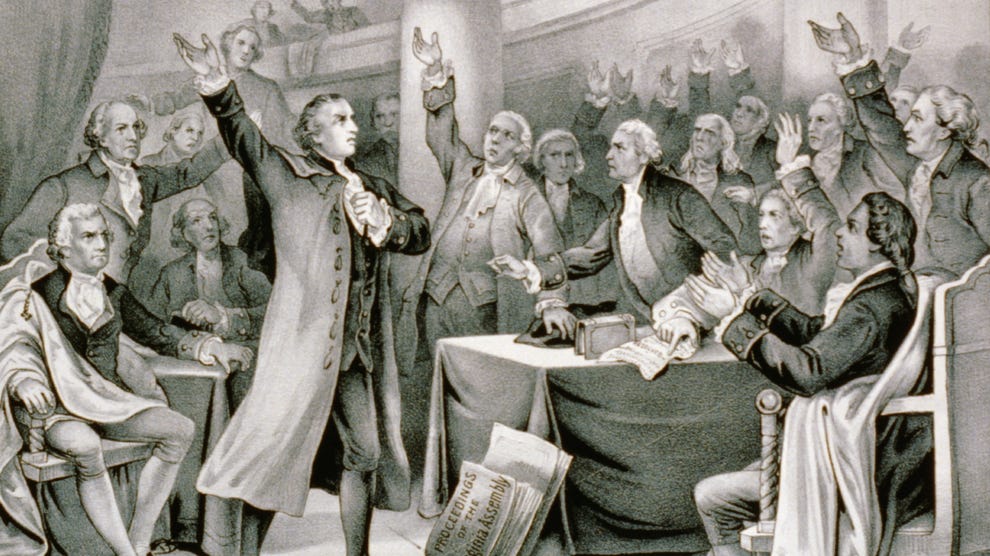
The conversation begins with Patrick Henry’s “Liberty or Death” speech, one of the most famous moments of political oratory in American history. Stewart emphasizes not only Henry’s rhetorical gifts but his ability to crystallize a moment of uncertainty. Virginia had not yet committed itself to resistance. Many still hoped for reconciliation. Henry’s achievement was to persuade listeners that neutrality was no longer possible and that delay itself constituted a choice.
From Henry, the discussion moves to Thomas Paine and Common Sense. Paine’s contribution was different. Rather than attacking Parliament, he attacked monarchy itself. In doing so, he shifted the terms of debate. Colonists who had long considered themselves loyal subjects were invited to imagine an entirely different political future. Paine’s genius lay in presenting radical ideas in language that ordinary readers could understand.
The Declaration of Independence occupies a different place in the conversation. Stewart argues that its enduring power comes not from rhetorical excess but from restraint. The Declaration does not shout. It reasons. Its claims are presented as self-evident truths rather than partisan assertions. That calm confidence helps explain why it continues to resonate centuries later.
Federalist 51 introduces another set of concerns. Madison was less interested in inspiring citizens than in managing human nature. His famous observation that “if men were angels, no government would be necessary” reflects a deeply realistic understanding of politics. Government exists because people are imperfect. The challenge is to create institutions that can govern while simultaneously preventing those institutions from becoming oppressive.
The discussion highlights how different this vision is from popular descriptions of “checks and balances.” Madison was not imagining a machine that would run automatically. He expected ambition, rivalry, jealousy, and self-interest. The constitutional structure seeks to harness those tendencies rather than eliminate them. Human weaknesses become tools for preserving liberty.
Washington’s Farewell Address brings many of these themes together. Washington’s central concern is union. He worries about sectionalism, faction, and foreign influence. He fears that political divisions might grow strong enough to destroy the republic itself. His warnings emerge not from pessimism but from a sober recognition that republics fail. The success of the American experiment was never guaranteed.
One particularly striking theme is Washington’s concern with civic friendship. Political disagreement is inevitable, but disagreement must not become alienation. Citizens may oppose one another’s ideas while still recognizing one another as members of the same political community. Once that bond breaks down, faction becomes something more dangerous.
The conversation concludes with Stewart’s reflection on patriotism. For him, patriotism is neither sentimentality nor slogan. It involves recognizing both the achievements and the fragility of the American experiment. The founders left behind institutions, but they also left behind questions. Those questions remain worth asking because the democracy they created remains something that must be maintained rather than assumed.
Questions for Reflection and Discussion
Why was Patrick Henry’s speech persuasive at that particular moment?
What made Common Sense so revolutionary?
Do you agree that the Declaration’s power comes partly from its restraint?
What does Madison mean when he says that government must first control the governed and then control itself?
Is “checks and balances” an adequate description of Federalist 51?
Why was Washington so concerned about faction?
What is civic friendship, and why does it matter?
How should citizens balance disagreement with political loyalty?
Which document discussed in this conversation seems most relevant today?
What does Stewart mean by “the democracy we must keep”?
For Further Investigation
Books
David O. Stewart, The Democracy We Must Keep: Seven Founders, Nine Documents, and the Ideas That Shaped America
—, George Washington: The Political Rise of America’s Founding Father
John Kukla, Patrick Henry: Champion of Liberty (Simon and Schuster, 2017)
Dennis Rasmussen, Fears of a Setting Sun: The Disillusionment of America’s Founders (Princeton University Press, 2021)
Gordon S. Wood, The Creation of the American Republic, 1776-1787 (Omohundro Institute and University of North Carolina Press, 1998)
—, The Radicalism of the American Revolution (Vintage, 1993)
—, The Idea of America: Reflections on the Birth of the United States (Penguin, 2012)
Primary Sources
Patrick Henry, “Give me Liberty or Give Me Death!”—performed by Nathaniel Lasley of Colonial Williamsburg.
Thomas Paine, Common Sense and The American Crisis I, edited by Richard Beeman (Penguin, 2025)
Publius, The Federalist Papers (Signet, 2003)
George Washington, Farewell Address—from Mount Vernon, a digital copy of the printed address in the American Daily Advertiser, along with a transcript
Related Episodes
Civic Bargain: Brook Manville and Josiah Ober on democracy, self-rule, and civic renewal
Remaking American Citizenship: Christopher Bonner on Black Americans and democratic identity
Civil War Politics: Paul Escott on political traditions in crisis
Tags
America 250; American Revolution; David O. Stewart; Patrick Henry; Thomas Paine; Declaration of Independence; Federalist 51; George Washington; Founding Era; Political Thought; Historical Thinking