

This a Historically Thinking Field Guide, a guide to a set of episodes on a topic, a historical problem, or a habit of historical thinking. In time we plan for these to be classroom companions for high school and college teachers.This is not only our third Field Guide but by far the largest yet produced, jam-packed with links and references and general historical goodness.
I. Introduction
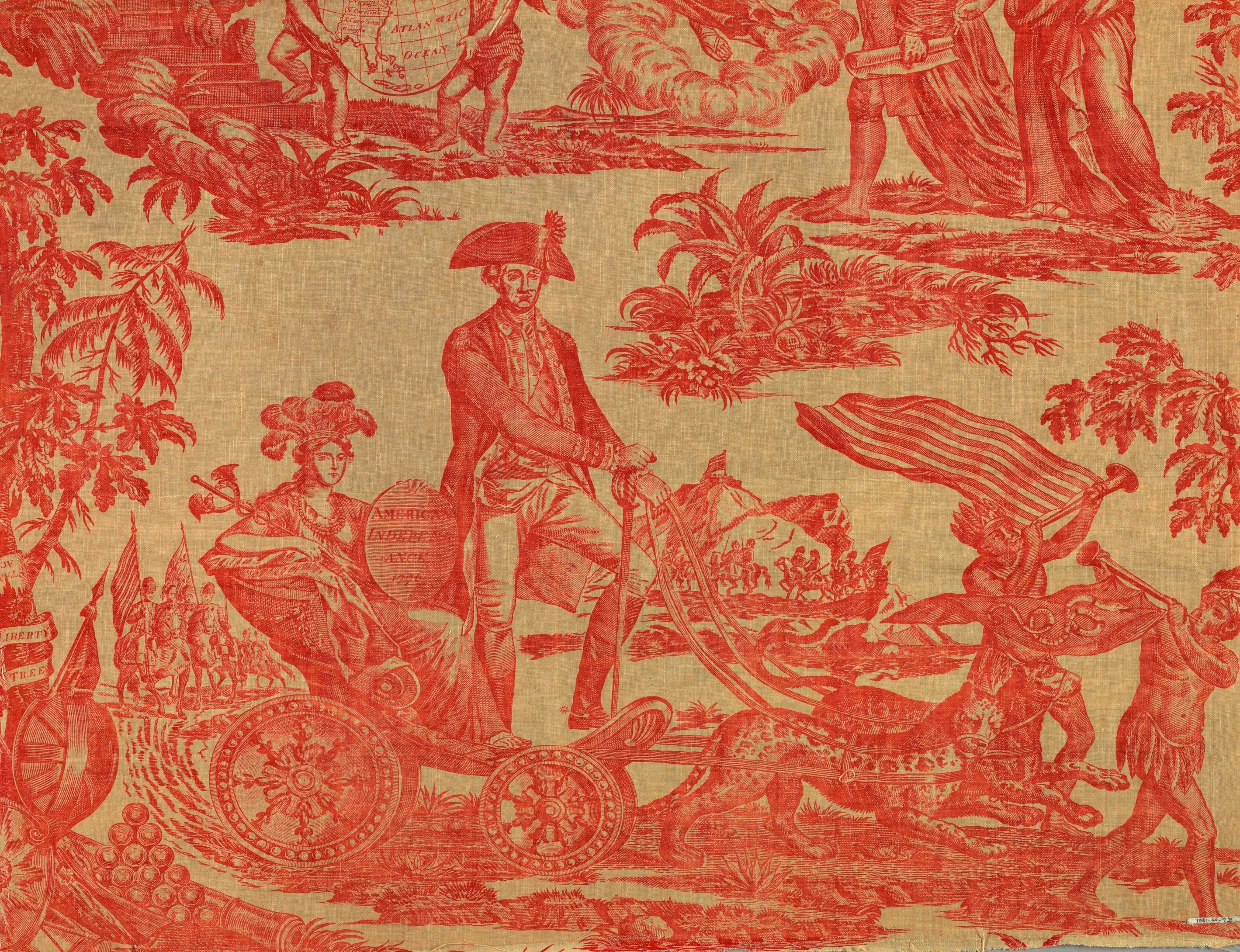
Years ago I heard David Hackett Fischer give a talk about symbols of the American Revolution, and of American liberty and freedom. He admitted that he was perplexed about the symbolism of the image you see above, which comes from a French textile. I assured him after the talk that it was pretty clear to me what was going on, and I’m not sure that he was much interested in what my opinion was after that introduction. But here’s what I might have told him, or should have.
In the center of this particular set of images from the textile (another features, not surprisingly, Benjamin Franklin) we have of course George Washington. The textile artist has lifted Washington’s image from an engraving by Charles Willson Peale that had sold well in France (and England), but no doubt horrified by Washington’s being presented without a hat in Peale’s engraving, he (or she) has provided the General with a handsome tricorn.
After that it gets a little more complicated. Washington is driving a chariot in which sits (I would guess) a personification of either America or of Liberty—probably America, since she wears a Francofied vision of an Indian headdress. More confusingly, for a contemporary audience, Washington is whipping along a pair of muzzled leopards. But this is not confusing if you were French in the late eighteenth century. Since at least the Hundred Years War you and your ancestors had been calling the English leopards, because what the English took as lions in their royal heraldry the French identified as leopards. (Lions can only be rampant, you see; any other kind of heraldric cat, when unrampant, is a leopard. Simple, n’est ce pas?)
Note also that in the apparent throes of a mescaline-addled dream scrambling together classical and American tropes, the artist shows the chariot preceded by two putti who seem to be amalgrams of both Blacks and Native Americans. They’re blowing horns of triumph, and there are flags attached to the horns. One is the “rebellious stripes”, the thirteen stripes sans blue field with stars. The other is one of the wide variety of rattlesnake flags flown by rebels from New England to the Carolinas—though it’s unclear to me if it’s based on any particular model. Tucked just to the left you see a “Liberty Tree”, this one with the trophies of victory over the leopards strewn before it. And off in the background, its realism somewhat jarring with all the classicized symbolism, is a very nice rendition of an American cavalry troop complete with its own flag-bearers.
Now I’ve gone into all this because, you know, when will I ever have the chance to do it again. And for another reason because this view of the American Revolution from France says something about the American Revolution that resonates with a great many of the conversations below. For a variety of reasons we need not get into, a wide swathe of Americans have seen the American Revolution as a strictly provincial affair, in all the meanings of the word. But that is what it never was. From before it began in earnest it was of intense interest to people around the Atlantic seaboard. When it did begin, it quickly turned into what is arguably the Second World War, a war that dragged into conflict peoples around the world who lived thousands of miles away from Lexington Green.
In the following conversations you’ll hear about some of those peoples. You’ll also hear about Americans that you might never have heard of before, and some that you’ve heard a lot about but never in this way. But you’ll also hear about some of the "King’s Friends,” both British American, British-British, Native American, and German. You can listen to a variety of conversations about the war itself, and how it changed things. And you can trace its consequences, and the memories it left behind.
All in all, there are 28 hours of conversation waiting for you. That’s like a fourteen week semester, with two hour long conversations a week. And it doesn’t cost you a thing.
II. Episodes
Prologue
The Man at the Center of Two Revolutions: Martin Clagett on William Small, Thomas Jefferson’s teacher and James Watt’s collaborator
Republic and Empire: Andrew O’Shaughnessy on the global causes and consequences of the American Revolution
Rebels
Eliza Lucas Pinckney, Independent Woman in the Age of Revolution: Lorri Glover on how one woman’s life reveals the opportunities and limits of female independence in the 18th century
The First Martyr of the American Revolution: Christian DiSpigna on Dr. Joseph Warren, his life and times, his death at Bunker Hill, and his legacy
Founders as Fathers: Lorri Glover on family, fatherhood, and the American Revolution
Quaker Founder: Jane E. Calvert on John Dickinson, Quaker Constitutionalism, and America’s “Penman of the Revolution”
George Washington, Politician: David Stewart explains why Washington’s greatest talent was not war, but politics
The King’s Servants
Noble Volunteers: Don N. Hagist on the myths and realities of British soldiers who fought in America.
The Hessians are Coming!: Friederike Baer on the German soldiers who fought for the British Army in the American Revolution
Tory’s Wife: Cynthia Kierner on Jane Welborn Spurgin’s American Revolution
The Family That Lost America: Julie Flavell on the Howe dynasty and Britain’s wars in and for America
Declaration
National Treasure: Michael Auslin on the Declaration of Independence's Two Simultaneous Lives
When the Declaration of Independence was News: Emily Sneff on how people first encountered independence–in newspapers, sermons, rumors, and public readings
The War
If This Be Treason, Make the Most of It: Carlton W. Larson on treason, juries, and citizenship in the American Revolution
War Without Mercy: Mark Lender on the American Revolution as an Existential War
Down the Road to the Cedars: Mark R. Anderson on Native politics, diplomacy, and the American Revolution in Canada
The American Revolution in the South: John Buchanan on Nathanael Greene, the Southern Campaign of the American Revolution, and the Road to Charleston
The Crisis of Peace: David Head on the Newburgh Conspiracy, and the Fate of the Revolution
World Crisis: Richard Bell on how the American Revolution became a global event that reshaped nearly every corner of the world
Influences and Aftershocks
Revolutionary Age: Nathan Perl-Rosenthal on the Atlantic World in Upheaval
The American Revolution in Hapsburg Lands: Jonathan Singerton onthe American Revolution’s influence on the Austrian Empire
The Great Atlantic Freedom Conspiracy: Micah Alpaugh on correspondence, revolution, and social movement
Suitable: Chloe Chapin on the Sartorial Revolution and the Fashioning of Modern Men
Men on Horseback: David A. Bell on charisma, revolutions, and the paradox of democratic leadership
Remembering
Glorious Lessons: Richard Brookhiser on John Trumbull, Revolutionary Art, and Civic Virtue
Longing for Connection: Andrew Burstein on memory, emotion, and early America
Long Revolution: Nathan Perl-Rosenthal on a century of talking about the Revolution
The Democracy We Must Keep: David Stewart on seven founders, nine documents, and the ideas that shaped them
III. Epilogue
If you’ve gone through a section of these conversations, or (wow!) all of them, I hope that you’ve encountered some of these underlying themes:
contingency rather than inevitability
citizenship rather than mere independence,
the Revolution as a process rather than a moment
historical memory as an active, ongoing practice
In the introduction I asked you to think about the American Revolution as larger than they imagined. Now I would end by asking them to think about your own place within that Revolution’s continuing history.
After all, this is not meant to be just an anthology of podcast episodes. It’s really a very long argument about what it means to think historically about the American Revolution. If all you have after you’ve finished is a more exhaustive list of facts, then it’s been a failure. Hopefully you have some facts, but also a much more expansive set of questions—and if so, that is exactly what Historically Thinking is for.
IV. Questions for Reflection and Discussion
Many of these conversations challenge familiar ideas of who “made” the American Revolution. How does the story change when we shift our attention from the canonical founders to figures such as Eliza Lucas Pinckney, Joseph Warren, John Dickinson, or Abigail Adams? What does this suggest about the way revolutions create—and forget—their heroes?
These episodes blur the boundaries between public and private life. How did family, friendship, patronage, reputation, and local community shape political leadership during the Revolution? Can we really separate the “private” lives of the founders from their public actions?
Several conversations ask us to reconsider familiar reputations. Joseph Warren became a forgotten martyr; John Dickinson a remembered “coward”; George Washington a soldier rather than a politician. Why do historical reputations change? What responsibilities do historians have in recovering neglected lives—or revising celebrated ones?
Many of these conversations complicate the familiar division between “Americans” and “the British.” How useful are those categories for understanding the Revolution? What do we miss when we forget that Loyalists, Hessians, and British soldiers all had their own motives, loyalties, and aspirations? What factors—family, profession, patronage, principle, geography, or opportunity—seem to have mattered most in determining where people’s loyalties lay?
What can historians learn by following people who did not support independence—or who simply found themselves on the wrong side of history? Does writing history from the perspective of the defeated change the story we tell?
How does recovering the Declaration’s original context—its uncertainty, circulation, and immediate political consequences—change the way we read it today?
The Declaration has lived both as a text and as a physical object. Why have Americans attached such importance not only to its ideas but also to the parchment itself? What does the history of the Declaration suggest about the relationship between ideas, artifacts, and national memory?
Many of these conversations challenge the familiar image of the Revolutionary War as a straightforward struggle between Britain and the thirteen colonies. How do Native nations, civil conflict, legal prosecutions, and the Southern Campaign reveal the Revolution to have been a far more complex—and often more local—war than popular memory suggests?
Several episodes remind us that the outcome of the Revolution remained uncertain until the very end. Which moments seem most contingent? How did military decisions, political leadership, and even chance shape the survival of the revolutionary cause?
War changes societies as well as governments. Many of these conversations explore the Revolution’s effects on law, political authority, and the conduct of violence. In what ways did the experience of war transform Americans’ ideas about citizenship, loyalty, justice, and the legitimate use of power?
Many of these conversations suggest that the American Revolution was never an isolated event. How does placing it within an Atlantic world of ideas, revolutions, diplomacy, and exchange change our understanding of what happened in North America?
Political revolutions are rarely only political—they therefore often leave unexpected legacies. Beyond constitutions and governments, how did the Revolution reshape everyday life, including clothing, consumption, public opinion, political organization, and ideas about leadership? Which of these changes seem most enduring?
How do these conversations encourage us to think about the American Revolution as a process rather than a moment? Where do you see its influence extending across borders, generations, or aspects of life that are easy to overlook?
Every generation inherits the American Revolution, but no generation remembers it in exactly the same way. How have public speeches, founding documents, works of art, and historical writing shaped what later Americans believe the Revolution meant? What do these acts of remembrance reveal about the needs and concerns of their own time?
These conversations remind us that the Revolution has always been interpreted as well as commemorated. How have Americans used the Revolution’s documents, stories, images, and heroes to teach civic virtue, define citizenship, or debate the nation’s future? When does remembrance deepen historical understanding—and when can it oversimplify the past?
Again and again, these conversations suggest that Americans have regarded the Revolution not as a completed achievement but as an unfinished experiment. Why have its documents, ideals, and symbols remained objects of debate for nearly 250 years? What does that continuing conversation suggest about the relationship between history, memory, and democratic self-government?
V. Bibliography
Micah Alpaugh, Friends of Freedom: The Rise of Social Movements in the Age of Atlantic Revolutions (Cambridge University Press, 2022)
David A. Bell, Men on Horseback: Charisma and Power in the Age of Revolutions (Farrar, Straus and Giroux, 2020)
John Buchanan, The Road to Charleston: Nathanael Greene and the American Revolution (University of Virginia Press, 2019)
—, The Road to Guilford Courthouse: The American Revolution in the Carolinas (1999)
Trevor Burnard & Andrew Jackson O’Shaughnessy, Republic and Empire: Crisis, Revolution, and America’s Early Independence (Yale, 2025)
Chloe Chapin, Suitable: The Sartorial Revolution and the Fashioning of Modern Men (Oxford University Press, 2026)
Don N. Hagist, Noble Volunteers: The British Soldiers Who Fought for the American Revolution
—, British Soldiers, American War: Voices of the American Revolution
Andrew Jackson O’Shaughnessy, The Men Who Lost America: British Leadership, the American Revolution, and the Fate of the Empire (Yale University Press, 2014)
Nathan Perl-Rosenthal, The Age of Revolutions–And the Generations Who Made It (Basic Books, 2024)
—, Citizen Sailors: Becoming American in the Age of Revolution (Harvard, 2015)
Brendan McConville, The King’s Three Faces: The Rise and Fall of Royal America, 1688–1776 (North Carolina, 2007)
Jonathan Singerton, The American Revolution and the Habsburg Monarchy (University of Virginia Press, 2022)
VI. Suggestions for Teachers
These conversations are intended to supplement classroom instruction. They work best when students encounter them alongside primary sources, textbooks, and discussion. In effect they are substitutes for a more conventional lecture.
Here are a few possibilities for what you might then do:
Use one episode to complicate a familiar story.
Many students arrive with a simplified understanding of the American Revolution. Rather than assigning several episodes, try pairing one conversation with the corresponding classroom topic.
For example:
Joseph Warren alongside Lexington and Concord
Hessians during the New York campaign
John Dickinson during debates over independence
Chloe Chapin when discussing republicanism and the Early Republic
Emily Sneff before reading the Declaration itself
One carefully chosen episode can widen students’ understanding without overwhelming them.
Compare interpretations
Many episodes challenge stories students think they already know.
Ask students:
What assumptions did this conversation challenge?
Which evidence surprised you?
Did the guest persuade you? Why or why not?
What further evidence would help answer the question?
Historical thinking begins with questioning familiar narratives.
Connect military, political, and social history
The Revolution was simultaneously
a military conflict,
a constitutional crisis,
a civil war,
a social revolution,
an Atlantic event.
Invite students to trace one event through several perspectives.
For example, the Declaration appears differently in conversations with Emily Sneff, David Stewart, Michael Auslin, and Nathan Perl-Rosenthal.
Introduce historiography naturally.
These episodes expose students to historians disagreeing—not through abstract debate but through evidence.
Encourage students to notice:
What question is this historian trying to answer?
What kinds of evidence are being used?
How does this interpretation differ from older accounts?