

Why This Conversation Matters
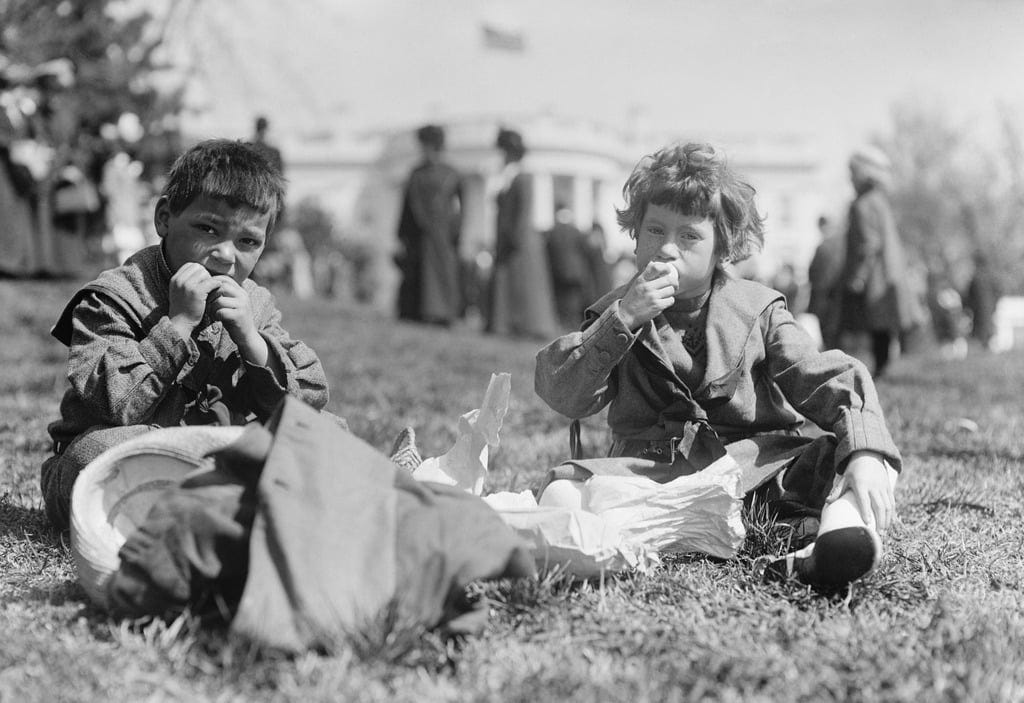
In this week’s conversation with Helen Zoe Veit, we began with a startling reversal: in the nineteenth century, Americans worried that children were not picky enough. They ate oysters, organ meats, sauerkraut, highly seasoned dishes, and whatever else appeared on the family table. They were assumed to be omnivorous.
Today, we assume the opposite. Children are widely believed to be “food rejectors by nature.” Parents navigate an exhausting landscape of nutritional science, psychological advice, processed food marketing, and guilt. Somewhere between those two moments—overeager omnivores and refusers by virtue of evolutionary biology—something obviously changed. But what? And how? And why?
As you think about the conversation, ask yourself which and how ideas about childhood, technology, psychology, commerce, and pleasure reshaped the act of eating itself.
Throughlines
One of the most striking claims in the conversation is also the simplest: for most of history, children ate what adults ate. In nineteenth-century America, that meant a cuisine far more varied—organ meats, fermented foods, smoked meats, richly seasoned dishes—than many families serve today. Children were not given separate menus. They were expected to eat the family meal.
This arrangement was not necessarily the result of scarcity or severity. The United States was, by the mid-nineteenth century, a land of agricultural abundance. Contemporary observers described children as eager and curious eaters. The prevailing assumption was not that children were biologically predisposed to reject unfamiliar foods, but that they were capable of eating almost anything.
The shift began not with marketing, but with reform. Nineteenth-century doctors and food reformers, concerned about digestion and high child mortality rates, argued that rich or heavily seasoned foods were unsuitable for young bodies. They advocated plain fare and regulated diets. By the early twentieth century, nutrition science amplified this impulse. Experts urged parents to monitor intake carefully and to differentiate children’s diets from adult fare. For the first time, “children’s food” became distinct in theory—even if everyday practice lagged behind.
Material changes then made differentiation easy. Refrigeration, processed food production, pasteurization, and the supermarket transformed the conditions of eating. The grocery cart placed children face-to-face with packaged foods designed to attract their attention. Industrial food processing made it possible to prepare separate meals with minimal additional labor. What had once been logistically difficult—customized eating within the same household—became ordinary.
Psychology intensified the transformation. Mid-twentieth-century experts warned parents not to pressure children about food, arguing that coercion could create emotional harm. At the same time, nutrition advice stressed the importance of proper intake for growth and development. Parents were left in a contradictory position: food mattered immensely, but direct influence was risky. The result, as emerged in the conversation, was a culture of anxiety and guilt, layered atop expanding consumer choice.
Running quietly through the discussion was the question of pleasure. Earlier accounts of childhood eating often emphasized delight and participation—children helping prepare food, sharing meals, and encountering strong flavors without fear. Modern discourse, by contrast, tends to center avoidance and management: avoiding rejection, avoiding conflict, avoiding unhealthy options. The narrowing of taste was not inevitable. It was the outcome of a complex interaction among reform, technology, commerce, and advice.
If something has a history, it is not fixed. Nor does it have the long time horizon of geology or evolution. That idea—articulated repeatedly in different forms—was perhaps the most hopeful insight to emerge from the conversation. If mass childhood pickiness is overwhelmingly cultural, then it can change. The history of children’s food suggests that young eaters are more adaptable than we assume, and that the structure of meals matters as much as the contents of the plate.
Questions for Reflection & Discussion
Why did nineteenth-century Americans see children’s omnivorousness as a problem rather than a virtue?
How did early nutrition science alter the moral stakes of feeding children?
In what ways did refrigeration and processed food enable the fragmentation of family meals?
How did the supermarket reshape the balance of power between parent and child?
What unintended consequences followed from psychological advice about not pressuring children to eat?
How does guilt function as a mechanism of cultural change in parenting practices?
To what extent is “picky eating” a product of abundance rather than scarcity?
How does the history of children’s food challenge pop evolutionary explanations of taste?
What role does pleasure play in shaping both historical and modern eating habits?
If culture produced modern pickiness, what specific practices would need to change in order to reverse it?
For Further Investigation
Helen Zoe Veit, Picky: How American Children Became the Fussiest Eaters in History (St. Martin’s Press, 2026)
Food History & Culture
Harvey Levenstein, Revolution at the Table: The Transformation of the American Diet (University of California Press, 2023)
Amy Bentley, Eating for Victory: Food Rationing and the Politics of Domesticity (University of Illinois Press, 1998)
Warren Belasco, Appetite for Change: How the Counterculture Took On the Food Industry (Cornell, 2006)
Childhood & Psychology
Benjamin Spock, Dr. Spock’s Baby and Child Care: A Handbook for Parents of the Developing Child from Birth through Adolescence (Dutton, 1998)
Ann Hulbert, Raising America: Experts, Parents, and a Century of Advice About Children (Knopf, 2004)
Steven Mintz, Huck’s Raft: A History of American Childhood (Harvard, 2006)
Technology & Consumption
Ruth Schwarz Cowan, More Work For Mother: The Ironies Of Household Technology From The Open Hearth To The Microwave (Basic Books, 1985)
Lizabeth Cohen, A Consumers’ Republic: The Politics of Mass Consumption in Postwar America (Vintage, 2003)
Susan Strasser, Satisfaction Guaranteed: The Making of the American Mass Market (Smithsonian, 2004)
Tracey Deutsch, Building a Housewife’s Paradise: Gender, Politics, and American Grocery Stores in the Twentieth Century (UNC Press, 2012)
Manifestos
Michael Pollan, In Defense of Food: An Eater’s Manifesto (Penguin, 2009)
Related Episodes
Cuisine and Empire: Rachel Laudan on the world history of food
The History of Keeping Things Cold: Jonathan Rees on ice, refrigeration, and the rise of the modern cold chain
Breakfast Cereal: A global history of grains, health, and culture with Kathryn Cornell Dolan
Street Food: Charlie Taverner on street vendors, London, and the history of urban eating