

Why This Conversation Matters
We tend to treat political maps as if they were geological formations. France is France. India is India. Singapore is Singapore. The world appears divided naturally into sovereign states, each with its flag, borders, passport, and seat at the United Nations. We even imagine that every linguistic community needs its own nation-state, as if that is its right. It is often difficult to imagine that things could have been otherwise.
Jon Wilson’s Out of Chaos invites us to do exactly that. His argument is not merely that the nation-state has a history, it is that the triumph of the nation-state was astonishingly late, remarkably contingent, and in many respects accidental. For much of the twentieth century, intelligent observers expected the future to belong to empires, federations, multinational unions, or even institutions of world government. Instead, within only a few years after the Second World War, the political imagination narrowed until the sovereign nation-state became almost the only acceptable answer.
Throughlines
At the beginning of the conversation, I trotted out my new favorite dictum that “the curious task of the historian is to make the present seem weird.” Jon Wilson laughed, but his entire book is an extended demonstration of exactly that proposition.
It is remarkably easy to assume that today’s political world emerged naturally. We inherit atlases in elementary school, we memorize national capitals (well, probably not, but we did), we cheer for countries at the Olympics. The nation-state feels almost biological, as though political communities naturally grow into bounded territories with governments, passports, and flags.
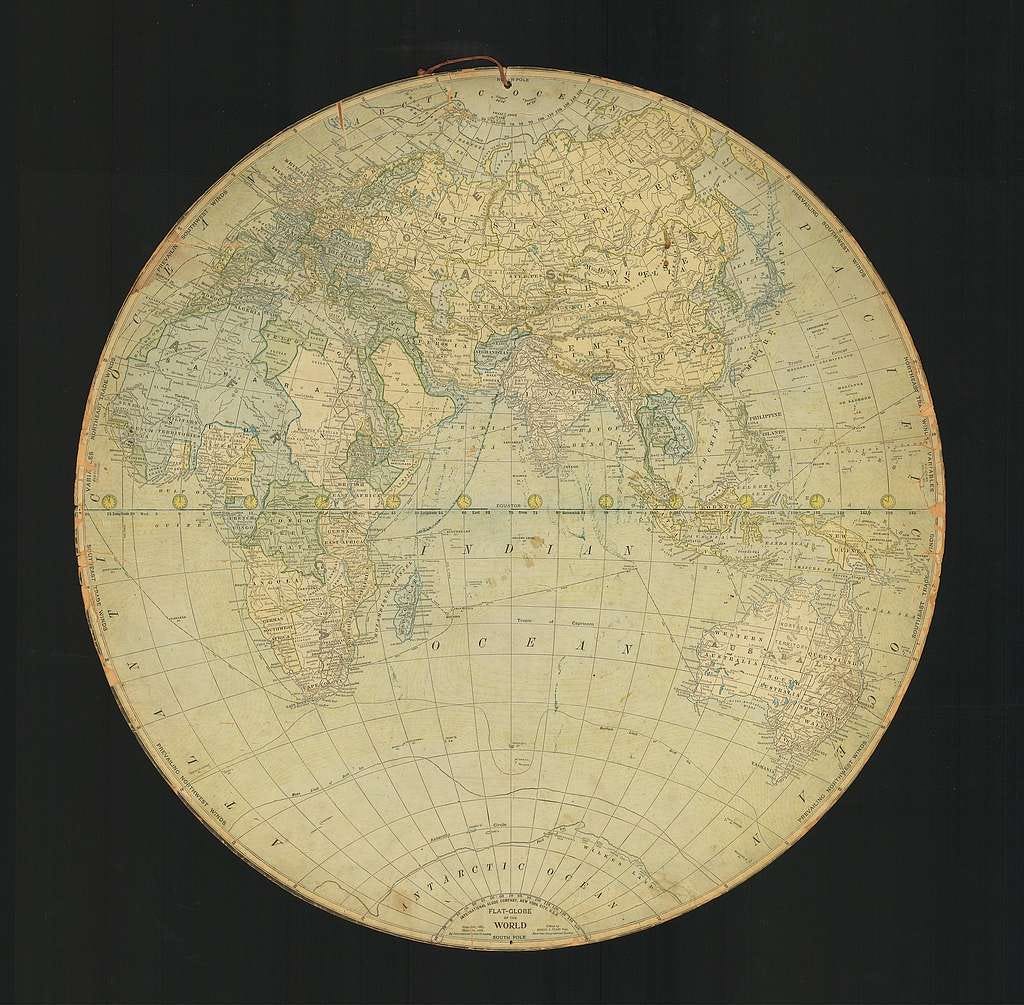
Wilson asks us to forget everything we know, and to do that he essentially recommends that we imagine ourselves viewing a globe in 1900. That globe is dominated by empires. The British Empire reaches around the world. The Russian Empire spans Eurasia. Austria-Hungary dominates most of Eastern Europe, and the Ottoman Empire controls what is left. The French and American republics have recently extended their republican empires to Southeast Asia. And the Chinese Empire in 1900, however beleaguered, still governed multiple peoples under a single political roof.
So in 1900, empires were not generally regarded as a relics. Quite the opposite: for many contemporaries it appeared to be the most practical response to an increasingly interconnected world.
That observation alone changes the conversation. We often tell ourselves that empire was already dying before the First World War. Yet the people living through those years did not generally think so. They debated how empires should be organized, how much autonomy different peoples should enjoy, and whether federations might replace older imperial structures. Few imagined that almost every corner of the globe would eventually consist of sovereign nation-states.
One of the pleasures of this conversation was discovering how crowded the marketplace of political ideas once was. There was no single obvious future.
The Soviet Union imagined itself as a federation of peoples rather than a conventional empire. British imperial thinkers increasingly discussed commonwealths and federations. The United Nations began life amid genuine hopes that it might coordinate the world’s resources and institutions on a scale previously unimaginable. Even world government, which today sounds utopian, attracted serious advocates after 1945.
Then everything changed.
Wilson repeatedly returned to the atmosphere of 1945 through 1947. The war ended, but peace did not arrive. Populations were moving across continents. Famines threatened. Civil wars simmered. Empires were exhausted. Governments struggled simply to maintain order.
In those circumstances, the nation-state ceased to be merely one possible political form. It became the only one capable of attracting support across ideological divides. which is a point struck me more than any other. Communists could support nation-states; Liberals could support nation-states; Progressives could support nation-states; Conservatives could support nation-states; Anti-colonial movements could support nation-states; Former imperial administrators could support nation-states. The remarkable thing was not that everyone agreed about politics, because they certainly didn’t. It was that people with profoundly different visions of politics increasingly agreed about the container in which politics should occur.
Perhaps nowhere does this become clearer than in the partition of India. Wilson resists treating partition as a uniquely South Asian tragedy. Instead, he places it alongside the broader political improvisations occurring across Europe, the Middle East, and Asia after the war. Borders were not simply expressions of ancient national identities. They were often emergency solutions to immediate crises. States emerged not because they represented timeless peoples but because governments desperately needed workable units to which authority could be transferred.
That perspective also explains why so many decisions made during those years continue to shape international politics. They were not the culmination of centuries of careful planning, but were often responses to immediate fears, improvisations of necessity.
One of the ironies Wilson emphasizes is that the nation-state ultimately survived not because it answered every political question, but because it answered so few. It established borders. Beyond that, it proved remarkably adaptable. A nation-state could define itself through ethnicity, citizenship, language, religion, or constitutional principles. It could become democratic, authoritarian, socialist, capitalist, or something in between. Precisely because the form was flexible, it outlived many of the ideologies that first inhabited it.
That flexibility may also explain why today’s political map has proven more stable than many of us appreciate. We speak constantly of globalization, supranational institutions, and multinational corporations. Yet almost every political movement still seeks recognition through the language of statehood, sovereignty, and self-determination. Even those who challenge existing borders usually do so by demanding new nation-states rather than abandoning the concept altogether.
History rarely ends by arriving at its inevitable destination. More often, it settles—for a time—on arrangements that nobody quite expected. And that makes the present weird.
Questions for Reflection
Why does today’s political map seem so inevitable to us? What does that say about us?
What alternatives to the nation-state appeared plausible in 1900?
Why did so many different ideologies converge on the nation-state after 1945?
Does viewing partition as an improvised political solution alter our understanding of decolonization?
Why are political institutions often products of crisis rather than long-term planning?
What advantages does the nation-state possess precisely because it is ideologically flexible?
How might the history of empire look different if we stop assuming its collapse was inevitable?
Which political institutions today might future historians regard as surprisingly contingent?
Why does Wilson believe the nation-state is here to stay? Do you agree? Why or why not?
What other present-day assumptions deserve to be made “strange” by historians?
For Further Investigation
Jon Wilson, Out of Chaos: How the Nation-State Emerged from the Ruins of World War II (Basic Books, 2026)
—, The Chaos of Empire: The British Raj and the Conquest of India (PublicAffairs, 2016)
Mark Mazower, Governing the World: The History of an Idea, 1815 to the Present (Penguin, 2013)
Susan Pedersen, The Guardians: The League of Nations and the Crisis of Empire (Oxford University Press, 2017)
Erez Manela, The Wilsonian Moment: Self-Determination and the International Origins of Anticolonial Nationalism (Oxford University Press, 2009)
Sunil Khilnani, The Idea of India (Farrar, Strauss, and Giroux, 1999)
Related Episodes
Louisiana Purchase: Alexander Mikaberidze on the acquisition that (eventually) transformed the United States into a continental empire.
Inventing a New World Order: Glenda Sluga on the Congress of Vienna and the birth of international politics
War and Power: Phillips Payson O’Brien on Who Wins Wars and Why
1942—When World War II Engulfed the Globe: Peter Fritzsche on the decisive year of a global conflict
So grateful for this conversation! It's such an important exercise for those of us interested in understanding the past to try to stop remembering what did happen, and where we are now, if we want to actually get a solid grasp of what did happen, what could have happened, and what it all meant for the people in that moment.