

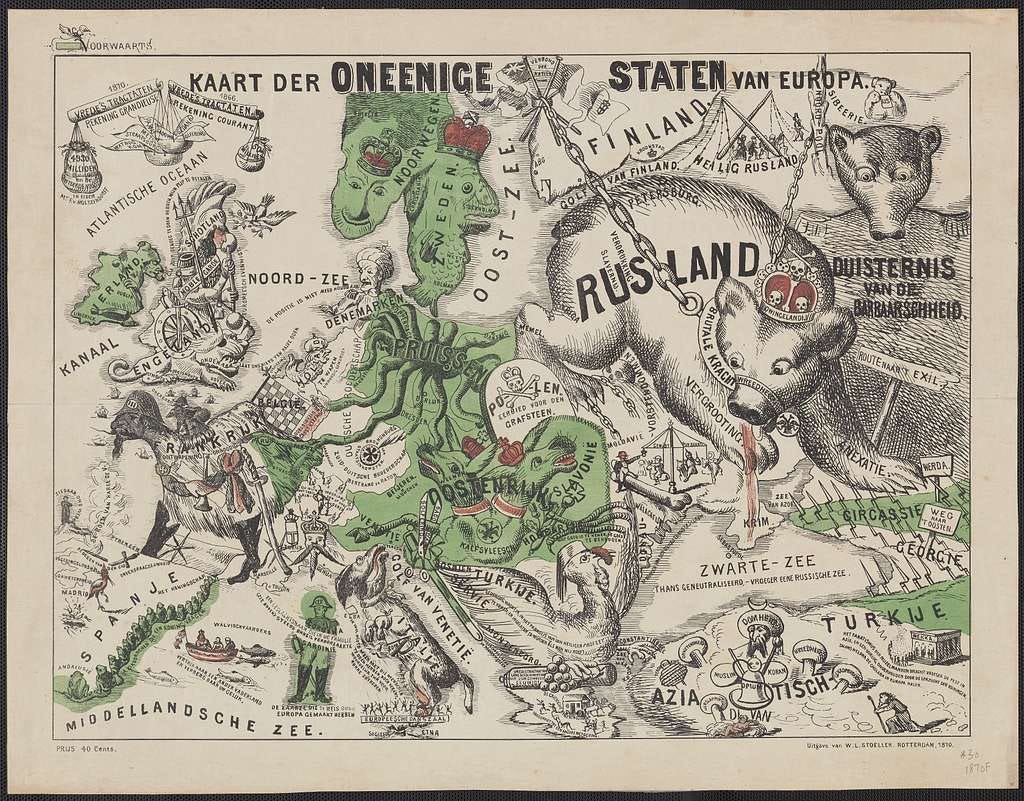
Why This Conversation Matters
Roderick Beaton begins with a question that sounds ordinary and turns out not to be ordinary at all: why do we need a new history of Europe? His answer is not publishing boilerplate. We need one, he says, because events have changed the pattern. The present has shifted, and when the present shifts, the past arranges itself differently in our sight. That is not a gimmick. It is one of the things history is for.
This matters because “Europe” is not merely a place on a map. It is an argument about a place, a long-running act of self-definition, and a civilization that has repeatedly imagined itself in different ways while insisting, somehow, that it is still itself. Beaton’s conversation is valuable precisely because it does not let the word “Europe” remain lazy or self-evident.
As you read or think back through the episode, consider these questions:
What if Europe is less a continent than a historical choice?
What if the openness of Europe—its permeability, its inability to seal itself off—has been one of its defining strengths?
And what happens to “Europe” when pressure from east and west forces Europeans to decide again who they are?
Throughlines
The conversation opens with the question of “newness,” and then—rather than marching chronologically through centuries of kings and wars—you and Beaton agree to decorate a kind of conceptual Christmas tree. The first ornament is geography. Beaton begins with a provocation: Europe, objectively speaking, does not quite exist. It is a long promontory sticking out from Eurasia, bounded by seas on three sides but open on the fourth, with no decisive geographical marker separating it from Asia. So from the start, the very idea of Europe is already more than physical fact; it is something people invented in order to describe themselves.
That leads naturally to openness. Europe is not India, with the Himalayas doing some of the work of definition. It is exposed, especially to the east, and that exposure explains much of its history. Beaton stresses the two great routes in and out—across the steppe, and through the Mediterranean and straits—and you push the point that Europe has long been both destination and launching point, a place where peoples arrive, mix, settle, and eventually burst outward again. Before the fifteenth century, the movement is largely inward; after that, Europeans begin crossing oceans and remaking the wider world. Europe, in this telling, is not static but tidal.
From there the conversation turns to idea and institution. Scandinavia becomes European not because a map says so, but because it is drawn into Christianity, urban life, and kingdoms; “Europe,” then, expands by incorporation. That sets up the long discussion of res publica—the public thing—running from the Greek and Roman sense that the polity belongs to all its citizens, through the Roman Empire’s appropriation of the term, into the res publica Christiana, and forward, in altered form, even into the European Union. Alongside this sits the persistent but repeatedly frustrated dream of empire. Europe keeps producing would-be unifiers—Charlemagne, Charles V, Napoleon, Hitler—yet never remains monolithic. Compared with China’s centripetal history, Europe appears centrifugal: broken, various, restless. Beaton is unconvinced by simple national-character explanations and prefers geography, rivalry, and habit.
But he does not finally praise competition in the brutal sense. He prefers emulation: Europeans looking over one another’s shoulders, borrowing, matching, surpassing, and in the process sharing a field of play. That, in turn, shades into Christianity—not as present-day confession, but as the long institutional framework within which Europe was ruled, morally shaped, and intellectually formed. Christianity mattered because in Europe Christians ruled; it was not merely believed, but built into law, power, and social order. Even secular Europe, Beaton suggests, emerged out of that inheritance rather than against it in some simple way.
The conversation ends where the book begins: with events. Ukraine, Maidan, the Russian invasion, Brexit, and the sudden British rediscovery that Europe might be “us” rather than “them.” Beaton’s closing point is that Europe is not only geography or inheritance, but self-definition. People choose it, or refuse it. Under pressure, they are forced to say again what they belong to. And that is why a new history is needed now.
Questions for Reflection and Discussion
Why does Beaton insist that Europe “objectively” does not quite exist as a continent? What does that claim clarify?
How does the openness of Europe’s eastern frontier help explain recurring patterns in European history?
In what sense is Europe an idea invented by the people who live there rather than simply a geographical fact?
What does the example of Scandinavia suggest about how places become “European”?
How does Beaton’s use of res publica deepen or complicate modern ideas of democracy and republican government?
Why has Europe repeatedly produced empires or would-be empires without remaining permanently unified under one?
Beaton prefers “emulation” to a harsher idea of competition. Is that distinction persuasive?
How does Christianity function in this conversation: as faith, as institution, as inheritance, or all three?
What does Ukraine’s insistence on being European reveal about Europe as a matter of choice and self-definition?
After hearing this conversation, what now seems “new” to you about Europe—and what merely seems newly visible?
For Further Investigation
Roderick Beaton, Europe: A New History (Basic Books, 2026)
—, The Greeks: A Global History (Basic Books, 2021)
John Rigby Hale, The Civilization of Europe in the Renaissance (Scribner, 1995)
Mark Mazower, Dark Continent: Europe’s Twentieth Century (Vintage, 2000)
Tony Judt, Postwar: A History of Europe Since 1945 (Penguin, 2006)
Tim Marshall, Prisoners of Geography: Ten Maps That Explain Everything About the World (Scribner, 2016)
Walter Scheidel, Escape from Rome: The Failure of Empire and the Road to Prosperity (Princeton University Press, 2019)
Tom Holland, Dominion: How the Christian Revolution Remade the World (Basic Books, 2019)