

Why This Conversation Matters
The fall of Constantinople is one of those events that might feel overfamiliar. We think we know it: a tired, decaying remnant of Rome finally collapsing under the pressure of a rising Ottoman power. A tragic inevitability, though long delayed.
Anthony Kaldellis asks us to reconsider that story. What if the fall of Constantinople was not inevitable at all? What if the defenders believed, with good reason, that they might survive? What if the story we tell has been shaped less by what happened than by how survivors later made sense of defeat?
This matters because it raises a deeper historical question: do we too easily confuse outcome with inevitability?
Consider:
How often do historians—and readers—mistake what happened for what had to happen?
What evidence would persuade us that a lost cause was not actually lost until the very end?
And what does it mean for a society to refuse, even in defeat, to consent to its own obsolescence?
Throughlines
The conversation begins by confronting what Zambone typically calls the “standard received view”: Constantinople as a fossilized remnant, a city living on borrowed time, destined to fall. Kaldellis pushes back sharply at this. Such language—“decadent,” “obsolete,” “exhausted”—is rhetorical, he argues, not analytical. It tells a story, but it obscures reality.
In fact, Constantinople in the decades before 1453 was still a functioning, even vital place. It was a hub of trade, especially for Venetian and Genoese merchants; a center of classical learning, drawing Italians eager to study Greek; and a focal point of Orthodox Christianity. It was diminished in population and marked by ruins, but it remained central within its own world.
This reframing sets up one of the conversation’s key moves: the fall becomes something to be explained, not assumed. Kaldellis notes that the city’s survival had already been extended by contingency—by the Ottoman defeat at the hands of Timur decades earlier. It might have fallen long before. It might, under different circumstances, have survived longer. The story is not one of steady decline but of precarious endurance.
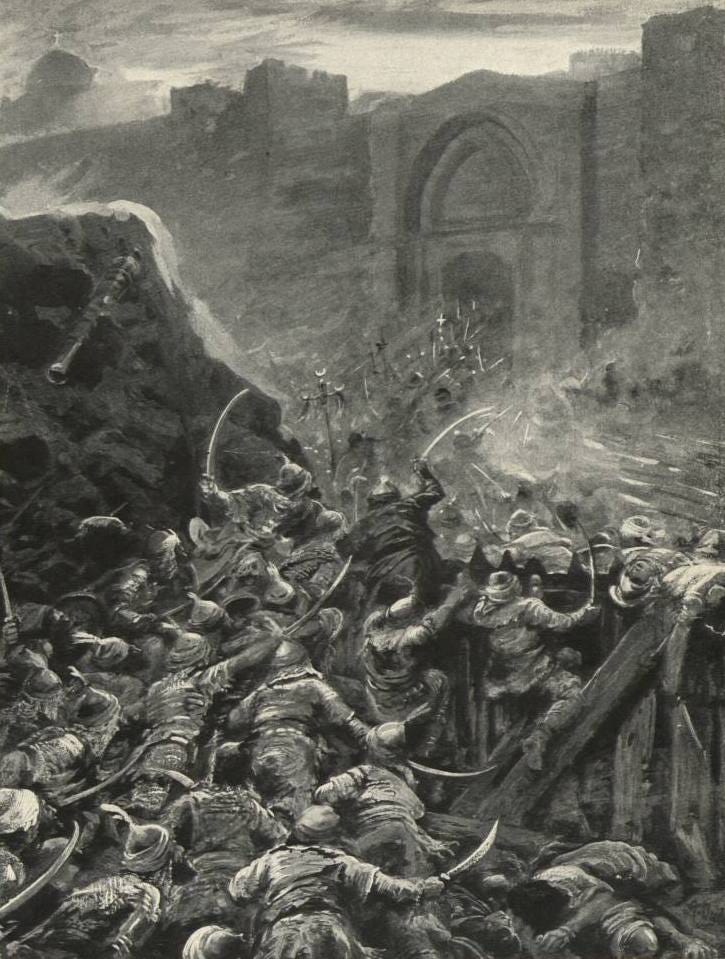
The discussion then turns to the siege itself, and here Kaldellis’s reinterpretation is most striking. By reconstructing events day by day from multiple sources, he argues that the defenders were not collapsing into despair. On the contrary, they were holding. The famous walls, combined with naval advantages and careful concentration of forces, allowed a relatively small defending force to resist a much larger Ottoman army.
This produces a surprising picture: not a doomed last stand, but a stalemate. Mehmed II throws everything at the city—artillery, mining operations, naval maneuvers, diversionary attacks—and yet fails to achieve a decisive breakthrough. Over time, the strain may have weighed as heavily on the besiegers as on the defenders. The outcome, in this telling, is contingent, even fragile.
The turning point, as Kaldellis presents it, is not grand strategy but collapse under pressure. The wounding of Giovanni Giustiniani—the Genoese commander holding together the most critical sector of the defense—triggers a chain reaction. His withdrawal is interpreted as retreat; panic spreads; Ottoman forces exploit the breach. A system already stretched thin, with few reserves and no redundancy, suddenly gives way.
Here the earlier theme of contingency returns with force. Had there been more defenders, more ships, more time—or fewer distractions imposed by Mehmed’s diversions—the outcome might have been different. The fall was not foreordained. It was, Zambone quoting the Duke of Wellington, “a damn close-run thing.”
The conversation also pauses on cultural “fluidity”—the overlapping worlds of Greeks, Italians, and Turks—but only to qualify it. Yes, there was exchange, shared practices, even mutual influence. But when the moment of decision arrived, those fluidities hardened into lines. In the end power clarified identity.
And then comes the end—not as abstraction, but as experience. The city falls; the population is rapidly enslaved and dispersed; the urban world is effectively erased in a single day. What follows is not immediate continuity but rupture: an emptied city, later repopulated, reshaped, and repurposed.
Kaldellis’s closing words return us to the ground level. For those who lived through it, the siege was not a symbol. It was stone, iron, bodies, smoke, and noise—a desperate struggle by a few thousand men fighting on ancient walls. Not inevitability, but effort. Not theory, but survival.
Questions for Reflection and Discussion
What are the key elements of the “standard received view” of Constantinople’s fall, and why does Kaldellis reject them?
How does the evidence of Constantinople’s continued vitality complicate the idea that it was an “obsolete” city?
What role does contingency—chance events and unexpected developments—play in Kaldellis’s account of the city’s survival and fall?
How does reconstructing the siege day by day change our understanding of the defenders’ prospects?
Why does Kaldellis argue that the siege was effectively a stalemate for much of its duration?
How did Mehmed II attempt to overcome the defenders’ advantages, and why were these efforts only partially successful?
What does the wounding of Giustiniani reveal about the weaknesses of the defense?
How persuasive is Kaldellis’s argument that the fall hinged on a failure of redundancy rather than upon the Ottoman’s overwhelming force?
In what ways does the idea of cultural “fluidity” help explain the world of 1453—and where does it fall short?
After hearing this conversation, how would you now describe the fall of Constantinople: inevitable collapse, contingent defeat, or something else?
For Further Investigation
Primary Sources
Barbaro, Nicolò, Diary of the Siege of Constantinople, ed. E. Cornet, Giornale dell’assedio di Costantinopoli 1453 (Vienna 1856); English trans. J. R. Jones, Nicòlo Barbaro: Diary of the Siege of Constantinople 1453 (New York 1969)
Benvenuto of Ancona, Report on the Siege of Constantinople, ed. Pertusi, Testi inediti, 4–5; English trans., M. Philippides, Byzantium, Europe, and the Early Ottoman Sultans, 1373–1513: An Anonymous Greek Chronicle of the Seventeenth Century (Codex Barberinus 111) (New Rochelle 1990)
Doukas, History, ed. S. Kotzabassi, Ducae Historia (Berlin and New York 2024); English tr. H. Magoulias, Decline and Fall of Byzantium to the Ottoman Turks, by Doukas (Detroit 1975)
Kananos, Ioannes, The Siege of Constantinople, ed. and English tr. A. M. Cuomo, Ioannis Canani de Constantinopolitana obsidione relatio (Boston and Berlin 2016)
Nestor-Iskander, The Tale of Constantinople (Of Its Origin and Capture by the Turks in the Year 1453), ed. and English tr. W. K. Hanak and M. Philippides (New Rochelle, NY 1998)
Tetaldi, Giacomo, Treatise on the Fall of Constantinople, ed. and English tr. M. Philippides, Mehmed II the Conqueror and the Fall of the Franco-Byzantine Levant to the Ottoman Turks: Some Western Views and Testimonies (Tempe, AZ 2007)
Secondary Sources
Anthony Kaldellis, 1453: The Conquest and Tragedy of Constantinople
—, Phantom Byzantium: Europe, Empire, and Identity from Late Antiquity to World War II
Judith Herrin, Byzantium: The Surprising Life of a Medieval Empire (Penguin, 2010)