

Why This Conversation Matters
The tablet computer feels like a distinctly twenty-first-century object, and—to be honest—just a little boring. We associate it with the iPad, introduced in 2010, and with the familiar gestures of tapping, swiping, pinching, and scrolling. It is easy to assume that the tablet emerged when improvements in batteries, processors, screens, and wireless networks finally made it possible. But long before the technology of its many parts made it viable, the tablet computer was an idea. Not just any idea, but the idea of what the perfect personal computer could be—what the perfect personal computer should be.
In The Tablet Computer: The Idea of a Machine, Elizabeth Petrick reconstructs the genealogy of that idea. Engineers, computer scientists, educators, designers, corporate executives, and science-fiction writers repeatedly imagined a portable, book-sized, networked computer operated through touch. They disagreed about what it should do, who should use it, and how it might change human life. They built prototypes, created cardboard models, produced promotional films, launched unsuccessful products, and watched supposedly revolutionary machines disappear.
This history matters because it challenges one of our most persistent habits of thought: treating technology as an impersonal force that simply arrives. Technologies do not descend upon societies from somewhere outside culture. People imagine them, argue about them, assign purposes to them, and decide which users matter. The resulting machines embody those choices—even when they do not fulfill the visions that inspired them.
Throughlines
The conversation begins with Alan Kay and the Dynabook, one the most famous ancestors of the modern tablet. In his 1972 paper “A Personal Computer for Children of All Ages,” Kay imagined something very different from the beige box that would later be called a personal computer. His personal computer was portable, lightweight, networked, and small enough for a child to carry. It would combine text, sound, images, animation, and computation in a single universal medium.
Education was not incidental to this vision. Kay believed that children could use computers to explore ideas, construct models, create games, and learn how to solve problems. The machine would not merely deliver information. It would encourage active learning and allow its users to pursue their own questions.
But Petrick complicates the familiar story of a lone visionary inventing the future. The Dynabook was developed by the Learning Research Group at Xerox PARC, and Adele Goldberg was central to that work. Goldberg helped develop Smalltalk, directed educational experiments, and eventually led the research group. When the Dynabook could not yet be built, the group treated the Xerox Alto as an “interim Dynabook”—a platform on which to develop the software and forms of interaction that a future portable computer might use.
Children experimented with the Alto in local schools. Some created animations and games, but the broader educational transformation Kay and Goldberg hoped for did not occur. As the evidence failed to match the original expectations, children gradually receded from the imagined market for tablet computers. The educational ideal remained influential, but the intended user began to change.
At this point, the story becomes a history not simply of machines but of representations. The Dynabook existed primarily in papers, drawings, and a cardboard model. Yet these images mattered. Kay’s drawing of children using portable computers while sitting outdoors gave engineers and designers a compelling picture of what personal computing might become.
This is one of the problems Petrick confronts as an intellectual historian. Once a vision becomes widely known, later technologies can appear to descend from it whether or not a direct connection can be demonstrated. She therefore follows people as well as devices. Alan Kay moved among research institutions and technology companies. Other employees left Xerox PARC for Apple and elsewhere. Ideas circulated through conversations, professional networks, advisory positions, and shared corporate cultures. Technological genealogies are rarely tidy lines of descent.
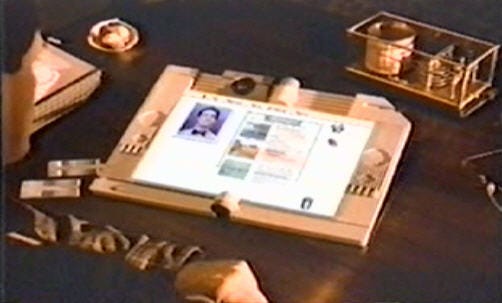
Along the way, pieces of the tablet appeared separately. Graphics tablets such as the KoalaPad allowed ordinary computer users to interact through a stylus. Apple designers proposed the Magic Slate. John Sculley’s Knowledge Navigator video imagined a tablet-like machine equipped with a conversational digital assistant. The film was widely mocked as an unrealistic corporate fantasy, but it gave visible form to a future in which people would communicate with computers through speech and touch—and in which the computer would know its user.
Then came the failures. The GRiDPad found specialized uses in inventory management and other forms of mobile work, but most early tablets were expensive, heavy, poorly networked, and limited by short battery life. The Apple Newton promised to recognize ordinary handwriting, an exceptionally difficult problem that it could not reliably solve. Its mistakes became the subject of jokes, and the device became one of the most famous failures in consumer electronics.
Yet failure did not end the tablet idea. Engineers left unsuccessful projects and carried their experience elsewhere. Technologies developed for one machine reappeared in another. Palm found success by abandoning the larger tablet form and producing a smaller device that could fit in a pocket, operate for weeks on its battery, and perform a limited set of tasks well.
Petrick argues that the concept of the tablet computer survived despite so many failures because it represented more than a product category. It was repeatedly imagined as the computer of the future—the machine that would finally make computing personal, portable, intuitive, and bodily. Its dimensions recalled objects that humans had used for centuries: books, notebooks, slates, tablets, and writing pads. It could be held, carried, written upon, and touched. The form seemed naturally suited to the human body even when the available technology could not yet realize it.
The eventual success of the modern tablet required both technological capacity and cultural preparation. Better batteries, wireless networks, processors, displays, and touchscreens were necessary. But so were users who had become accustomed to carrying digital devices and navigating graphical interfaces. The iPhone established the conventions of multitouch interaction before the iPad appeared. The App Store then allowed users to decide what their machines were for.
Even so, the iPad did not fulfill the Dynabook vision. Alan Kay did not regard it as the educational revolution he had imagined. The modern tablet has certainly opened new possibilities in art, communication, reading, accessibility, and note-taking. But it is also commonly used for passive consumption, distraction, and—as we joked during the conversation—the sedation of children in restaurants.
The history of the tablet is therefore not a story of a vision gradually and inevitably becoming reality. Some parts of the early vision were realized, particularly portability, touch, and wireless networking. Other parts disappeared or were transformed. The tablet became ubiquitous, but not necessarily revolutionary.
Our conversation ends by returning to the broader implications of Petrick’s approach. Technologies are culturally situated. They embody ideas about their intended users and about work, learning, creativity, and human nature. They do not simply replace everything that came before them. The tablet coexists with laptops, desktop computers, books, paper, notebooks, pencils, and fountain pens because different technologies continue to serve different purposes.
This history also offers a warning about artificial intelligence. AI agents seem startlingly new, but Petrick found remarkably similar promises and rhetoric in the 1990s. Forgetting those earlier cycles of enthusiasm makes it difficult to determine what is genuinely new about the present. Before declaring that a technology will transform everything, we should investigate how long that future has already been promised.
Questions for Reflection and Discussion
What is gained—and what is lost—when the history of a technology is organized around a single inventor?
How do drawings, prototypes, promotional films, and other unrealized designs influence technological development?
Why did the idea of the tablet remain compelling despite repeated commercial failures?
Should an unsuccessful technology be judged by its sales, its immediate usefulness, or its influence on later developments?
How did the imagined user of the tablet change from the child learner to the business executive and eventually to the general consumer?
Why did the PalmPilot succeed by moving away from the physical form that tablet designers had pursued? What did the PalmPilot lead to that prophecies of the tablet computer did not imagine?
Does the modern tablet fulfill the Dynabook vision, or does it represent the abandonment of that vision?
What assumptions about work, learning, creativity, and human nature are embodied in the tablets we use today?
Why do new technologies so often supplement older technologies instead of replacing them?
What current “technology of the future” might possess a similarly long and complicated history of aspirations, experiments, and failures?
Further Investigation
Elizabeth R. Petrick, The Tablet Computer: The Idea of a Machine (Johns Hopkins University Press, 2026).
—, Making Computers Accessible: Disability Rights and Digital Technology (Johns Hopkins University Press, 2015).
Alan Kay, “A Personal Computer for Children of All Ages”, presented at the ACM National Conference, 1972.
Alan Kay and Adele Goldberg, “Personal Dynamic Media,” Computer 10, no. 3 (1977). The paper and related material can be explored through the Xerox Alto File System Archive.
The Computer History Museum’s profiles of Adele Goldberg and Alan Kay, along with its account of the Xerox Alto.
The Computer History Museum’s model of Alan Kay’s Dynabook, based on the original mockup.
Steven Levy, Insanely Great: The Life and Times of Macintosh, the Computer That Changed Everything (Penguin, 2000).
The Apple Knowledge Navigator video—it’s about the tablet computer, but it’s also about AI
David Parisi, Archaeologies of Touch: Interfacing with Haptics from Electricity to Computing (University of Minnesota Press, 2018), on the long effort to make touch a means of communication between humans and machines.
Related Episodes
Together these conversations explore how societies imagine technological futures—and what happens when those futures are built, transformed, deferred, or destroyed.
The History of Technology, from Leonardo to the Internet: Thomas J. Misa on the reciprocal relationship between technological change, society, and culture.
The Firearm Revolution: Catherine Fletcher on how a military technology became an everyday object and acquired new cultural and political meanings.
The History of the Future: David Hochfelder on how historians can study expectations, predictions, and imagined futures as historical evidence.
How the Victorians Took Us to the Moon: Iwan Rhys Morus on the nineteenth-century technologies and forms of knowledge that made journeys to the moon conceivable.
His Majesty’s Airship: S. C. Gwynne on the short first flight of the dirigible R101, the technological and imperial ambitions invested in airships, and a form of failure so catastrophic that further experimentation became nearly impossible.
Tags
Elizabeth Petrick; Tablet Computers; History of Technology; History of Computing; Human-Computer Interaction; Educational Technology; Artificial Intelligence; Technological Failure; Historically Thinking