

Why This Conversation Matters
The American Revolution occupies a peculiar place in historical memory. Americans often regard it as the nation’s founding event, while many outside the United States see it as only one revolution among many, overshadowed by the French Revolution, the Haitian Revolution, or the upheavals of the nineteenth century.
Richard Bell asks us to look again. What if the Revolution was never merely an American story? What if it was, from the beginning, a global event whose consequences reached every inhabited continent?
Doing so changes not only our understanding of the Revolution itself. It changes how we think about the eighteenth century, about empire, and about the ways ideas, people, diseases, and ambitions move around the world.
Throughlines
One of Richard Bell’s central arguments is that the American Revolution cannot be understood within the borders of the thirteen colonies. From its beginning, it drew people, resources, and ideas from around the globe. German soldiers crossed the Atlantic to fight in North America. Black refugees sought freedom by fleeing to British lines. Loyalists scattered throughout the British Empire. Indigenous peoples found themselves fighting for their own political futures in a conflict not of their making. The Revolution was a vast movement of peoples, voluntary and involuntary alike.
Bell also emphasizes the extraordinary human cost of the war. Americans often imagine the Revolution as a relatively restrained conflict, especially when compared to the Civil War. Yet participants experienced it as a catastrophe. Indigenous confederacies fractured under the pressure of choosing sides. Civil war erupted between Loyalists and Patriots. Disease spread through military camps and civilian communities alike. Entire populations were displaced. The Revolution was not simply a contest of ideas but a prolonged period of violence and suffering.
The outcome itself was far from inevitable. Looking backward, it is tempting to imagine a steady march toward independence. Bell reminds us that participants did not enjoy that luxury. George Washington spent much of the war trying not to lose rather than expecting to win. The Continental Army lacked money, supplies, gunpowder, uniforms, and often men. American success depended on diplomatic efforts that brought France, Spain, and eventually the Netherlands into the conflict. Independence emerged not from destiny but from a series of improbable developments and contingent decisions.
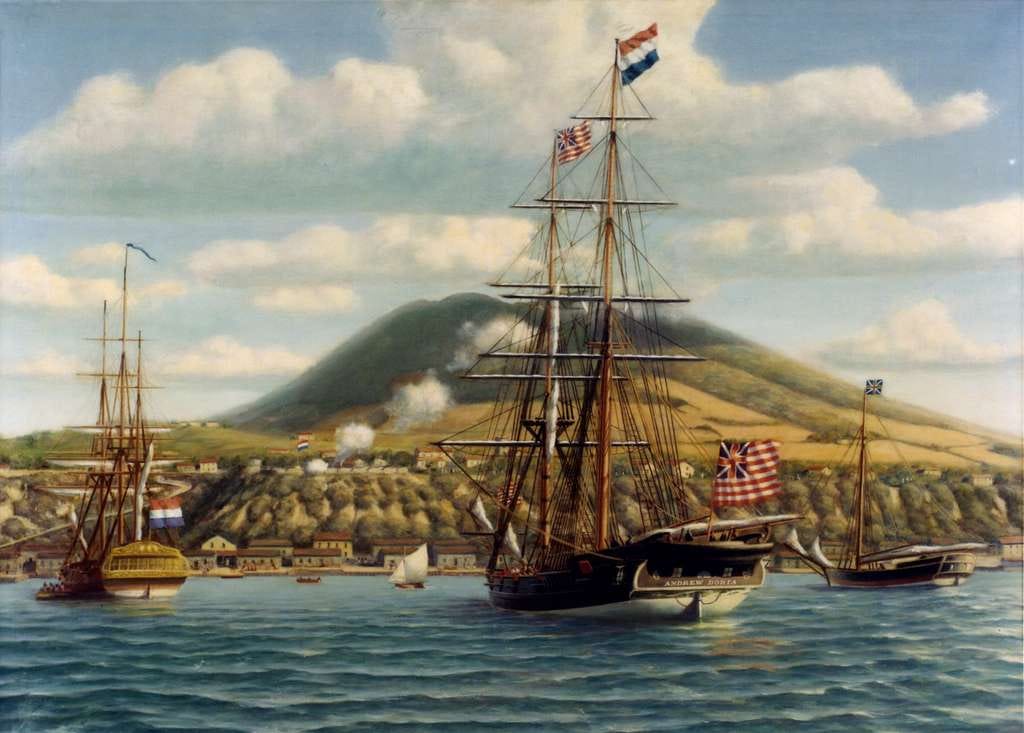
Another theme of the conversation is the importance of the sea. Histories of the Revolution often follow armies across battlefields, but Bell points out that the eighteenth century was the great age of sail. The British Empire’s greatest strength lay in its navy. Blockades, troop movements, privateering, and naval warfare shaped the conflict as profoundly as events on land. Patriot privateers captured or destroyed enormous quantities of British shipping, while British prison hulks became sites of staggering mortality. The war’s maritime dimensions were not peripheral but central to the conflict.
Trade appears throughout Bell’s account as another form of power and influence. Governments and merchants alike understood that commercial networks shaped political possibilities. The same concerns that animated colonial protests against imperial trade restrictions also influenced the decisions of Spain, France, and Britain during the war. Control of trade routes, access to markets, and the movement of commodities mattered as much as territory. Economic interests helped turn a colonial rebellion into a global conflict.
The Revolution’s success also transformed how empires governed. Far from encouraging colonial authorities to loosen their grip elsewhere, the American example often prompted tighter control. British authorities worked to prevent similar movements in Ireland and Canada. Spanish officials crushed uprisings in South America. Across the imperial world, rulers studied the American example and sought ways to ensure that it would not be repeated. The Revolution inspired hope among some and fear among many others.
Yet the language of liberty continued to travel. Ideas crossed oceans just as people did. Reformers, radicals, and revolutionaries looked to America for inspiration, even when their own circumstances differed dramatically. The Revolution became part of a broader conversation about freedom, representation, and political legitimacy. Bell’s point is not that every later movement copied the American example. Rather, the Revolution became one of the reference points through which people around the world imagined alternatives to existing forms of power.
In the end, Bell suggests that Americans have often told the story of the Revolution too narrowly. As a national origin story, it has usually been reduced to a struggle between Patriots and Redcoats. But widening the lens reveals a more complicated reality: multinational coalitions, global migrations, competing empires, and worldwide consequences. The American Revolution remains an American story. But it is also much more than that.
Questions for Reflection and Discussion
Why has the American Revolution so often been presented as a national rather than a global event?
Which of Bell’s seven arguments most changes your understanding of the Revolution?
How does the story of Harry Washington challenge traditional narratives of the founding era?
What does the experience of native peoples reveal about the costs of the Revolution?
Was American independence more contingent than Americans generally acknowledge?
Why do naval power and maritime history receive relatively little attention in popular accounts of the Revolution?
How did trade function as a form of political and military power?
Why did other empires respond to the Revolution by tightening rather than loosening their control?
In what ways did the Revolution inspire later movements for liberty?
What is gained—and what is lost—when nations turn historical events into origin stories?
For Further Investigation
Books
Richard Bell, The American Revolution and the Fate of the World (Penguin, 2025)
Trevor Burnard & Andrew Jackson O’Shaughnessy, Republic and Empire: Crisis, Revolution, and America’s Early Independence (Yale, 2025)
Elizabeth A. Fenn, Pox Americana: The Great Smallpox Epidemic of 1775-82 (Hill & Wang, 2002)
Holger Hoock, Scars of Independence: America’s Violent Birth (Crown, 2017)
Maya Jasanoff, Liberty’s Exiles: American Loyalists in the Revolutionary World (Vintage, 2011)
Mark Lender and James Kirby Martin, War Without Mercy: Liberty or Death in the American Revolution (Osprey, 2026)
Cassandra Pybus, Epic Journeys of Freedom (Beacon, 2007)
Alan Taylor, American Revolutions: A Continental History, 1750–1804 (W.W. Norton, 2016)
Articles
Baigent, Elizabeth, and James E. Bradley. “The Social Sources of Late Eighteenth-Century English Radicalism: Bristol in the 1770s and 1780s.” The English Historical Review 124, no. 510 (2009): 1075–108
Clark, William Bell. “John the Painter.” The Pennsylvania Magazine of History and Biography 63, no. 1 (1939): 1–23.
Philip Ranlet, “How Many American Loyalists Left the United States?” The Historian 76, no. 2 (2014): 278–307
Primary Sources
The Book of Negroes: “The ‘Book of Negroes’ is the single most important document relating to the immigration of African Americans to Nova Scotia following the War of Independence. It includes the names and descriptions of 3000 black refugees registered on board the vessels in which they sailed from New York to Nova Scotia between 23 April and 30 November 1783.” (Nova Scotia Archives)
Related Episodes
Republic and Empire: Andrew O’Shaughnessy on the global causes and consequences of the American Revolution
The American Revolution in Hapsburg Lands: Jonathan Singerton onthe American Revolution’s influence on the Austrian Empire
The Hessians are Coming!: Friederike Baer on the German soldiers who fought for the British Army in the American Revolution
Tory’s Wife: Cynthia Kierner on Jane Welborn Spurgin’s American Revolution
The Great Atlantic Freedom Conspiracy: Micah Alpaugh on correspondence, revolution, and social movements
Share CTA
The American Revolution is often told as the story of thirteen colonies breaking away from Britain. Richard Bell’s argument is that it was something much larger: a world crisis whose consequences reached from Nova Scotia to Sierra Leone, from Ireland to India, and from Peru to Australia. If this conversation changed how you think about the Revolution, share it with someone else who enjoys seeing familiar history from a wider perspective.