

Why This Conversation Matters
Americans tend to remember the Revolution through its most elevated moments, a series of isolated snapshots: Lexington and Concord, the Declaration of Independence, Washington crossing the Delaware, the victory at Yorktown. These events happened, and they matter. But they can also obscure another reality.
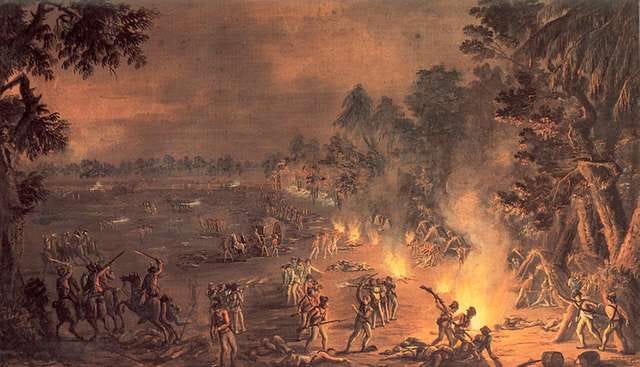
For many of the people who lived through the Revolution, the war was not experienced as a constitutional debate or a struggle over abstract principles. It was local, it was personal, and it was often terrifying. Neighbors chose sides. Families divided. Communities fractured. Property was destroyed. People fled their homes. Violence spread far beyond the battlefields that later generations would memorialize.
In their book War Without Mercy: Liberty or Death in the American Revolution, Mark Lender and the late James Kirby Martin ask a simple but unsettling question: why did the Revolutionary War become so brutal? Their answer is that many participants came to see it as an existential conflict. Once people believe that everything they value is at stake, restraints begin to weaken and compromises become harder to imagine.
Throughlines
The conversation begins with the central argument of Lender and Martin’s War Without Mercy: that the American Revolution became exceptionally violent because many participants came to regard it as an existential war. By existential, Lender explains that he means a conflict in which defeat threatens not merely political loss but the destruction of one’s family, community, property, culture, and future. When people reach that conclusion, violence acquires a different logic. Actions that might otherwise seem unacceptable become necessary if the alternative is believed to be annihilation.
This interpretation immediately raises a question. The eighteenth century was also the age of Enlightenment thought, of writers such as Grotius and Vattel who argued that warfare should be governed by rules and restraints. Why did those restraints fail? Lender suggests that they worked best among professional armies operating under centralized command. Much of the Revolutionary War was not fought under those conditions. It was fought locally, among people who knew one another, remembered old grievances, and often viewed the conflict through intensely personal terms.
New Jersey emerges as one of the conversation’s most revealing examples, perhaps because no one associates New Jersey with revolutionary violence. But during teh American Revolution the new state was crossed repeatedly by the opposing armies, occupied occasionally and always divided politically. It was a laboratory for testing loyalty and resistance. Here the war usually resembled a civil war more than a conventional military campaign. Neighbors informed on neighbors. Punishment and retaliation followed one another in cycles that proved difficult to stop.
The discussion then widens to include the frontier and the role of Native nations. The experience of warfare in the backcountry often differed dramatically from warfare in the east. Figures such as the Mohawk leader Joseph Brant operated in a world where communities feared displacement, destruction, and extinction. The result was a form of conflict that many contemporaries regarded as especially brutal, though participants themselves often saw their actions as necessary responses to existential threats.
One of the most interesting threads of Al and Mark Lender’s conversation concerns political radicalization. Lender points to William Livingston of New Jersey, who began the imperial crisis as a moderate and became increasingly uncompromising as events unfolded. His story illustrates how prolonged conflict changes people. The longer the struggle continued, the more difficult it became to imagine coexistence with political opponents. Moderation, once possible, came to seem naïve or even dangerous.
The southern campaigns offer another illustration. By the late stages of the war, the fighting in the Carolinas and Georgia frequently blurred the distinction between military operations and civil conflict. Allegiances shifted from side to side, and reasons for revenge accumulated. Military victories mattered, but so did local feuds, fears, and calculations of survival. The war’s brutality was not an accidental byproduct of the Revolution. It emerged from the ways participants understood what was at stake in either side being victorious.
Throughout the conversation, Lender repeatedly returns to a larger point. Most people do not wake up eager to abandon restraint. They do so when they become convinced that restraint itself is a luxury they can no longer afford. That insight helps explain not only the American Revolution but many other conflicts as well. The question that remains at the end is not simply why eighteenth-century Americans acted as they did. It is how any of us might behave if we became convinced that the only alternatives were liberty or death.
Questions for Reflection and Discussion
What makes a war “existential” rather than merely political?
Do you find Lender’s explanation for the brutality of the Revolution persuasive? Why or why not?
Why are civil wars almost always more bitter than wars between nations? (Or are they? Give that some thought.)
How effective are theories of restrained or “civilized” warfare when conflict becomes local and personal? What would it take to adhere to those theories when conflict does become local and personal?
What role did fear play in shaping the actions of Patriots, Loyalists, and Native peoples?
Why do historical memories often emphasize great battles while minimizing local violence? (Beware giving just one explanation!)
How does William Livingston’s story help explain political radicalization of both Loyalists and Rebels?
Can people recognize when they are becoming more extreme, or is that only visible in hindsight? How might they be able to tell at the moment?
Are there modern examples of conflicts that participants view as existential?
What does the phrase “liberty or death” mean when taken literally rather than rhetorically?
For Further Investigation
Books
Mark Lender, War Without Mercy: Liberty or Death in the American Revolution (Osprey, 2026)
James Kirby Martin and Mark Lender, A Respectable Army: The Military Origins of the Republic, 1763-1789 (Wiley-Blackwell, 2015)
Alan Taylor, American Revolutions: A Continental History, 1750–1804 (W.W. Norton, 2016)
Holger Hoock, Scars of Independence: America’s Violent Birth (Crown, 2017)
Maya Jasanoff, Liberty’s Exiles: American Loyalists in the Revolutionary World (Vintage, 2011)
Articles
Hugo Grotius (Stanford Encyclopedia of Philosophy)
Scholarship on Loyalist experiences during the Revolution
William Livingston’s World (website at Kean University)
Michael Adelberg, “250 for the 250th: Celebrating the 250th Anniversary of the American Revolution in Monmouth County”—no less than 250 articles on Monmouth County’s American Revolution “where Patriots and Loyalists clashed in brutal, localized civil warfare”.
Primary Sources
The Loyalist Collection: “a special collection of British and Colonial North American sources, including the British West Indies, predominantly from 1750-1850, published mainly in microformat and limited digital format.” (University of New Brunswick Libraries)
Emer de Vattel, The Law of Nations
Related Episodes
The American Revolution in the South: John Buchanan on Nathanael Greene, the Southern Campaign of the American Revolution, and the Road to Charleston
The First Martyr of the American Revolution: Christian DiSpigna on Dr. Joseph Warren, his life and times, his death at Bunker Hill, and his legacy
If This Be Treason, Make the Most of It: Carlton W. Larson on Treason, Juries, and Citizenship in the American Revolution