

Why This Conversation Matters
For a brief period—from July 1945 to August 1949—it seemed as if nuclear weapons belonged to one nation alone. But as David Holloway insists, that appearance is misleading. From the beginning, nuclear weapons were embedded in an international world: of shared scientific knowledge, espionage, rivalry, imitation, and fear.
This matters because nuclear weapons are not just weapons. They are systems of relationship. They force states to think about one another in new ways—about deterrence, survival, escalation, and restraint. And they force historians to think differently too. If we treat nuclear weapons as a national story, we misunderstand them. If we treat them as an international one, we begin to see how deeply they have shaped global order.
As you reflect on the conversation, consider:
Can any technology born in international science ever remain national?
Does the effort to control nuclear weapons represent cooperation—or managed distrust?
And is the “nuclear order” a moral achievement, or simply a fragile arrangement among powerful states?
Throughlines
The conversation opens with Holloway’s central framing: nuclear weapons must be understood through international history. That means not just multiple countries possessing them, but a web of relationships—scientific, political, and strategic—from the very beginning. Physics itself was an international enterprise, and when the possibility of a chain reaction emerged, so too did multiple national efforts to harness it.
This leads directly to the early wartime and postwar period, where collaboration and mistrust coexist uneasily. Britain’s role is especially revealing. Initially a partner in atomic development, it finds itself increasingly sidelined by the United States, even as knowledge continues to circulate in less official ways. The figure of Klaus Fuchs embodies this tension: a conduit through which information flows not only to the Soviet Union but, indirectly, to Britain as well. Technology, in this world, does not respect political boundaries.
From there, the conversation moves to what might be called the thermonuclear turning point. The development of hydrogen weapons forces a conceptual shift. By the mid-1950s, leaders such as Eisenhower, Khrushchev, and Eden begin to grasp that nuclear war, at this scale, is not simply another form of conflict. It is catastrophe—so destructive that it undermines its own utility as an instrument of policy. And yet, as you press Holloway, this realization coexists with something else: the continued use of nuclear threats in diplomacy. Eisenhower, even while recognizing the horror of nuclear war, still gestures toward its use in Korea or as a way of reducing conventional military spending. The tension is not resolved; it is managed.
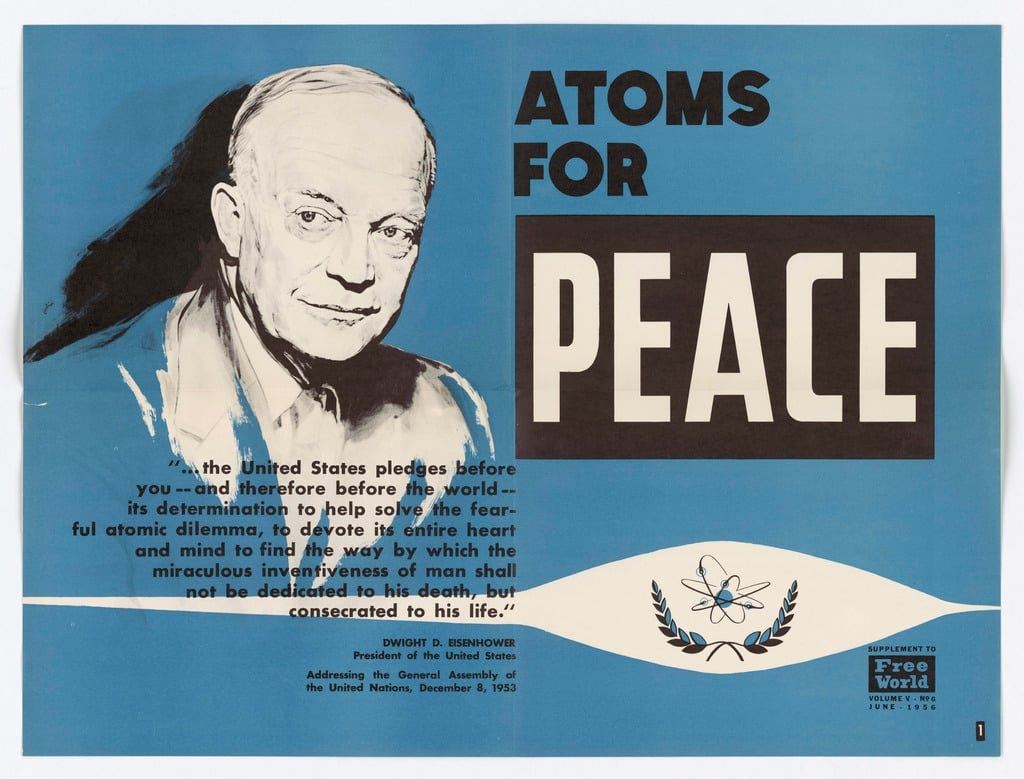
That tension deepens as the conversation turns to nonproliferation. Programs like “Atoms for Peace” appear, at first glance, to spread nuclear knowledge. But they also create frameworks for control—institutions, inspections, and norms that begin to define who may and may not possess nuclear weapons. Kennedy’s fears of widespread proliferation underscore how precarious this effort seemed.
The discussion of Sweden provides a revealing counterpoint. Here is a technologically capable state that seriously considers nuclear weapons and then renounces them. That decision, Holloway suggests, tells us something important: that the nuclear order is not inevitable. It is contingent, shaped by political choices as much as by technical capacity.
The conversation then shifts beyond the Cold War superpowers to South Asia, where India and Pakistan develop nuclear weapons in a very different context. Here, the “nuclear order” looks less stable, more layered. Conflict operates on multiple levels—local, regional, and global—and outside powers play a persistent role. The episode of the “blind eye” reinforces Holloway’s larger point: nuclear arrangements never transcend international politics. They are expressions of it.
The conversation closes by returning to the idea of “international society.” The nuclear order, Holloway argues, reflects an effort by powerful states to manage an existential danger. It is not necessarily just, nor necessarily stable. But it represents a set of shared understandings—fragile, contested, but real.
And your final observation lingers: what once seemed remote now feels immediate again.
Questions for Reflection and Discussion
What does it mean to describe nuclear weapons as having an “international history” rather than a national one?
How did the international nature of physics shape the development of nuclear weapons programs?
What does the story of Britain and Klaus Fuchs reveal about the limits of controlling technological knowledge?
Why did the development of thermonuclear weapons force a rethinking of nuclear war among world leaders?
How can we explain the coexistence of nuclear restraint and nuclear threat in leaders like Eisenhower?
Did programs like “Atoms for Peace” increase the risk of proliferation, or help create the conditions for control?
What does Sweden’s decision not to pursue nuclear weapons suggest about the role of political choice in the nuclear age?
How does the nuclear dynamic between India and Pakistan differ from that of the Cold War superpowers?
What does Holloway mean by saying that the nuclear order does not transcend international politics?
Is the nuclear order best understood as a success, a failure, or an ongoing experiment?
For Further Investigation
Primary Sources & Archives
U.S. National Security Archive Virtual Reading Room (George Washington University)
Archives of the Soviet Communist Party and Soviet State Microfilm Collection (Hoover Institution)
Secondary Sources
David Holloway, Nuclear Weapons: An International History (Yale University Press, 2026)
Richard Rhodes, The Making of the Atomic Bomb (Simon and Schuster, 2012)
John Lewis Gaddis, The Cold War: A New History (Penguin, 2006)
Marc Trachtenberg, History and Strategy (Princeton University Press, 1991)