

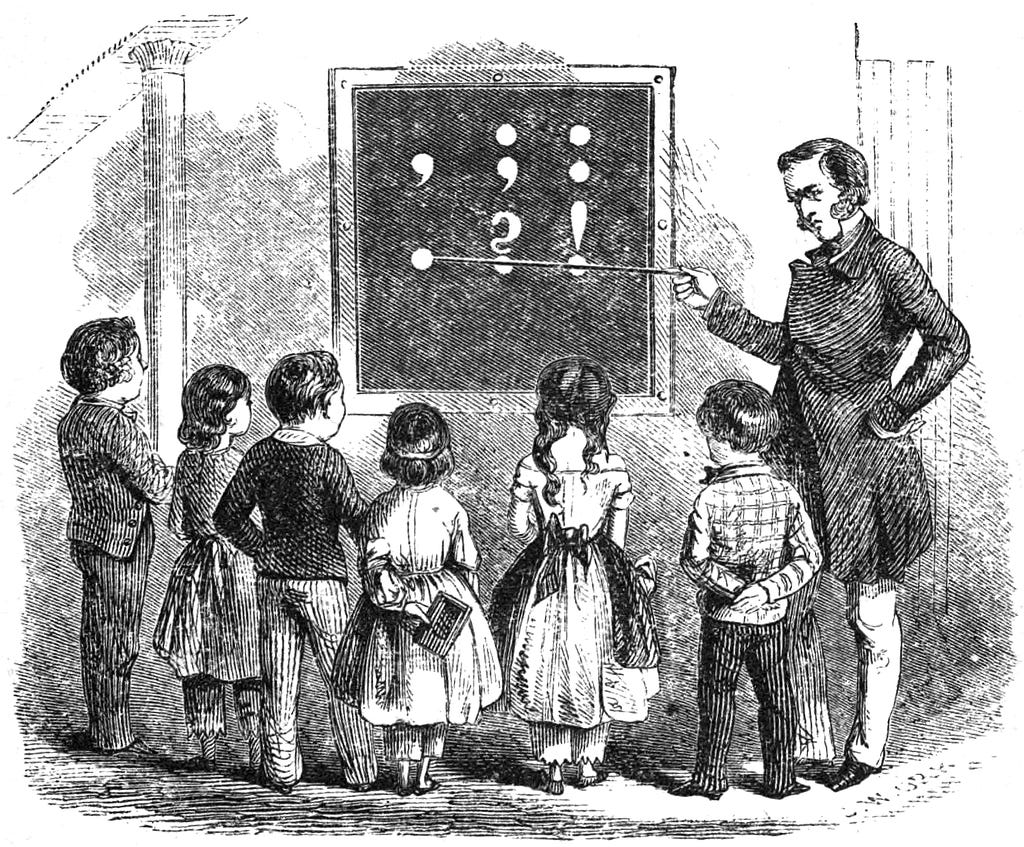
Why This Conversation Matters
Most of us think about punctuation only when it goes wrong. We notice the missing comma, the questionable apostrophe, or the email written entirely in capital letters. Otherwise, punctuation disappears into the background, doing its work so quietly that we forget it exists.
Florence Hazrat asks us to see punctuation differently—not as a collection of rules imposed by schoolteachers, but as one of civilization’s hidden technologies. The period, the paragraph, the space between words, the question mark: none of these was inevitable. Each had to be invented, and each changed not simply how people wrote, but how they read, thought, argued, remembered, and ultimately understood the world.
People who think about the importance of technology, or just about its coolness, focus on conspicuous inventions: the wheel, the printing press, the steam engine, railroads, the internet. But sometimes history advances by means of much smaller innovations. A tiny dot at the end of a sentence can alter the way an entire civilization encounters knowledge.
Throughlines
One of the most illuminating themes running through this conversation is that punctuation is not only part of writing, but part of thinking itself. A period tells us where an idea ends. A paragraph groups thoughts into meaningful units. Spaces between words make silent reading possible. The page itself becomes a map that guides both eye and mind. Seen this way, punctuation belongs alongside those other great cultural technologies that quietly expanded human possibilities.
The history which Florence Hazrat recounts is striking because it repeatedly overturns assumptions that seem obvious only because we have inherited them. There was a time when texts flowed continuously, without spaces between words. Reading required extraordinary training. The reader’s task was to disentangle language from an uninterrupted stream of letters. The introduction of spaces did not merely make reading easier; it changed what reading was. Silent reading became faster, more accessible, and more widely available. The written page became something a reader could navigate rather than decode.
Cicero assumed an educated audience capable of supplying rhythm and pauses without visual assistance. But medieval monks copying Scripture wanted precisely the opposite. Their punctuation invited readers into the text. Charlemagne’s reforms standardized writing across an empire because governments, like churches, depend upon shared systems of communication. Renaissance printers refined the page still further, recognizing that typography and punctuation were not afterthoughts but essential tools for making knowledge portable and comprehensible.
Throughout these changes, punctuation performs a quiet act of hospitality. It anticipates the reader’s needs. We often imagine punctuation as restrictive—a collection of rules limiting expression. Hazrat suggests almost the reverse. Punctuation emerged because writers cared about readers. Every period, every paragraph, every parenthesis represents an attempt to reduce ambiguity just enough for communication to succeed while leaving enough freedom for interpretation to remain alive.
The conversation ends by bringing this history into the present. The recent fascination with em dashes and artificial intelligence is amusing, but it also reveals something important. We instinctively treat punctuation as evidence of personality, and recognize voices through their habits of punctuation just as we recognize them through vocabulary or tone. The smallest marks on the page continue to carry social meaning far beyond grammar.
Perhaps that is why punctuation has remained remarkably stable for four centuries. While we have not stopped inventing technologies, in punctuation we inherited a system of marks so flexible that it continues to adapt to new media, from printed books to text messages to large language models.
The tiny dot at the end of a sentence turns out to be far more than a dot. It is one of the innumerable ways human beings have learned to make thought visible.
Questions for Reflection
Why do we tend to overlook the historical importance of everyday technologies such as punctuation?
How did spaces between words change the experience of reading?
In what ways does punctuation reflect assumptions about the relationship between writer and reader?
Why might punctuation be understood as a technology rather than merely a set of grammatical conventions?
How have religious traditions influenced the development of writing and punctuation?
What responsibilities do writers owe their readers when deciding how clearly—or ambiguously—to write?
How does the physical form of a text shape the way we understand it?
Why do seemingly small innovations often have such large historical consequences?
What does the current fascination with AI and punctuation suggest about how we recognize human writing?
What ordinary feature of modern life might future historians discover has quietly transformed the way we think?
For Further Investigation
Florence Hazrat, On the Mark: From Periods to Interrobangs (Basic Books, 2026)
—, An Admirable Point: A Brief History of the Exclamation Mark! (Godine, 2023)
Malcolm B. Parkes, Pause and Effect: An Introduction to the History of Punctuation in the West (Routledge, 1992)
Walter J. Ong, Orality and Literacy: The Technologizing of the Word (Routledge, 2013)
Lynne Truss, Eats, Shoots & Leaves (Avery, 2006)
John Harris, Punctuation Personified (1824), from The Public Domain Review
Related Episodes
Weavers, Scribes, and Kings: Amanda Podany on 3,000 years of the Ancient Near East (where all this punctuation business started)
Offa the King: Rory Naismith on a forgotten King, with some discussion of manuscripts, literacy, and early medieval England.
Book Makers: Adam Smyth on the Lives Behind the Printed Page
The History of Technology, from Leonardo to the Internet: Thomas J. Misa on how technologies reshape societies and cultures–and how culture shapes technology