

Episode 451: Terrible Intimacy
Why This Conversation Matters
We often imagine slavery at scale: vast plantations, hundreds of enslaved people, distance between enslaver and enslaved measured in fields and overseers. But what happens when that distance collapses?
What if slavery is not impersonal—but proximate? Not bureaucratic—but domestic?
This conversation asks you to reconsider where the system was most human—and therefore, perhaps, most revealing.
Does closeness mitigate cruelty, or sharpen it?
What does power look like when it lives under the same roof?
And how should we think about a system that depended not only on domination, but on constant, daily negotiation?
Throughlines
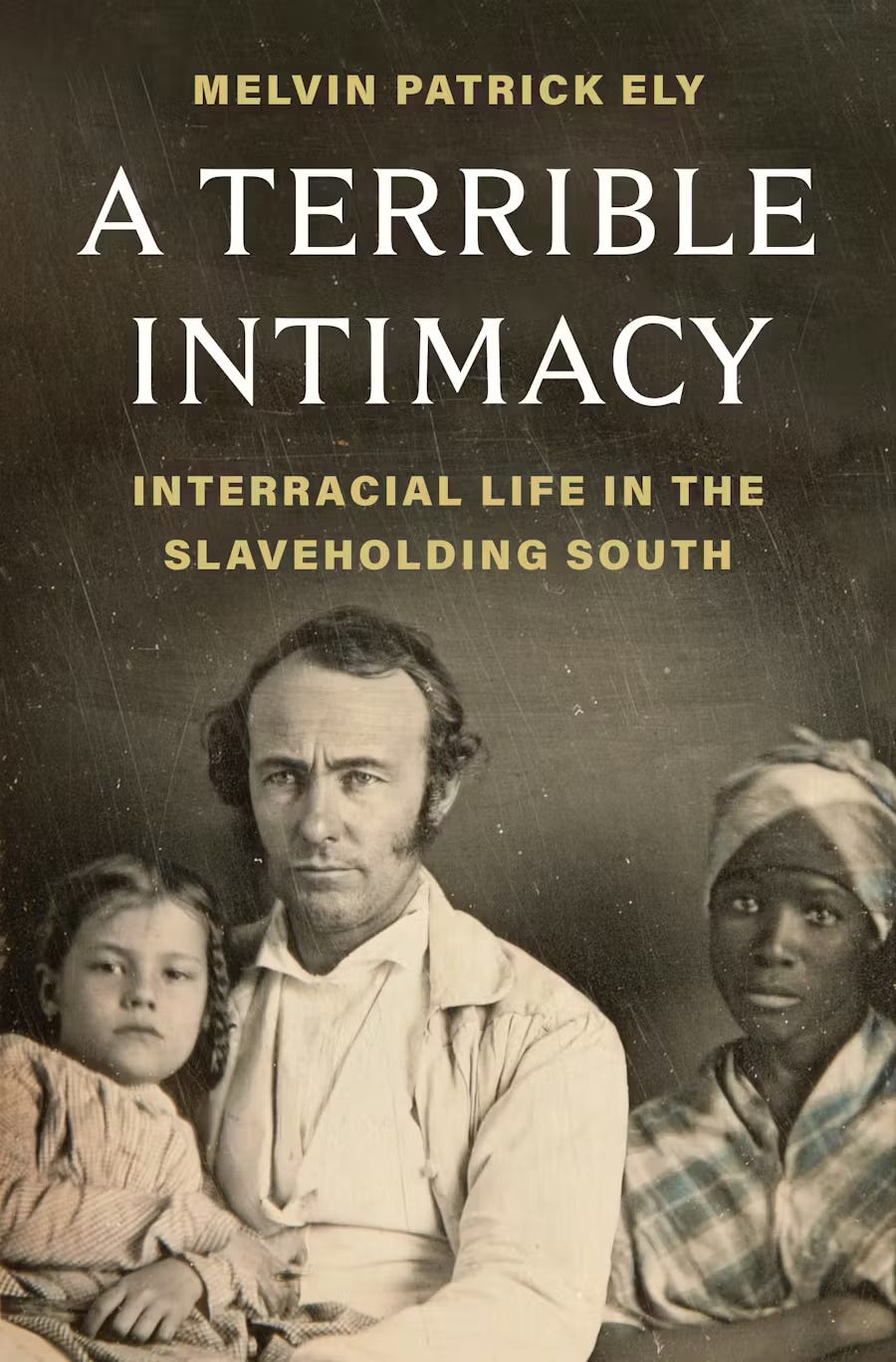
Melvin Patrick Ely’s work, now in his latest book A Terrible Intimacy turns our attention away from the grand plantation and toward what he shows was, in Virginia and much of the Upper South, the modal experience of slavery: small-scale holdings, often with fewer than twenty enslaved people, and sometimes far fewer.
In these environments, enslavers and enslaved people lived in close physical proximity. They saw one another daily, often constantly. There was no managerial buffer—no overseer class to mediate relationships. The enslaver was not an abstraction. He (or she) was present: in the yard, in the house, at the table, in moments of discipline, and sometimes in moments of uneasy familiarity.
Ely emphasizes that such proximity did not soften slavery. If anything, it made its contradictions more visible. Enslavers often knew the individuals they held in bondage—their skills, personalities, families. Yet this knowledge coexisted with, and indeed enabled, exploitation. The system required a kind of moral partition: recognition without acknowledgment, familiarity without equality.
For the enslaved, this closeness created a different set of possibilities and constraints. On the one hand, small-scale settings could allow for negotiation—over work, over family life, over limited forms of autonomy. On the other hand, they offered little refuge. Surveillance was constant because it always is in small places. Resistance, when it occurred, was immediately personal.
The phrase that emerges—“terrible intimacy”—captures this paradox. Slavery in these contexts was not distant or anonymous. It was immediate, relational, and inescapable. But it could be no less terrible. Even though, the case Ely and Zambone discussed, the enslaved man Tom had the scale of justice weighted in his favor such that he escaped execution, he was still transported away—possibly to a death on a plantation in Brazil.
Ely also gestures toward a broader historiographical implication: that understanding slavery requires attention not only to its largest and most visible forms, but to its most common ones. If nearly half of enslaved people lived in such conditions, then any account of American slavery that centers only on the plantation risks distortion.
In this sense, the conversation is not merely about scale. It is about perception. What we imagine slavery to have been shapes how we interpret its legacy. And Ely asks us, to imagine it differently.
Questions for Reflection and Discussion
How does beginning with Tom—and a specific act of violence—change your understanding of slavery compared to starting with laws, statistics, or large plantations?
In Tom’s case, how are we meant to understand his act: as crime, resistance, desperation, or something else? What categories are available—and which ones fail?
What does the community’s response to the homicide reveal about how enslaved people were perceived: as property, as persons, or as something unstable in between?
How does the legal handling of Tom’s case expose the tensions within a system that must treat a human being simultaneously as accountable subject and owned object?
In a small-scale setting where everyone knows everyone, how might testimony—who speaks, who is believed, who remains silent—be shaped by proximity and dependence?
Does the closeness between enslaver and enslaved in Tom’s world make the violence more shocking, or more predictable?
Ely suggests that such environments involved constant negotiation. What happens to those negotiated understandings when they break down—as they seem to have in Tom’s case?
How does the idea of “terrible intimacy” help explain not just daily life under slavery, but moments when that life erupts into violence?
If cases like Tom’s were not structurally unusual, why do they feel exceptional to us? What does that say about how slavery has been remembered or simplified?
After hearing this conversation, how would you now describe the “typical” experience of slavery—and what role should stories like Tom’s play in shaping that description?
For Further Investigation
Commonwealth v. Tom, County Court Order Book 21, pp. 274, 275, and 281–84; Co Ct 1825 November.
Melvin Patrick Ely, Israel on the Appomattox: A Southern Experiment in Black Freedom from the 1790s through the Civil War. Knopf, 2004.
Edward E. Baptist, The Half Has Never Been Told: Slavery and the Making of American Capitalism. Basic Books, 2014.
John W. Blassingame, The Slave Community: Plantation Life in the Antebellum South. Oxford, 1972.
Bertram Wyatt Brown, Southern Honor: Ethics and Behavior in the American South. Oxford University Press, 2007.
Stephanie M. H. Camp, Closer to Freedom: Enslaved Women and Everyday Resistance in the Plantation South. University of North Carolina Press, 2004.
Charles B. Dew, Bond of Iron: Master and Slave at Buffalo Forge. Norton, 1994.
—, Apostles of Disunion: Southern Secession Commissioners and the Causes of the Civil War. University of Virginia Press, 2001.
Eugene D. Genovese, The Political Economy of Slavery: Studies in the Economy and Society of the Slave South. Vintage, 1967.
—, Roll, Jordan, Roll: The World the Slaves Made. Pantheon, 1974.
Walter Johnson, Soul by Soul: Life inside the Antebellum Slave Market. Harvard University, 1999.
—, River of Dark Dreams: Slavery and Empire in the Cotton Kingdom. Belknap, 2013.
Calvin Schermerhorn, The Business of Slavery and the Rise of American Capitalism, 1815–1860. Yale University, 2015.
Diane Miller Sommerville, Rape and Race in the Nineteenth-Century South. University of North Carolina Press, 2004.
James Oakes, The Ruling Race: A History of American Slaveholders. Knopf, 1982.