

Why This Conversation Matters
Strategy is frequently treated as a collection of techniques: define an objective, assemble resources, make a plan, and execute it. Eliot Cohen’s argument is more unsettling. Strategy connects violence to political purpose, and therefore requires judgment about human beings whose motives, capabilities, and reactions can never be known completely.
That is why strategy cannot be reduced to a procedure. It demands choices among competing priorities, adaptations to changing circumstances, and decisions made with inadequate information. It also requires habits familiar to historians: attention to context and contingency, curiosity about unfamiliar people, empathy without sentimentality, and humility before surprise.
And because citizens authorize wars, sustain them, suffer their consequences, and judge their results, strategy cannot be the concern of military professionals alone.
Throughlines
Cohen begins with a deliberately narrow definition derived from Clausewitz: strategy is the use of military force to pursue the ends of policy. That definition excludes corporate strategy, campaign strategy, and the casual use of “strategic” to mean merely important.
It also refuses to separate military success from political purpose. Claims that the United States has never been defeated militarily miss the point: tactical success is not strategically decisive if it fails to secure the desired political result. The North Vietnamese officer who told Harry Summers that American forces had never been defeated in battle conceded the claim—and then called it irrelevant.
Cohen applies an equally restrictive definition to the strategist. A strategist is not simply someone who studies, teaches, or comments upon strategy. A strategist makes and implements it. Strategy is therefore iterative: decisions alter circumstances, circumstances frustrate plans, and leaders must continually reconsider what they are trying to accomplish.
The Strategist’s Catechism
At the center of the conversation are seven deceptively simple questions:
What else is going on? Strategy begins with context. Leaders focused on the immediate crisis can overlook allies, adversaries, domestic politics, and events elsewhere that will shape what happens next.
Who are those guys? Strategists must understand motives, morale, leadership, corruption, institutional culture, and the reasons an opponent continues to fight.
What is the objective? Political objectives are rarely as clear or stable as military planners would like. Some remain unstated; others change during the conflict.
What are the means? Means include technologies, organizations, institutions, and human capabilities. States often enter wars without understanding either their enemies’ means or their own.
What is the priority? Resources are finite. Governments reveal their priorities through what they fund, deploy, postpone, and leave exposed—even when they avoid acknowledging those choices.
What is the sequence? The order of decisions matters. Once a course has begun, path dependence can close some possibilities and make others nearly unavoidable.
What is the theory of victory? A strategist must explain why particular actions and resources should produce the desired political outcome. Governments frequently debate inputs without articulating the causal story connecting those inputs to success.
These questions constitute a discipline rather than a formula. They cannot eliminate uncertainty, but they can expose assumptions that would otherwise remain hidden.
Planning for Surprise
War repeatedly surprises people who know that war is full of surprises. Cohen suggests that one reason is the resemblance between military planning and engineering. Vast operations require schedules, diagrams, logistical systems, and precise coordination. These can create the impression that events will unfold predictably.
His example is the D-Day landing at Omaha Beach. The planning diagram presented an orderly succession of landing waves. The official history recorded a far more confused operation. The opening of Saving Private Ryan represented the experience of the soldiers as lethal chaos. All three perspectives were accurate—and the invasion could not have occurred without the plan.
Plans are necessary, but reality will not conform to them. Surprise may arise from the enemy, unexpected technological effects, institutional weakness, wishful thinking, physical illness, age, exhaustion, or the dispositions of individual leaders. Strategy therefore depends less upon getting everything right beforehand than upon recognizing error and adapting quickly.
The Strategist’s Virtues
Because no method can overcome uncertainty, Cohen turns from technique to character. He identifies four virtues: courage, honesty, empathy, and curiosity. Courage enables a leader to decide without certainty. Honesty permits the strategist to admit that assumptions have failed or that conditions are worse than expected. Empathy makes it possible to understand adversaries, allies, and one’s own side from perspectives other than one’s own. Curiosity sustains the search for information that might challenge settled beliefs.
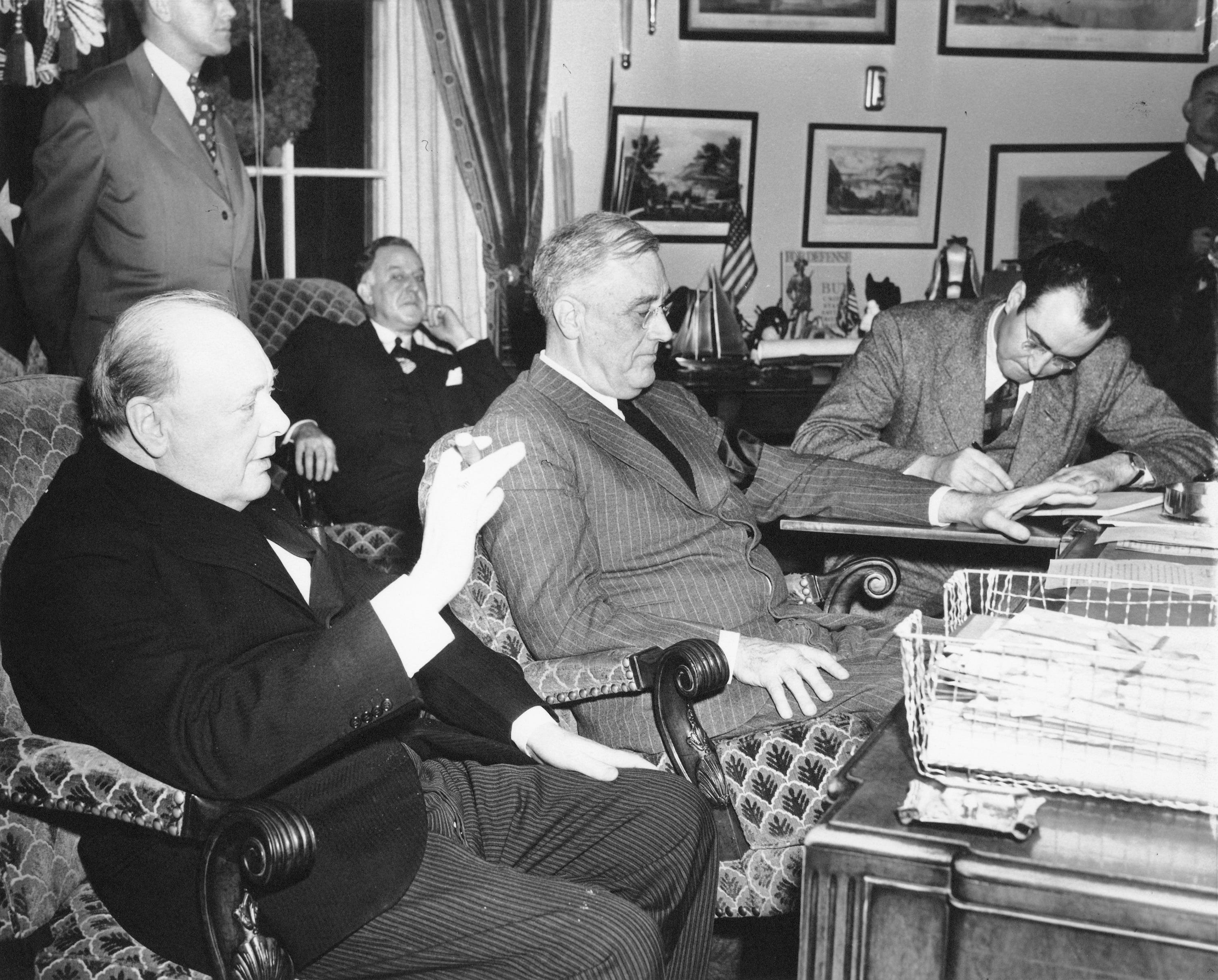
Cohen finds these qualities in Winston Churchill. Speaking of empathy he quotes the historian John Lukacs, who observed that Churchill could imagine what it was like to be Hitler, while Hitler could not imagine what it was like to be Churchill. Churchill similarly devoted enormous effort to understanding Franklin Roosevelt—his purposes, temperament, limitations, and methods of persuasion. Empathy here is not sympathy. It is a very much like the exercise of historical imagination: the attempt to understand how the world appears to someone else.
Churchill Thinking at Sea
Shortly after Pearl Harbor, Churchill crossed the Atlantic to meet Roosevelt. During the voyage, insulated from many of the interruptions of daily government, he dictated a series of memoranda considering the future direction of the war.
Cohen treats these memoranda as an example of a first-rate strategic mind at work. Churchill identified what he believed, admitted what remained uncertain, considered how far ahead events could reasonably be foreseen, and quietly shaped arguments intended to influence Roosevelt.
The memoranda were not flawless, and indeed much of their importance lies partly in what Churchill got wrong. Strategy at its best is not omniscience, but disciplined thought conducted within acknowledged limits, joined to the political art of persuading other people to act.
History and Strategic Judgment
The conversation concludes by distinguishing historical thought from much political science. Political science generally seeks useful abstractions and generalizations. History insists upon contingency, personality, and context.
For Cohen, experience in government reinforced the historian’s perspective. Events could have turned out differently. Outcomes depended upon who was in the room, how participants understood one another, and what they knew—or believed they knew—about the origins of the problem.
History cannot tell strategists exactly what to do. It is not a guidebook, or set of rules. But it can make them more alert to context, more suspicious of simple analogies, and better able to ask questions. In strategy, as in historical thinking, the quality of the question may matter more than the confidence of the answer.
Questions for Reflection and Discussion
What is gained by defining strategy narrowly as the use of military force to pursue political ends? What might that definition exclude?
Why is it misleading to separate military victory from political success?
What does the story of Clausewitz’s post-Vietnam revival suggest about the relationship between historical experience and intellectual fashion?
Which of Cohen’s seven questions is most likely to be neglected by political or military leaders? Why?
How can leaders answer “Who are those guys?” without reducing an adversary to stereotypes or projecting their own motives onto others?
Why are political objectives so often ambiguous, changeable, or unstated? Can a strategy remain coherent when its objectives change?
What is the difference between a plan and a theory of victory?
If surprise is inevitable, what kinds of preparation remain possible?
How do courage and honesty reinforce—or come into conflict with—one another in strategic decision-making?
Why does Cohen regard empathy as a strategic virtue? How does strategic empathy resemble historical imagination?
What do Churchill’s wartime memoranda reveal about the relationship between solitary reflection, collaborative planning, and political persuasion?
Are contingency, personality, and context obstacles to useful generalization—or necessary correctives to it?
Further Investigation
Eliot A. Cohen, The Strategist: How to Think About War and Politics (Princeton University Press, 2026).
—, “Why Is Strategy So Difficult?”, The Atlantic, October 20, 2026.
—, Supreme Command: Soldiers, Statesmen, and Leadership in Wartime (Free Press, 2002).
—, The Hollow Crown: Shakespeare on How Leaders Rise, Rule, and Fall (Basic Books, 2023).
Carl von Clausewitz, On War, edited and translated by Michael Howard and Peter Paret (Princeton University Press, rev. ed., 1984).
Harry G. Summers Jr., On Strategy: A Critical Analysis of the Vietnam War (Presidio Press, 1982).
Hew Strachan, The Direction of War: Contemporary Strategy in Historical Perspective (Cambridge University Press, 2013).
Richard E. Neustadt and Ernest R. May, Thinking in Time: The Uses of History for Decision Makers (Free Press, 1986).
Francis J. Gavin, Thinking Historically: A Guide to Statecraft and Strategy (Yale University Press, 2025).
Winston S. Churchill, The Grand Alliance, vol. 3 of The Second World War (Cassell, 1950).
The Franklin D. Roosevelt Presidential Library, “The Atlantic Charter”.
Shield of the Republic, Eliot Cohen and Eric Edelman’s podcast and Substack on foreign policy and national security.
Related Episodes
Hollow Crown: Eliot Cohen on Shakespeare’s understanding of leadership, character, power, and political failure.
War and Power: Phillips Payson O’Brien on the material, technological, and organizational foundations of military power.
The Devils Will Get No Rest: James Conroy on Roosevelt, Churchill, coalition politics, and strategic decision-making at Casablanca.
Strategy is too consequential to be left to those who use the word most confidently. Share this Reflection with a historian, military officer, policymaker, public servant—or anyone interested in how difficult decisions are made under conditions of uncertainty.
If you value conversations like this one, please subscribe. If you believe they are worth sustaining, consider becoming a paid subscriber and financial supporter of Historically Thinking.
Tags
Eliot Cohen; Strategy; Strategic Thinking; Carl von Clausewitz; Winston Churchill; Franklin Roosevelt; Military History; Statecraft; Civil-Military Relations; Leadership; Historical