

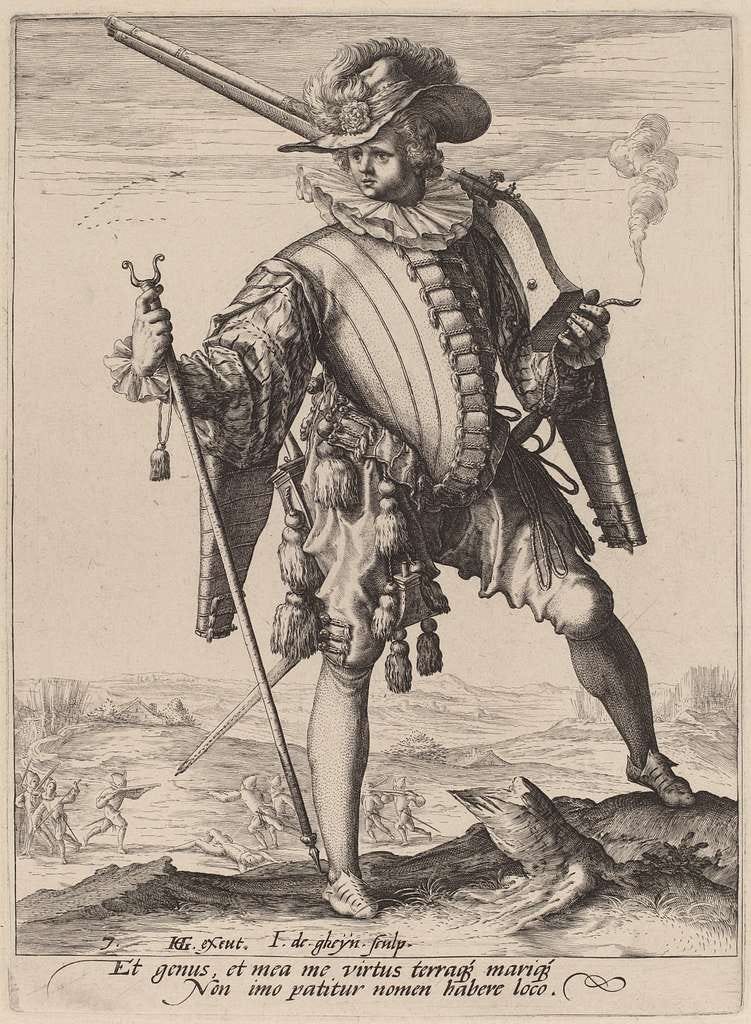
Why This Conversation Matters
We are perhaps accustomed to thinking about firearms as instruments of war, or as objects of political controversy. Catherine Fletcher invites us to entertain more unsettling ideas. What if firearms are best understood not primarily as weapons, but as social technologies? That is, as objects that reshape everyday life, reorder authority, and redefine violence?
Her argument turns on a historical shift that she carefully documents, when the handgun (any gun that could be carried) moved from novelty to normality. That transition forced societies to answer new questions: who may carry weapons, under what conditions, and with what expectations of restraint? In answering those questions, states did not simply suppress violence—they reorganized it.
As you read, or listen, consider these questions:
When a weapon becomes ordinary, does it stabilize or destabilize society?
Is state control over violence a sign of increasing order, or simply a more efficient form of coercion?
How did firearms violate certain principles of the culture of the Renaissance? What does that indicate about the relationship between technology and culture?
Throughlines
Fletcher’s argument proceeds by tracing a transformation that is easy to miss precisely because it is so gradual. Firearms did not suddenly revolutionize society; they seeped into it. What begins as a specialized military technology becomes, over the course of the sixteenth century, an object increasingly present in civilian hands.
At first, handguns were unstable tools—dangerous, unreliable, and in many ways suspect. They lacked the cultural legitimacy of older weapons. Yet that very instability made them socially significant. Firearms did not require the same degree of training or physical conditioning as traditional arms, and so they had the potential to unsettle established hierarchies. The question was not simply how they were used in war, but who would be permitted to use them at all.
States responded not by eliminating firearms, but by attempting to regulate their presence. Fletcher emphasizes that the spread of guns produced a parallel expansion of rules governing them. Authorities became increasingly concerned with when firearms could be carried, where they could be discharged, and by whom. This was not merely about public safety; it was about asserting jurisdiction over violence itself.
In this sense, the firearm sits at the intersection of three larger processes: military change, state formation, and social discipline. Governments recognized the utility of firearms even as they feared their disruptive potential. The result was not a simple monopoly on violence, but a managed distribution of it. In some contexts, civilians were encouraged—or even required—to bear arms; in others, restrictions tightened. The pattern varied, but the underlying dynamic was consistent: firearms forced states to define the boundaries of legitimate violence more precisely.
This is where Fletcher’s argument engages most directly with the idea of the civilizing process. If, as Norbert Elias argued, early modern Europe saw a gradual internalization of restraint and a reduction in overt violence, firearms complicate that narrative. On the one hand, they increased the capacity for sudden, lethal force. On the other, their regulation required new forms of behavioral control. The presence of guns did not simply make societies more violent; it made them more attentive to violence—more concerned with when, where, and how it could occur.
Crucially, Fletcher does not present this as a linear story of progress. The spread of firearms did not inevitably produce greater order. Instead, it exposed tensions between individual agency and collective authority, between the desire for security and the fear of disorder. Firearms became embedded in everyday life, but always as objects that demanded interpretation—tools whose meaning depended on the frameworks built around them.
Seen in this light, the “firearm revolution” is not just about technology. It is about the slow construction of a world in which violence is both more accessible and more tightly regulated—a paradox that remains with us.
Questions for Reflection and Discussion
Fletcher argues that firearms became “everyday objects” in the sixteenth century. What changes—social, cultural, or psychological—when a weapon becomes ordinary rather than exceptional?
What changes when any technology becomes ordinary rather than exceptional? What is required of a society and culture to make that change?
How did the spread of firearms challenge older social hierarchies based on strength, training, or status? Did it democratize or simply redistribute violence?
Does the spread of the technology come first, or does the state’s attempt to regulate it precede the spread of a technology?
In what ways do early modern governments resemble modern ones in their efforts to regulate weapons? In what ways might they be fundamentally different?
Norbert Elias’s “civilizing process” suggests a long-term reduction in interpersonal violence. Do firearms support that thesis—or complicate it?
Is the regulation of violence best understood as a moral achievement, a political necessity, or a strategy of control? Can it be all three at once? If not, why not?
How does thinking about firearms as a “social technology” change the way we understand other technologies, past or present? What are “social technologies” that do not look like technologies, but are techniques or institutions?
The episode suggests that firearms required new habits of restraint and new expectations of behavior. What does that tell us about the relationship between technology and character?
If the firearm revolution created a world in which violence was both more available and more regulated, are we still living in that world—or have we moved beyond it?
Related Episodes
For Further Investigation
Catherine Fletcher, The Firearm Revolution: From Renaissance Italy to the European Empires (Princeton, 2026)
Norbert Elias, The Civilizing Process (Second Edition)— one of the books that when I read it lit a fire inside my mind
Geoffrey Parker, The Military Revolution: Military Innovation and the Rise of the West, 1500–1800 — the classic argument on early modern military change
Tonio Andrade, The Gunpowder Age: China, Military Innovation, and the Rise of the West in World History — for a broader, comparative perspective on firearms and state power