

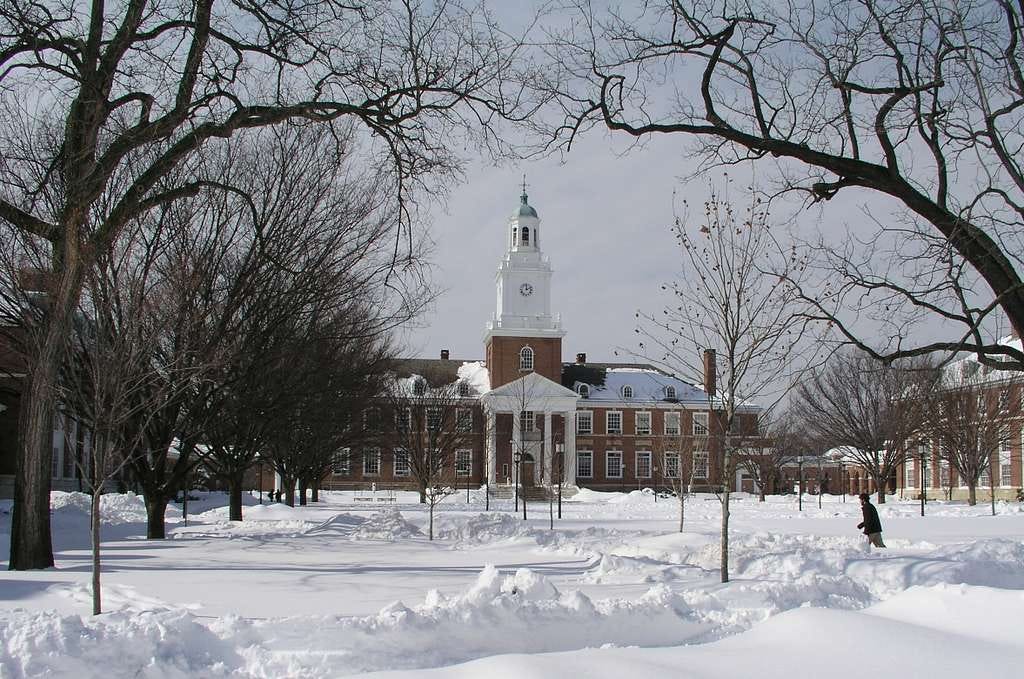
I. Introduction
Higher education can feel bewildering: admissions, affordability, student life, and everything that goes on—or doesn’t—in the classroom.
What can make it worse is that a lot of people have opinions about it, but those are often a decade or so old—accumulated when they were residential college students. Close examination would show they didn’t actually know all that much about how their own college worked at the time, let alone ten years later. And they certainly didn’t know how other four-year residential colleges worked, and as for two-year colleges…they don’t even think of them as college.
This Field Guide brings together conversations with historians, educators, and practitioners in order to replace vaguely formed opinions with some actual knowledge. This being a podcast about history and historical thinking, the field guide begins with a series of conversations about the past of higher education. It’s helpful to realize that things haven’t always been this way; it took some work, some errors, some mistakes, some brilliant ideas.
But from the very beginning of the podcast we have also had conversations about some things that it would be nice for parents and prospective students—and sometimes professors—to know. That’s where the subtitle “A Guide for the Perplexed” came from. Things like how the admissions process actually works; questions that people ought to ask an admissions counsellor, but don’t; why the “sticker price” of tuition isn’t the real price. Or why most of the things that people believe about “the best colleges” are wrong. And why college ratings systems are on a scale from somewhat to badly wrong, depending on the questions you want them to answer.
Finally in a series of conversation we address the question of: how could things be better? Since nothing was foreordained about American higher education, how might we set about ordaining something new? If we sat down and imagined what college ought to be like—how it was structured; what we studied; how we studied it; how a college interacts with the community around it.
And then, as always, we conclude the field guide with a list of questions for reflection, a bibliography, online resources, and—first time ever—a set of activities for would-be undergraduates and the adults who love them. As well as the usual hortatory conclusion, which in this Field Guide is even longer than usual, so hopefully someone reads it.
II. Episodes
Histories
Mr. Jefferson and His University
Andrew O’Shaughnessy on Thomas Jefferson’s vision for higher education. Jefferson dreamed of a university that would shape citizens for a republic, improve society, and uplift humanity itself. That vision was utopian, but as O’Shaughnessy makes clear, it was also profoundly influential.
The First Research University
Andrew Jewett on the history of The Johns Hopkins University, which is also a microcosm of the history of the American research university. Bound into that history are debates concerning questions that remain unsettled. Should a university emphasize advanced research or undergraduate education? Should research be pursued wherever an investigator’s curiosity leads, or directed toward practical ends? How much influence should donors, foundations, corporations, and governments possess? And what happens when an institution created to be different becomes the model everyone else follows?
The Amateur Hour
Jonathan Zimmerman on the long, frustrating, futile, and often funny history of teaching in American colleges. He chronicles the ups and downs of college teaching in the United States: the great teachers, the lazy teachers, the endless student complaints, the constant attempts at reform, the insistence that teaching can’t really be reformed—and then the recurrence of the whole cycle, until it then repeats itself.
American Dorm
Architectural historian Carla Yanni argues in her new book Living on Campus: An Architectural History of the American Dormitory (University of Minnesota Press, 2019) that physical space is not simply a backdrop for college students. The two act on each other.
College Sports
Many college professors like to remind each other that no other nation on earth has the system of collegiate sports that has developed in the United States, one in which the mishaps of a mediocre football team attract much more attention than what goes on in classrooms, labs, and libraries. But far less often do they admit the truth: that college sports have always been intertwined with the university, growing and changing alongside higher education itself.
Degrading Equality
For decades, Black and white students at Oberlin College—and later at Berea College in Kentucky—stood together first in the cause of abolition, and then in the fight for civil rights. Yet following the collapse of Reconstruction, even these campuses that once stood as bastions of equality began to draw color lines. John Frederick Bell demonstrates how colleges founded to create a community of principle instead compromised their ideals, mirroring the retreat from equality in the nation at large.
Battle for the Classics
Humanities professors these days often find themselves defending the humanities (see the conversation with Johann Neem, below). But Eric Adler argues that their arguments often unknowingly recycle bad arguments of generations past. From Cicero to Charles William Eliot, from 19th-century reformers to our present moment, Adler demonstrates how the “battle for the classics” has always been a battle for the humanities themselves.
The Truth About How Things Work
“The Truth About College Admissions”
Rich Clark and Brennan Barnard know a lot about college admissions, far more than a high school student, the parents of a high school student, or your average high school counselor. They’ve written a guide to getting into college while keeping the family together.
Hard Questions to Ask College Admissions Officers
Mark Salisbury joins me to offer some practical advice that you unfortunately can’t get from very many places. We work backwards from where graduates actually end up, rather than where glossy brochures imagine they’ll go. Along the way we take apart the U.S. News & World Report rankings, discuss a survey you’ve probably never heard of (with a name that sounds suspiciously like “Nessie”), and explain how to ask better questions when visiting a campus.
How College Works
In what is probably my favorite book about college, Daniel F. Chambliss and Christopher Takacs examine their own institution of Hamilton College to uncover how students actually experience higher education. Their findings overturn common assumptions about what matters about a college. In the end, the conclude, it’s less about prestige, and more about relationships, mentoring, and lived experience. This serves to answer two excellent questions: how in an era of shrinking budgets can colleges do more to improve the quality of education? And how can students get more out of college without paying higher tuition?
The First Three Weeks
Mark Salisbury explains the research that indicates how important the first three weeks is for a new undergraduate. We discuss how this should influence what new students do, and what professors do.
The Secret Syllabus
Unlike most people, Jay Phelan and Terry Burnham, have really good advice to give to new undergraduates. In fact, they wrote probably the best book to give new students.
The Achievement Culture
My guest Joseph Davis has thought a lot about the culture of the hight-achieving college campus, in which many undergraduates are obsessed with personal achievement. As you’ll hear, Davis believes that anxiety is the natural result of a world in which everything is possible
Shooting Down Helicopter Parents
Mike Edmondson, argues that parents’ expectations about majors, careers, and college life are often grounded in myths. We discuss what parents get wrong about higher education, careers, and how students can chart their paths. With some gentle (and not-so-gentle) admonitions, we try to reset the conversation about what college is really for.
The College Tuition Problem
Mark Salisbury points out that tuition is more like the sticker price on a car: it’s the starting point for negotiation, not the final number. And like going to a Buick dealer and finding everything priced like a Porsche, it often feels arbitrary, confusing, and unfair. He unpacks the myths and realities of tuition. We talk about why the school your child attends might not matter as much as you think, how the “information problem” leaves families in the dark, and why understanding actual tuition offers is the first step toward solving the crisis.
Work College
Deep in the mountains of eastern Kentucky is Alice Lloyd College. It is one of a small network of “work colleges” in the United States, which the Work College Consortium defines as “colleges that integrate work, learning, and service to build student skills and reduce education costs.” Allison Holbrook Southard, now Vice President for Advancement at Alice Lloyd College, joins me to talk about the legacy of Alice Lloyd, the unique mission of work colleges, and the challenges of fundraising and advancement in higher education.
After Graduation
“What’s the Use of Your Humanities Degree in an AI World?”
Brent Orrell, a policy expert on labor and jobs issues at the American Enterprise Institute, explains that a humanities degree has a lot of utility in a world that is hurtling towards artificial intelligence and increasing automation.
The Purposeful Graduate
Tim Clydesdale on vocation, anxiety, and higher education. His research shows how deliberate conversations about meaning can improve academic performance, strengthen campus communities, and prepare students for life beyond graduation.
Things Could Be Different
College Made Whole
Many would-be college reformers, says Chris Gallagher, talk about “unbundling.” By this they mean breaking a college into parts to save on costs and increase efficiency. In reality, Gallagher argues, colleges are already far too unbundled; or, perhaps, dis-integrated. What we need, he argues, are integrated colleges, ones which are coherently designed so that all of their parts fit together and support one another.
Alternative Universities
The 1930s were an era of remarkable experiments in higher education: the University in Exile at the New School, the great books curriculum at St. John’s College, and Black Mountain College’s arts-centered approach. David J. Staley argues that such bold innovation has largely disappeared—and needs to be revived. So he outlines imaginative models for rethinking the university, from interdisciplinary “polymath colleges” to radically redesigned online institutions. You shouldn’t have favorite conversations, if you’re a podcaster, but this is one of them.
What’s the Purpose of College?
Johann Neem argues that college is not a place for business degrees, because “colleges are places where people step aside from the world of need — from the world of business — to engage in reflection.” Business schooling, says Neem, is the negation of the world of reflection.
Knowledge Towns
Town–gown clashes are as old as universities, but they don’t have to be. David Staley and Dominic Endicott propose a different compact: institutions that anchor local prosperity, cultivate homegrown talent, and weave themselves into the fabric of “strong towns” rather than operating as academic islands. We talk about the model the envision, possible scenarios, the pitfalls of campus monocultures, and why micropolitan regions may be the most overlooked engines of the knowledge economy.
Playing Games with History
So in part this is about a new pedagogy for teaching history. But it’s based on Mark Carnes study of the “shadow campus”, of what undergraduates get up to when they are not in class. So when we discuss the gap between how professors imagine college and how students actually experience it, and how immersive games can bridge that gap, we are actually talking about how colleges could be different.
III. For Users
A. Questions for Reflection
1. American colleges have been repeatedly reinvented (some of them at least three times), yet often present their current practices as ancient traditions. How does understanding the history of admissions, curricula, dormitories, athletics, and research change our assumptions about what a college must be?
2. Colleges promise many things: intellectual growth, preparation for employment, personal development, social mobility, and responsible citizenship. Are these goals complementary, or do they sometimes compete? How would you determine whether a particular institution achieves them?
3. Prestige and educational quality are often treated as synonymous. What evidence would you need to establish that one college actually provides a better undergraduate education than another? How much of what we call prestige reflects educational achievement, and how much reflects reputation, wealth, or selectivity?
4. Many of the most important experiences in college occur outside formal instruction: friendships, mentoring, residential life, extracurricular activities, and unexpected conversations. How should these experiences figure in evaluating a college? Can institutions deliberately create the conditions that make them possible?
5. Higher education is often discussed in terms of cost, earnings, and return on investment. What can these measures tell us, and what important things might they fail to measure? How should a prospective student balance financial prudence with intellectual curiosity and personal development?
6. If American higher education were being designed from scratch, which of its familiar features would we retain? Which would we discard? What historical experiments suggest possibilities for creating institutions better suited to the needs of today’s students?
B. Activities
Activity 1: Visit a campus as an investigator not a consumer
Don’t merely take the official tour. Arrange an admissions conversation, visit classes if permitted, speak with students who are not tour guides, and spend time in the library, dining hall, and common spaces.
The object is not to decide whether the campus feels attractive. It is to discover how students actually learn and live there.
As you poke about, you might ask some of the following questions. Each parenthetical reference is to the quality of the college that the question is seeking to understand:
Does the college participate in the National Survey of Student Engagement (NSSE)? May I see its most recent results, including comparisons with peer institutions? (Student engagement)
What percentage of first-year courses are taught by full-time faculty? (Faculty access)
What proportion of courses enroll fewer than 20 students, and how many enroll more than 50? (Real-life class size)
How does the college ensure that every undergraduate develops a sustained relationship with a faculty mentor? (Mentoring)
What do your internal surveys reveal about students’ sense of belonging and the quality of their interactions with faculty? (Student experience)
What percentage of first-year students return for their second year? (Retention)
What percentage graduate within four years? Within six? (Graduation)
What evidence does the college collect showing that students improve in writing, reasoning, and analytical ability? (Learning)
What percentage of graduates are employed or pursuing further education within six months, and what percentage of graduates supplied the underlying information? (Career outcomes)
What is the average net price actually paid by families in my financial circumstances? (Cost)
How much institutional grant aid is renewable, and under what conditions might it decrease? (Financial aid)
How have undergraduate enrollment, faculty numbers, and academic offerings changed over the past five years? (Institutional health)
Activity 2: Compare three colleges without using a rankings survey
This is an activity to help you realize that all rankings surveys, no matter how well intentioned, are liars. They can’t help it. And it is also an activity which can help you compare the apples of Research One universities with the peaches of liberal arts colleges, the oranges of regional commuter schools with the tomatoes of community colleges. They’re all part of American higher education—all fruit—but all different; and sometimes the differences are not where you might expect them to be.
Choose three institutions that differ substantially in type, size, price, or reputation. One might be a selective private college, another a regional public university, and the third a community college or less selective institution.
Construct a comparison using actual evidence. Start with these categories:
Net price after grants
Four- and six-year graduation rates
Student engagement and mentoring
Undergraduate teaching
Student debt and earnings
Campus community and belonging
Once you’ve assembled the evidence, first imagine three prospective students with very different interests, financial circumstances, and educational ambitions. Which college would you recommend to each of them, and why? Could the same institution be the best choice for all three?
Now ask a harder question: Which of these colleges provides the best education? And did you answer that question without first deciding what you mean by a good education? Why did you do that? And if you can’t, then you’ve discovered something important about college rankings.
Activity 3: Audit the first three weeks of college
Inspired by Mark Salisbury’s conversation on the first three weeks, this is particularly useful for new undergraduates. In fact, this should be mandatory for new undergraduates—colleges ought to expect it of every first year student in their first three weeks.
During the first 21 days:
“Visit the office hours of every professor teaching one of your classes, at least once during the first three weeks. If the professor teaching your class is a part-time or adjunct faculty, make a note. If the faculty member teaching your class does not have office hours or does not show up for them, drop their class.
Attend three events of organizations or groups that are your kind of thing
Attend at least three campus events of organizations or groups that don’t really seem like your kind of thing, but might be, maybe?
Explore a student organization by committing to attending meetings and volunteering for at least a semester—any less and you don’t know what you’re getting into. This is much better than going to the activity fair, signing up for twelve organizations, going to three initial meetings, and then dropping those.
Have two conversations with someone outside your existing social circle. If you don’t know how to have a conversation, this is one of the times it’s permissible to use AI. (Although asking a silicon-based non-entity for advice on how to talk with humans is just a little odd, right?)
Identify an academic adviser or potential mentor from among the full-time faculty members who had office hours.
At the end of the period, ask: Have I begun to build relationships that will sustain my education? Or have I simply learned how to attend classes? And what will I do differently in weeks 4, 5, and 6?
IV. Bibliography
Richard Arum and Josipa Roksa, Academically Adrift: Limited Learning on College Campuses (Chicago, 2011).
Brennan Barnard and Rick Clark, The Truth About College Admission: A Family Guide to Getting In and Staying Together (Hopkins Press, 2019)
John Frederick Bell, Degrees of Equality: Abolitionist Colleges and the Politics of Race (LSU Press, 2023)
Derek Bok, Higher Education in America, Revised edition. (Princeton University Press, 2015)
Daniel Chambliss & Christopher Takacs, How College Works (Harvard, 2018)
Tim Clydesdale, The Purposeful Graduate: Why Colleges Must Talk to Students About Vocation (Chicago, 2015)
—, The First Year Out: Understanding American Teens After High School (Chicago, 2008)
Mike Edmondson, Major in Happiness: Debunking the College Major Fallacies (Business Expert Press, 2015)
Chris W. Gallagher, College Made Whole: Integrative Learning for a Divided World (Hopkins Press, 2019)
Eric A. Moyen and John R. Thelin, College Sports: A History (Hopkins, 2024)
Martha C. Nussbaum, Not for Profit: Why Democracy Needs the Humanities (Princeton University Press, 2024)
Andrew O’Shaughnessy, The Illimitable Freedom of the Human Mind: Thomas Jefferson’s Idea of a University (University of Virginia Press, 2021)
Jay Phelan and Terry Burnham, The Secret Syllabus: A Guide to the Unwritten Rules of College Success (Princeton University Press, 2021)
David Staley, Alternative Universities: Speculative Design for Innovation in Higher Education (Johns Hopkins University Press, 2019)
John Thelin, A History of American Higher Education, 4th Edition (Johns Hopkins University Press, 2026)
Carla Yanni, Living on Campus: An Architectural History of the American Dormitory (University of Minnesota Press, 2019)
V. Online Resources
These resources help prospective students, parents, educators, and interested readers investigate colleges using evidence rather than rankings, reputation, or promotional materials. They will help you with Activities I and II, found above
National Survey of Student Engagement (NSSE) — Research on undergraduate engagement, faculty interaction, academic challenge, and high-impact educational practices. Particularly valuable for comparing what students actually experience. Individual institutional reports may need to be requested directly from colleges.
College Scorecard — Federal data on college costs, graduation rates, student debt, and graduates’ earnings. Useful for testing institutional claims, while remembering that earnings are not the same thing as educational quality.
College Navigator — Institutional profiles covering enrollment, academic programs, retention, graduation, and other characteristics. Particularly useful for comparing different types of colleges.
College Affordability and Transparency Center — Federal resources for understanding college costs, net prices, and institutional comparisons. (A launch page that takes you to both the College Scorecard and College Navigator, explained above, as well as other resources.)
Integrated Postsecondary Education Data System (IPEDS) — The underlying federal reporting system for institutional statistics. More demanding to use, but valuable for investigating trends in enrollment, finances, staffing, and graduation rather than relying on promotional materials.
National Association for College Admission Counseling (NACAC) — Resources on admissions practices, college counseling, and the application process, particularly helpful to families navigating college admissions.
A warning about college statistics: Every metric has its limitations. Graduation rates can reflect student populations as much as institutional performance (maybe the school didn’t ruin or improve their students, they just stayed the same). Earnings reflect regional labor markets and fields of study (it might be hard for a biology major to find a job in northern Idaho, if they don’t want to move). Student-engagement surveys measure reported experiences, not directly demonstrated learning (what the student thought they experienced, not what was actually happening inside their head).
No single number can establish whether a college provides a good education. No single number ever could, or ever will. Therefore the most useful comparisons draw on multiple sources of evidence.
VI. What Is College For?
I am writing this in the wake of reading a history of Johns Hopkins University, the first research university in America. It has prompted all sorts of reflections, not least because I was once an undergraduate at Johns Hopkins. It is an institution that has always regarded undergraduates as something of an optional extra: nice to have, certainly, so long as they behave like junior graduate students. The university was founded to advance research and graduate education, and its undergraduates have always had to find their place within that larger enterprise.
This makes Hopkins very different from just about every other university in America, with the probable exception of Caltech. And that immediately highlights something that people often fail to understand about American higher education: it is astonishingly varied. There are research universities, liberal arts colleges, regional public universities, community colleges, technical institutions, and all sorts of hybrids. They differ in their missions, their students, their resources, their expectations, and their understanding of what education is supposed to accomplish.
Yet discussions about American higher education often seem to concern only the Ivy League, plus Hopkins, Duke, Vanderbilt, Stanford, Emory, and Washington University, and if you are protesting that I left one out then you must be an alumnus. This is a remarkably small and unrepresentative sample of an enormous and complicated system. It might be better—and it would certainly be no worse—if all our national conversations about higher education focused instead on two-year colleges. At least then we would be talking about institutions that educate a substantial proportion of American undergraduates, rather than the tiny fraction who attend the most prestigious universities. But even when we restrict our attention to that small and privileged group of institutions, or to the larger category of what the Carnegie classification calls Research One universities—institutions with very high volumes of research activity and research-doctorate production—we still have very little agreement about what higher education is supposed to accomplish.
Perhaps this should not surprise us, because education is always an argument about what it means to be human. What sort of person ought an education to produce? What knowledge is worth possessing? What habits of mind and character should be cultivated? What obligations do educated people have to their families, communities, professions, and political societies? These are not questions that can be settled by either a committee or a rankings survey. They are questions about human flourishing, and they will remain open to debate for as long as human beings continue to educate one another, or wonder who exactly they are.
Many of the conversations collected in this Field Guide approach these questions from different directions. They do not all offer the same answers, but they are asking versions of the same fundamental question. We may never agree entirely about what it means to be human, or therefore about what it means to educate a human being. But surely we can agree on at least one thing: colleges are not simply competing products, and students are not consumers.
If we insist on a metaphor (why can’t students be students?), perhaps it is better to understand students as clients. A client engages a professional not simply to receive whatever he wants, but to benefit from knowledge, experience, and judgment that he does not yet possess. The client of a physician must sometimes hear unwelcome news, and must be prepared to follow advice that is inconvenient or unpleasant. The client of a lawyer may discover that the law is not what he wishes it to be, or that the course of action he prefers is a very bad idea. In both cases, the relationship depends on something more demanding than customer satisfaction. It depends on trust, expertise, candor, and a willingness to be corrected. The client seeks to be healthier, wealthier, or safer on the other side of that relationship.
Education ought to involve a similar relationship. Students should expect to be challenged, contradicted, and occasionally told that they are wrong. They should expect to encounter ideas that make them uncomfortable, subjects that do not immediately interest them, and demands that they would not voluntarily impose upon themselves. They should expect their teachers to know things they do not know, and to exercise judgment that they have not yet acquired. Otherwise, why go to college at all?
Some of that professional advice will certainly concern employment. Colleges should take seriously the question of how students will support themselves after graduation. It would be irresponsible to pretend otherwise. But the anxiety surrounding whether an eighteen-year-old will get a job four years later is among the least interesting questions we might ask about that person’s education. A job matters, as does the ability to change jobs, to learn new things, to recognize when one’s judgment is faulty, to form lasting relationships, to participate intelligently in public life, and to live with some understanding of oneself and others. The fact that colleges have often failed at one of the simplest aspects of their job should really be seen as a terrible admission of failure.
Ultimately a college education ought to contribute to the formation of a better person. What exactly constitutes a better person is, of course, where the argument begins again. And that is why choosing a college, attending one, teaching in one, or attempting to reform one necessarily involves judgments about what constitutes an educated human being, which means that it involved judgments about what constitutes a human being. We cannot avoid those judgments by appealing to rankings, salaries, graduation rates, or institutional prestige. Those things may provide useful evidence, but they cannot tell us what education is for. That is a question we must answer for ourselves—and one we really ought to keep asking long after graduation.