

Why This Conversation Matters
Every institution depends on rules, on the guardrails that constrain and direct behavior of the variety of humans within it. Yet from time to time every institution also requires, for its survival and the survival of those who depend upon it, on people who seem very nearly incapable of living within guardrails; people who as children probably ignored every admonition to color within the lines.
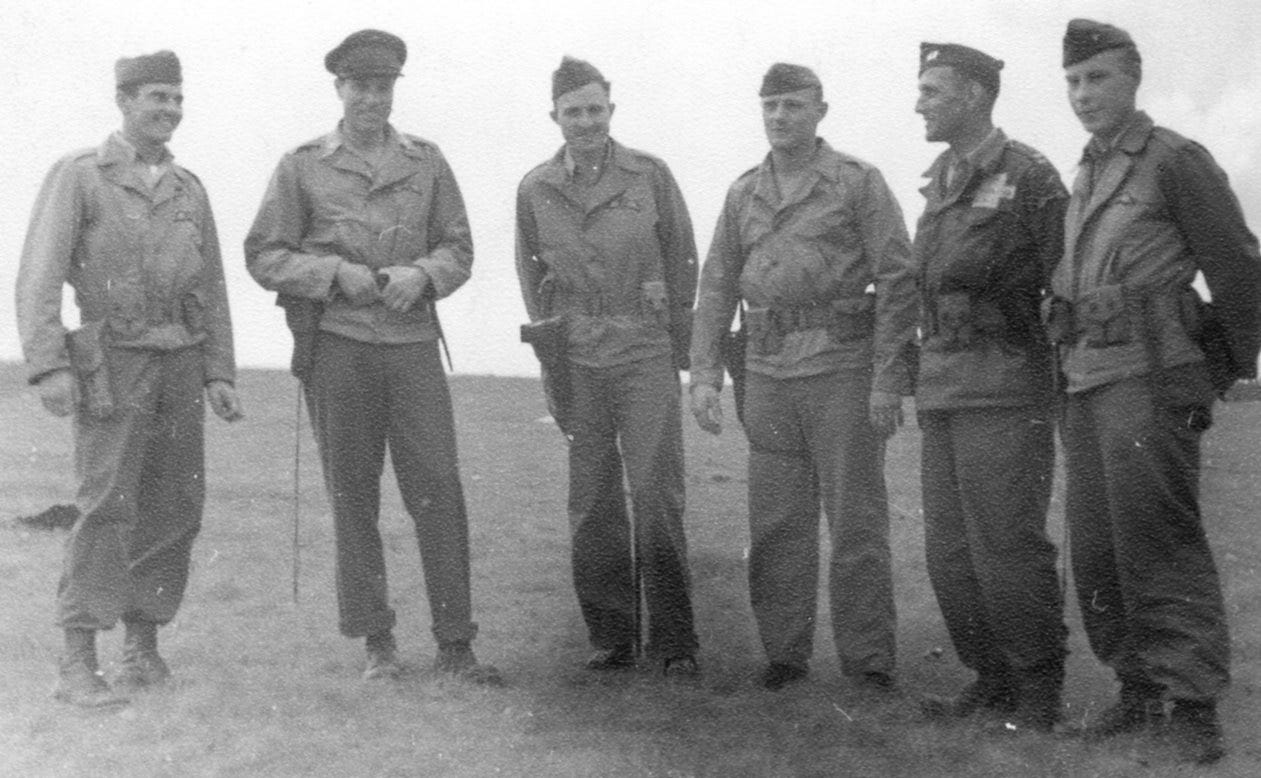
Peter J. Ortiz was one of those people. The more one learns about him, the less he resembles a conventional military hero. He was too cosmopolitan to fit comfortably into any one nation, too independent to become a successful bureaucrat, too restless to thrive in peacetime. Yet when the circumstances were exactly right—when occupied France needed a man who could disappear into another culture, improvise under impossible conditions, and inspire confidence simply by appearing—there may have been no one better suited to the task.
Studying institutional history in the 21st century seems at best old-fashioned, because in an age of hyper individualism institutions seem old-fashioned. (But we will miss them when they are gone.) Part of institutional history should be a reminder that they succeed because they find a place for remarkable eccentrics.
Throughlines
One of the most striking observations Nicholas Reynolds makes during our conversation is that Peter J. Ortiz was what today might be called a “third-culture” individual. He belonged completely to no single country. Born into a family divided between Europe and America, educated in France, forged in the French Foreign Legion, yet deeply committed to being an American, Ortiz possessed exactly the sort of divided identity that usually makes bureaucracies nervous. But when the Second World War came it also made him indispensable.
Modern states like clear categories. Soldier or civilian. American or Frenchman. Intelligence officer or commando. Ortiz was all of these at once. He could move through occupied France not simply because he spoke flawless French, but because he understood France instinctively. He knew its manners, its rhythms, its assumptions. He did not merely imitate another culture, he inhabited it, a skill that cannot be taught.
It is tempting to think that history is shaped primarily by institutions: armies, governments, intelligence services, political parties. Certainly they matter. But institutions regularly encounter problems for which their standard procedures are inadequate. At such moments they depend upon individuals who do not quite fit their own organizational logic.
Ortiz had spent years acquiring precisely the experiences no planner would ever have designed. He had run away to the French Foreign Legion, fought brutal colonial wars in North Africa, driven armored cars across deserts, learned to parachute, escaped German captivity, wandered across occupied Europe, and somehow found his way back to America where he rode horses on a dude ranch, drove race cars, tamed lions, and parachuted at air shows. None of these experiences followed a sensible career path. Collectively, however, they created the perfect operative for a very peculiar war.
The conversation also raises a question about organizations themselves. The Marine Corps recognized Ortiz’s extraordinary abilities almost immediately. The Office of Strategic Services understood even better how to employ them. Both organizations, at their wartime peak, proved remarkably flexible. Rather than forcing Ortiz into a conventional mold, they built missions around what he uniquely could accomplish. That willingness to accommodate unusual talent may itself be one of the hidden strengths of successful institutions. Great organizations are not merely disciplined, but are capable of recognizing exceptions.
The irony is that the very qualities which make someone invaluable in wartime often become liabilities in peace. Ortiz himself understood this. After the war he declined a regular Marine commission, observing that he simply was not made for peacetime soldiering. Morning formations, inspections, routine administration—these were not failures of discipline. They were essential parts of maintaining a professional military, but they were not what Ortiz had been built to do.
His postwar life carries a quiet sadness. Like many men whose gifts emerge most clearly under extraordinary circumstances, he struggled to discover an equivalent purpose once those circumstances disappeared. His body, already battered by wounds and imprisonment, no longer allowed him to seek fresh adventures. Hollywood found occasional use for him, but bit parts and consulting gigs could hardly provide the sense of necessity that had defined his wartime service.
Toward the end of our conversation, we found ourselves talking less about Peter Ortiz than about a broader human problem. Every profession contains people who seem oddly placed during ordinary times but become indispensable during moments of crisis. They are rarely the easiest colleagues, they seldom flourish inside normal bureaucratic structures, and they can even seem like dangerous misfits.
Yet history repeatedly demonstrates that civilizations ignore such people at their peril. Perhaps that is another reason—not just the incredible adventures—that stories like Ortiz’s continue to fascinate. They remind us that excellence is not always orderly. Some individuals spend their lives searching for the challenge that finally matches the peculiar shape of their abilities. Peter Ortiz had the great good fortune to find his. The tragedy is that human history so often provides those opportunities amidst terrible violence.
Questions for Reflection
Why do some of history’s most effective leaders seem uncomfortable within ordinary institutions?
How can qualities that appear eccentric in peacetime become indispensable during war or crisis?
How much of Ortiz’s effectiveness came from his learned skills, and how much from his unusual upbringing—or just the way that he was?
Are organizations better served by enforcing uniformity or by making room for exceptional individuals? How can they do both?
Why do military institutions often produce figures whose greatest difficulties begin after peace returns?
What distinguishes courage from recklessness, and where did Ortiz stand on that spectrum?
How important is cultural fluency—not merely language—in intelligence and diplomacy?
Why do societies remember some wartime heroes while allowing others to fade almost completely from public memory?
What kinds of talents does modern society fail to recognize because they do not fit conventional career paths?
Is history made more often by institutions—or by the rare people who operate just beyond their boundaries?
For Further Investigation
Nicholas Reynolds and Katie Sanders, Ortiz’s War: The Allies’ Secret Weapon Against the Nazis in France (Harper Horizon, 2026)
Nicholas Reynolds, Need to Know: World War II and the Rise of American Intelligence – How Churchill Built the CIA and Modern Spy Operations from Nothing (Mariner Books, 2022)
Ben Jones, Eisenhower’s Guerrillas: The Jedburghs, the Maquis, and the Liberation of France (Oxford University Press, 2016)
Douglas Waller, Wild Bill Donovan: The Spymaster Who Created the OSS and Modern American Espionage (Free Press, 2012)
Douglas Porch, The French Foreign Legion: A Complete History of the Legendary Fighting Force (Skyhorse, 2010)
—, The Conquest of Morocco: A History (Farrar, Strauss, and Giroux, 2005)
—, Defeat and Division: France at War, 1939-1942 (Cambridge University Press, 2022)
Related Episodes
Trojan War: Odysseus and Peter J. Ortiz might have had a lot to talk about
Agent Zo: Clare Mulley on Elżbieta Zawacka, a Heroine of Poland’s Resistance against Nazis and Soviets.
Eisenhower’s Guerillas: Ben Jones on the Jedburgh teams and the liberation of France