

Hello!
It’s chastening when you come to the realization that, as much as you try to do different conversations about different things, it’s all really autobiographical. This might be because, I don’t know, of a map or a picture that you saw in a National Geographic when you were five. But the seed was planted, and then fifty years later it sprouts.
But this autobiographical much more clear about the things that I hoover up for Notanda. Some of them are of course reminders of previous conversations. But others are connected to something I am or have been interested in, and I am continually reflecting that they make a curious miscellany.
Take the first two items below. When I was an undergraduate in the Department of History at Johns Hopins, the presence of Fernand Braudel was very much present—even though he had never taught there, and was indeed already dead for some years. Two of my favorite professors—and the greatest influences on me, I think—were Robert Forster and Orest Ranum, and they had translated Braudel and past issues of the Annales. I didn’t realize it, but when Forster taught “History III” as we called it, the first two weeks were very Annales, poured at cask-strength. While I am not now a historical materialist of the kind that I was, I am very grateful for that formation.
Fernand Braudel is thereby connected to the oyster. I grew up on the shores of the Delaware Bay, and while unlike Braudel the oyster is not extinct, when I arrived it was not what it had been. Old men told me stories of the bay being covered with the sails of oyster boats, not that many decades before. But by the time I went off to college, no one could make a living anymore as an oysterman. That cultural and social cataclysm, for small villages and communities along the Delaware and the Chesapeake, was as the article below makes clear the aftershock of an environmental cataclysm for those ecosystems.
And now the links…
Curiosities & Essays
The Historian Who Sought the Perspective of ‘God the Father’
In May 1967 I met Fernand Braudel for the first time. At the end of my ‘audience’ I asked him what constituted the greatest asset for a historian. I expected something along the lines of Leopold von Ranke’s famous formulation (‘Good history requires three things: critical use of the material, insight into how things happen, and good fortune in describing them’). Braudel disagreed. He answered my question without hesitation: ‘imagination’. It was Braudel’s imagination that made him the 20th century’s greatest Western historian.
The Chesapeake Bay—the largest estuary in the continental United States—used to be packed with oysters, more than anyone today might imagine. Native Americans had been harvesting oysters there for more than 12,000 years before the arrival of Europeans, as evidenced by piles of discarded shells left behind in trash pits. In the late 1800s, annual harvests from the bay—by then dominated by people of European descent—peaked at an estimated 600 million to 1,200 million pounds.
Technologies
The Boring Part of Bell Labs: How Bell Labs supported itself between moonshots

The Boring Part of Developing the Airplane: The Wright Brothers, Back in Ohio
The Outer Banks of North Carolina might have been the place that the Wrights flew their first airplane, but it was not the place they perfected it. That they did on a tract of prairie outside their native Dayton, Ohio.
In a 1906 statement to the Aero Club of America, they described how at Kitty Hawk, their “man-carrying motor flyer…sustained itself in the air for 59 seconds,” flying just 852 feet. This wasn’t enough for the inventors. “From the beginning,” they wrote, “the prime object was to devise a machine of practical utility, rather than a useless and extravagant toy.”
And that meant flying one prototype, and then the next, until one day their log would note the reason for ending a flight as “exhaustion of fuel”. Boring glorious success.
The Overly Thrilling Days of Balloon Ascents
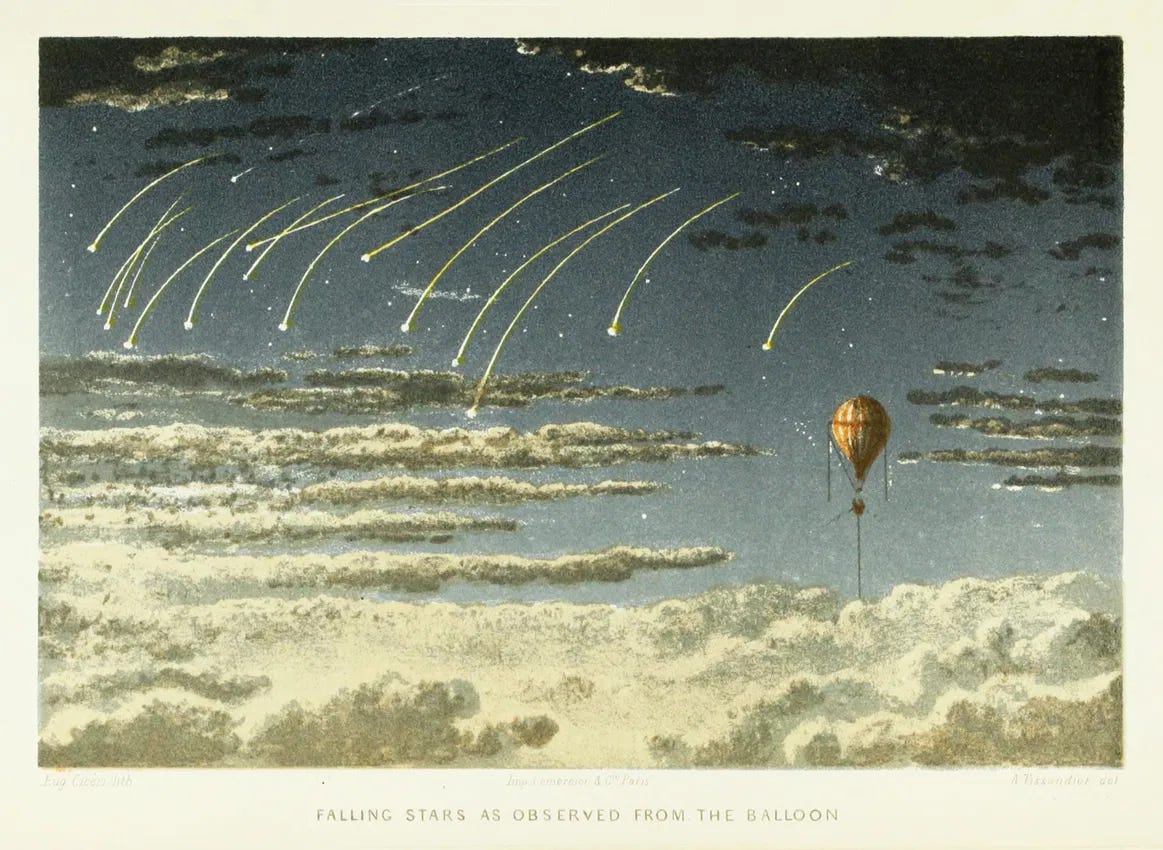
On a seaside holiday at Calais with his family in August 1869, French chemist and meteorologist Gaston Tissandier chanced to see a poster advertising a balloon launch from the central square the next day, as part of festivities celebrating Emperor Napoleon III. Going straight to the aeronaut’s hotel, he talked himself onto the voyage. Undaunted by wild nightmares of bursting balloons, his family’s strident pleas not to risk his life, and the blinding storm battering the coast, Tissandier arrived at the launch site at dawn, equipped only with life vests purchased from the Calais Humane Society.
From the wonderful site. Tissandier’s illustrations of flights in the balloon, like the one at the top of this Notanda, are marvelous.
Higher Ed: A Guide for the Perplexed (con’t)
You’re Not Wrong: The Kids Really Are Working Less…
Using multiple data sets from different time periods, we document declines in academic time investment by full-time college students in the United States between 1961 and 2003. Full-time students allocated 40 hours per week toward class and studying in 1961, whereas by 2003, they were investing about 27 hours per week. Declines were extremely broad based and are not easily accounted for by framing effects, work or major choices, or compositional changes in students or schools. We conclude that there have been substantial changes over time in the quantity or manner of human capital production on college campuses.
…But It’s Not Their Fault; They’re Rational Actors After All
I am deeply chagrined that I was until two days ago unaware of this website. Fascinating stuff.
This web site began as the data link to an op-ed piece I wrote on grade inflation for the Washington Post, Where All Grades Are Above Average, back in January 2003. In the process of writing that article, I collected data on trends in grading from about 30 colleges and universities. I found that grade inflation, while waning beginning in the mid-1970s, resurfaced in the mid-1980s. The rise continued unabated at almost every school for which data were available. By March 2003, I had collected data on grades from over 80 schools. Then I stopped collecting data until December 2008, when I thought it was a good time for a new assessment. At that time, I started working with Chris Healy from Furman University. We collected data from over 170 schools, updated this website, wrote a research paper, collected more data the following year and wrote another research paper.
Winner of This Month’s Perfect Opening Line Contest:
“After three years of doing essentially nothing to address the rise of generative AI, colleges are now scrambling to do too much.”
Speaking of AI: Beware the Prompts in the Essay That You Fed into AI Without First Reading
Because they know that Professor does that, and they are prepared to use it against you, and you probably deserve it
Private New England Colleges Standing on the Brink: First they came for Goddard College, but I did not care, because I had never worn Birkenstocks. Then they came for Eastern Nazarene, but I did not care, because I was not a Nazarene. And then they came for…
(Possible) Episode Previews
Carthage is More Than Just the Anti-Rome
What comes to mind today when we think of ancient Carthage are the great general Hannibal and his elephants who crossed the Alps, or Dido, the mythical founder of the city from the Phoenician city of Tyre. These stories dominate how we remember Carthage and the Carthaginians and are Roman memories that have persisted through the millennia. The very first Latin language histories and epics were written about the Punic Wars in the 3rd and 2nd centuries BC making the wars with Carthage foundational in the develop of Latin literature.
…Was Plato really hostile to poets? Or did he, rather, insist on the crucial importance of poetry—imaginative, emotionally evocative, and able to provide access to cognitive powers otherwise unavailable—to almost every subject he placed before us?
Essay–Episode Callbacks
Francis J. Gavin, “Wonder and worry: dealing with uncertainty in contemporary history” Engelsberg Ideas
“Thinking Historically”—with Francis J. Gavin
“Cold War Analogies”—with Francis J. Gavin
Johanna Winant, “The Claims of Close Reading: Literary studies have been starved by austerity, but their core methodology remains radical”, Boston Review
“Think More Like Shakespeare”—with Scott Newstok, who gets a brief mention in Winant’s article
“Academic Perfectionism, Psychological Well-Being, and Suicidal Ideation in College Students”
High levels of perfectionism in college students can compromise their academic performance and psychological well-being. This study aims to analyze the implication of perfectionism in psychological well-being and suicidal ideation in the last year. A total of 1.287 students from different degrees reported their academic performance in the previous academic year and completed questionnaires on academic perfectionism, psychological well-being, and suicidal thoughts in the last year. In both men and women, academic perfectionism correlates positively with academic performance and negatively with the different dimensions of psychological well-being.
“The Achievement Culture”—with Joseph Davis
Warmly,
Al Zambone
Historian, host of Historically Thinking