

Why This Conversation Matters
Most Americans encounter the Declaration of Independence as text. We memorize lines from it. We quote it. We argue about it.
But ideas are strangely fragile. They often survive because they become attached to places, objects, rituals, and memories.
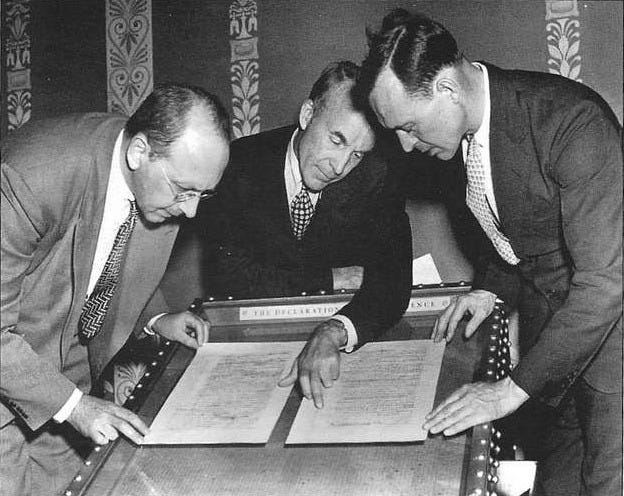
Michael Auslin’s book explores the unusual fact that the Declaration became not only a statement of principles but also a national relic. Americans preserved it, displayed it, celebrated it, and protected it. In doing so, they transformed a political document into a physical embodiment of the republic itself.
Throughlines
The conversation begins with a deceptively simple question: why does the Declaration still exist? Standing before the document in the National Archives, Michael Auslin realized that historians had paid immense attention to the Declaration’s ideas while largely neglecting the story of the document itself. Yet the two histories quickly prove inseparable. The Declaration survives because generations of Americans believed it mattered. And because it survived, later generations were able to invest it with new meanings.
The discussion then turns to the drafting process. Jefferson’s role was important, but the Declaration emerged from collaboration and revision. Congress edited it heavily, and those edits may have improved it. The resulting document was not simply Jefferson’s creation but an expression of what he called “the American mind.” The Declaration succeeded precisely because it gathered together ideas that many colonists already recognized.
From there the conversation follows the document’s transformation into print. The Dunlap broadsides spread the Declaration throughout the states, but surprisingly little attention was initially paid to the engrossed parchment itself. During the Revolution the document functioned primarily as an instrument announcing independence rather than as a sacred object. Its later status as a national treasure was not inevitable.
A major turning point came after the War of 1812. News that the Declaration had been saved from the burning of Washington generated public fascination. Americans who had long known the words suddenly became interested in the document itself. Reproductions, engravings, biographies of the signers, and public displays helped create a new relationship between citizens and the Declaration.
The conversation also highlights John Quincy Adams’s role in transforming the Declaration’s meaning. Adams linked it directly to the Constitution and to the broader American political experiment. In doing so, he helped lay the groundwork for later interpretations by reformers of all kinds. The Declaration became more than a justification for independence; it became a statement about the nature of American government and citizenship. Soon it became a template for other declarations, such as those for the rights of women and for alcoholic temperance.
The Civil War reveals how powerful that transformation had become. Lincoln viewed the Declaration as the moral center of the republic, while Confederate thinkers increasingly sought to challenge its claims but at the same time use it as a validation for their own declaration of independence from the union. The struggle over the meaning of liberty and equality became inseparable from the struggle over the nation’s future.
The final sections of the conversation examine the twentieth century. Immigration, the Cold War, and the Civil Rights Movement all gave the Declaration renewed significance. Political leaders, civil rights activists, and ordinary Americans repeatedly returned to it as a source of legitimacy and aspiration. The Declaration’s words mattered. But so did the continued existence of the parchment itself. Americans could visit it, view it, and imagine a direct connection to the founding generation.
The conversation closes with a striking observation. Had the document been destroyed, Americans would still have possessed its words. Yet something important would have been lost. The Declaration survives not merely as text but as a tangible link between generations—a national relic that helps make abstract principles feel real.
Questions for Reflection and Discussion
Why do physical artifacts matter in the preservation of ideas?
Did Congress improve Jefferson’s draft?
Why did Americans largely ignore the Declaration after independence?
What changed after the War of 1812?
Why were the signatures so important to later Americans?
How did John Quincy Adams reinterpret the Declaration?
Why did Lincoln place such emphasis on it?
Is the Declaration primarily a liberty document or an equality document? Or is that the wrong question to ask?
What role did it play in the Civil Rights Movement? What else was happening to the document at the time?
What would have been lost if the parchment itself had disappeared?
For Further Investigation
Books
Michael Auslin, National Treasure: How the Declaration of Independence Made America (Simon and Schuster, 2026)
Pauline Maier, American Scripture: Making the Declaration of Independence (Vintage, 1998)
Garry Wills, Inventing America: Jefferson’s Declaration of Independence (Knopf Doubleday, 2018)
Carl Becker, The Declaration of Independence: A Study in the History of Political Ideas
David Armitage, The Declaration of Independence: A Global History (Harvard, 2008)
Primary Sources
John Quincy Adams, “An Address…Celebrating the Declaration of Independence,” July 4, 1821 (TAH)
Abraham Lincoln, “Fragment on the Constitution and Union”
—, “Address at Independence Hall,” February 22, 1861
—, “Gettysburg Address”, November 19, 1864
Martin Luther King Jr., “Letter from Birmingham Jail” (University of Alabama Libraries)
Related Episodes
Civic Bargain: Brook Manville and Josiah Ober on democracy, self-rule, and civic renewal
Remaking American Citizenship: Christopher Bonner on Black Americans and democratic identity
Civil War Politics: Paul Escott on political traditions in crisis
The Great Atlantic Freedom Conspiracy: Micah Alpaugh on revolutionary tactics and adaptations in the Atlantic World