

Why This Conversation Matters
We know a great deal about how books are written, printed, and read. We know far less about the commercial machinery connecting those activities: the sellers, hawkers, subscription agents, lending libraries, department stores, mail-order firms, and bookshops that placed books in readers’ hands.
That missing history raises some revealing questions. Who assumed the financial risk of publishing a book? How did books reach people who lived far from a shop—or who found shops expensive and intimidating? And why has the printed book managed to survive every new technology once expected to destroy it? Andrew Pettegree’s history of bookselling suggests that while the book’s physical form has been remarkably durable, the ways in which books find their readers have been anything but.
Throughlines
Pettegree begins with a problem of visibility. Authors, printers, and publishers commonly announced themselves on title pages and in colophons. Booksellers were often less visible. Their names may survive only in business records, parish registers, legal proceedings, or inventories. Historians therefore inherited a documentary landscape that encouraged them to study production and reading while overlooking the transactions that joined the two.
Before printing, manuscript books were usually produced through individual commissions. Someone wanted a particular text and paid a scribe to make it. Printing introduced a fundamentally different problem: hundreds of copies could be produced before anyone knew whether hundreds of customers existed. The new technology therefore required new forms of speculation, credit, distribution, and salesmanship.
The boundaries between the different parts of the trade were fluid. A publisher might finance an edition, a printer manufacture it, and a bookseller distribute it—but one person could perform two or all three of those roles. Publishing and bookselling remained closely intertwined well into the modern period. Indeed, the notion of a neatly divided industry, with publishers producing books and independent retailers selling them, represents only one phase in a much longer history.
For its first decades, printing was surprisingly conservative. Printers reproduced the kinds of books already familiar from manuscript culture and often imitated their appearance. One of the genuinely transformative innovations was not the press itself but the title page, which provided a book with an identity that could be recognized, described, advertised, and sold.
The Reformation revealed what the new medium could do. Martin Luther wrote short, timely works in the vernacular, responding rapidly to unfolding controversies. Demand encouraged printers to produce editions in extraordinary numbers. Luther’s opponents replied, generating still more publications. Printers and sellers might have religious convictions, but controversy also made excellent business. The market rewarded speed, accessibility, and arguments.
Censorship followed the books into the marketplace. Yet booksellers could be difficult to hold responsible for everything they stocked. They might sell new books alongside secondhand ones, acquire mixed lots, or handle works they had never read. Official inventories rarely captured the whole truth. Forbidden theology, political controversy, pornography, and other illicit works continued to circulate because customers wanted them—and because someone could usually be found to supply them.
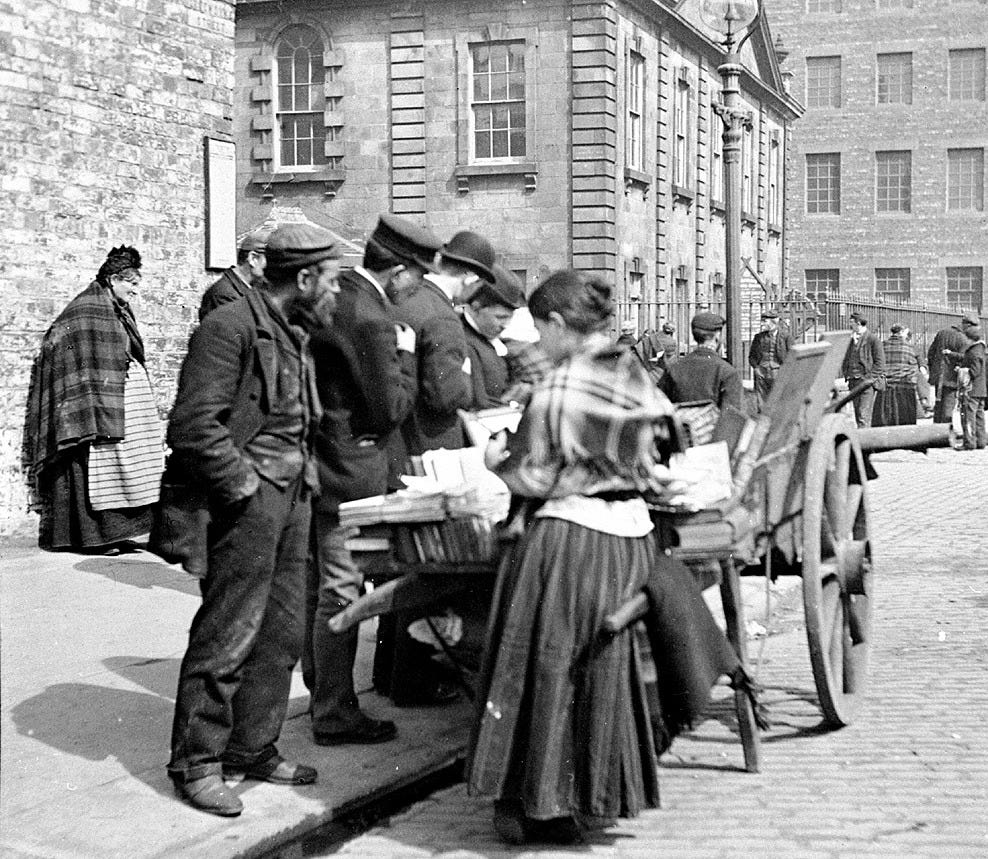
Nor did bookselling necessarily occur in the spacious, carefully arranged shops familiar today. Early sellers might occupy small stalls or lean-tos near churches and other centers of urban traffic. Such places served a relatively narrow and prosperous public. Itinerant vendors carried print much farther. Hawkers, chapmen, and ballad sellers transported pamphlets, songs, almanacs, and books into neighborhoods, villages, and towns unable to support permanent shops. Authorities sometimes treated them as vagrants; communities without other access to print could regard them rather differently.
In the early United States, books were often sold through general stores or by traveling agents. Mason Locke Weems—“Parson Weems,” later famous for popularizing the story of George Washington and the cherry tree—combined the roles of clergyman, author, publisher’s representative, and itinerant bookseller. He traveled for the Philadelphia publisher Matthew Carey, taking orders and sometimes playing the fiddle to attract an audience. The respectable author and the energetic salesman were one and the same person.
By the eighteenth and nineteenth centuries, bookshops had multiplied, although many remained small. Newspaper advertisements, auctions, trade directories, subscription libraries, and circulating libraries made books increasingly visible. Subscription libraries generally pooled the resources of members to build collections. Circulating libraries rented books as a commercial enterprise and became particularly important to the market for fiction. Many bookshops also operated lending services; the boundaries between selling and lending were as permeable as those between publishing and bookselling.
Industrialization altered the trade, although not always in the expected ways. Railways and steamships initially mattered more than the steam-powered press because they carried books farther and faster. In the United States, presses and newspapers became markers of westward settlement, while the postal system connected publishers to readers far from urban shops.
Few enterprises used that system more effectively than Emanuel Haldeman-Julius’s Little Blue Books. Produced in Girard, Kansas, these tiny, inexpensive volumes offered literature, political argument, practical advice, discussions of sexuality, and other subjects to workers and travelers. Titles were dropped when sales faltered, and ultimately hundreds of millions of copies circulated. Their success joined mass production to the postal service and demonstrated that a major publishing enterprise did not have to be located in New York, London, or another traditional center of the trade.
Other innovations were equally important: schoolbook contracts, department-store book departments, mail-order sets, and schemes such as the Harvard Classics “Five-Foot Shelf.” These were not new literary forms, but new ways of packaging, pricing, and selling books.
The paperback revolution of the 1930s was another change in commerce disguised as a change in format (books without covers had existed nearly since the beginning of printing). Cheap, well-designed editions from firms such as Penguin and Pocket Books made new writing available at a fraction of the price of a hardback. Established publishers could have resisted, but many chose to participate. Wartime reading and paper rationing further enlarged the paperback’s audience.
Electronic books and audiobooks belong to this same history of shifting delivery systems. Pettegree’s long view makes him skeptical of predictions that one medium will simply extinguish another. Manuscripts survived printing. Conversation survived writing. Printed books survived newspapers, cinema, radio, television, the CD-ROM, the Kindle, and online retail.
The book has proved durable partly because the codex is an extraordinarily effective technology: portable, browsable, resilient, and requiring neither power nor a software update. But the book’s survival has never depended on its form, but on constant innovation in the ways books are financed, promoted, transported, displayed, lent, and sold. The history of bookselling is therefore not peripheral to the history of the book. It is the history of how an available text finds a reader.
Questions for Reflection and Discussion
How has the information preserved on title pages shaped the history that historians have written about books?
Why did the transition from commissioned manuscripts to speculative printing require an entirely new commercial system?
What made Luther’s short, timely vernacular works so important to the development of the print market?
How did the overlapping roles of printer, publisher, and bookseller affect the circulation of controversial ideas?
What could itinerant booksellers do that permanent bookshops could not?
How did circulating libraries change both the audience for books and the kinds of books publishers produced?
What does the history of secondhand books reveal about the relationship between income, education, and reading?
Why were railways, steamships, and the postal service as important to the history of print as changes in printing technology?
What made the Little Blue Books possible, and what did their success reveal about neglected readers?
Was the paperback revolution primarily a technological innovation, a commercial innovation, or a cultural one?
Why do predictions of the printed book’s disappearance recur—and why have they repeatedly proved premature?
For Further Investigation
Books
Andrew Pettegree, The Bookshop: A History of Bookselling from the Dawn of Print to the Twenty-First Century (Basic Books, 2026)
—, The Book in the Renaissance (Yale University Press, 2010).
—, The Book at War: How Reading Shaped Conflict and Conflict Shaped Reading (Basic Books, 2023).
Andrew Pettegree and Arthur der Weduwen, The Bookshop of the World: Making and Trading Books in the Dutch Golden Age (Yale University Press, 2019).
Andrew Pettegree and Arthur der Weduwen, The Library: A Fragile History (Basic Books, 2021)
James Raven, The Business of Books: Booksellers and the English Book Trade, 1450–1850 (Yale, 2007)
Jonathan Rose, The Intellectual Life of the British Working Classes. Third Edition (Yale, 2021)
Laura J. Miller, Reluctant Capitalists: Bookselling and the Culture of Consumption (University of Chicago Press, 2006)
Jeff Deutsch, In Praise of Good Bookstores (Princeton University Press, 2022)
Beth Barton Schweiger, A Literate South: Reading Before Emancipation (Yale, 2019)
Primary Sources and Digital Collections
Universal Short Title Catalogue — a freely accessible record of editions printed between 1450 and 1700 and the surviving copies located around the world.
“The Little Blue Books,” University of Kansas Libraries — an introduction to Haldeman-Julius’s extraordinary publishing enterprise.
Mason Locke Weems, George Washington’s Mount Vernon — a concise account of the author, itinerant bookseller, and creator of the cherry-tree story.
Related Episodes
In Praise of Good Bookstores: Jeff Deutsch on the past, present, and future of bookstores
Tags: history of the book; bookselling; bookshops; publishing; printing; reading; Andrew Pettegree; Reformation; circulating libraries; Little Blue Books; paperbacks; digital media