

It’s already April but I still find myself occasionally thinking about my conversation in December with Lindsay Regele about Joel Poinsett, and some of you have told me that you’ve done the same. My thinking basically turns around Poinsett’s status as the consummate outsider—and how outsiders like him are necessary in any institution or organization, but how rarely they have ascended the heights of American political culture that Poinsett did.
My thoughts are mingled with some embarrassment at how I’ve been ignorant of his story. While I knew a little about Poinsett, that was mostly about his role as one of Tocqueville’s informants—which turns out to be one of the smaller episodes of his life. I had no idea at all about this first thirty years, and how un-American he literally was—certainly how un-Carolinian.
Poinsett’s family—and I don’t think I can emphasize this strongly enough—were on the losing side of the American Revolution. You do not leave Charleston and go live in England for seven or eight years if you were on the winning side. You do not do it even if you are a neutral, if there were any left in Charleston by 1782. The only reason that you leave Charleston for England, and stay there for nearly a decade, is if you fear the consequences of what will happen to you when the rebel army and government finally reenter Charleston.
The return of the Poinsett’s to America highlights one of the curious dynamics of the American Revolution and post-Revolution era. For some decades there has been a stronger emphasis on the violence of the American Revolution, and that it was a civil war. This has been a necessary correction to the historiography.
But often in trawls through the archives, looking for something else, I come across indications that the story is even more complicated than that. The Poinsett family’s experience demonstrates that. Had South Carolinian revolutionaries been Jacobins or Bolsheviks, they would certainly have seized and redistributed Poinsett property in their absence—and indeed they did seize the property of prominent Loyalists. But the Poinsetts held on to it, somehow, and the leases on their Charleston properties allowed young Joel to become a young gentleman of leisure. Because they held on to that property he was able do do things like study medicine in Edinburgh, spend time in Paris, relax in Switzerland, and do absolutely mad things like travel down the Volga to the Caspian Sea. The Poinsett experience proves that Loyalists could go home again, and I suspect that was a small but important current of life in the early American republic. Jeffersonians always claimed that Federalists had at their heart a coterie of former Loyalists, and the Poinsetts provide a point on the graph in the Jeffersonians’ support.
The next thing that sticks with me about Poinsett is the he was always and everywhere an outsider. In the first part of his life he was an American boy in England. Coming briefly back to South Carolina as a boy, he must have seemed thoroughly English to those who met him. And, whatever his accent was when he attended school in New England, or whether they saw him as English or Carolinian, he remained an outsider there. He was certainly no Yankee. Yet during his travels through Europe part of his charm to Europeans must have been that he was American—an American who could speak fluent French, and been educated in Britain. But what did being American mean to Joel Poinsett at that moment?
When he returned to South Carolina he was cosmopolitan and traveled in a way that most Americans could not afford to be, not even wealthy ones. Yet that does not seem to have hurt him. Quite the contrary. He must have succeeded in his initial forays into South Carolina politics because the South Carolina elite were impressed by his travels and experiences, rather than intimidated by them. Decades later the South Carolina elite were very proud of J. Johnston Petigrew’s book about his travels in Spain—if Pettigrew could milk a book out of a summer vacation to Spain, imagine what Poinsett could have produced from travels that ranged from Persia to Chile. But book or not, he had seen things that no American ever had; so that experience must have given him an entree into respectable Carolina politics.
Yet, because he was still an outsider, once he was in politics he had no base on which to build his power and ascent. When he did that, he did it because he was still an outsider, the most prominent of the South Carolina minority who were opposed to nullification and the confrontation with the Federal government. Poinsett might be hated by the majority, he might only be leader of a minority, but at least it was some sort of base—even though, by that choice of his, he had “outsider” practically burned onto his forehead.
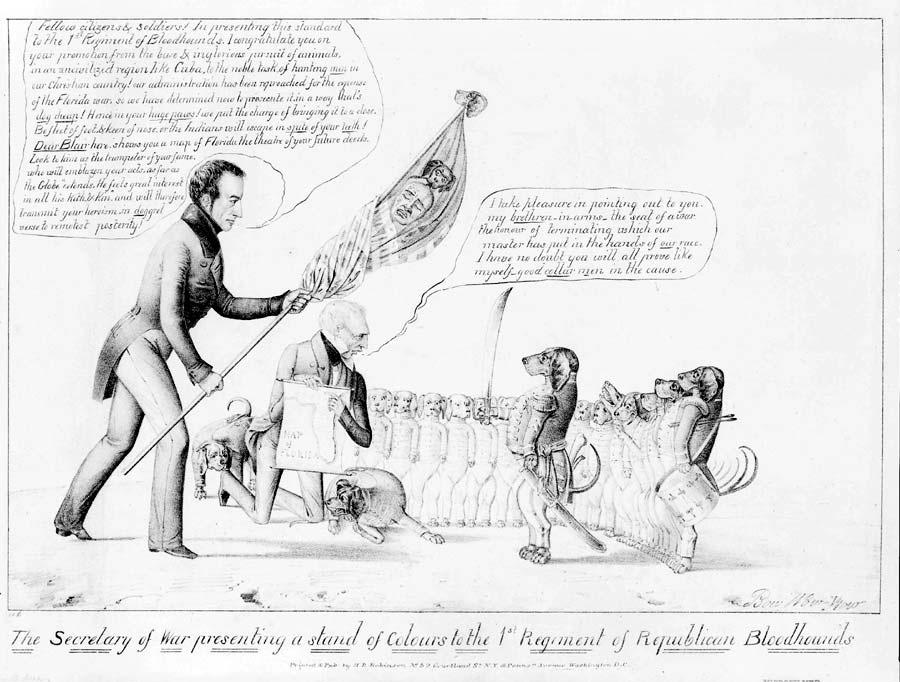
That political base might not give him power in South Carolina, but it gave him national prominence and signified his political benefit to the Democratic Party. Hence he was a logical selection to be Secretary of War in Martin van Buren’s administration. He was not the only Southerner in van Buren’s cabinet—there were two Kentuckians in the cabinet, as well as a Georgian. Yet among that group Poinsett must still have seemed an outsider, a recent convert to the Jacksonian faith with suspiciously stronger Federalist attachments than any other member of the cabinet. I wonder if any of them knew about the Poinsett family’s sojourn in Britain, or when it began.
Other men have come to America as immigrants and rose to positions of power—Albert Gallatin, Secretary of the Treasury for Jefferson and Madison was in his 20s when he wound up in southwest Pennsylvania and became a local politician. Carl Schurz was a German ’48-er who was in turn a Union general, Senator from Missouri, and Secretary of the Interior.
But Poinsett was not really an immigrant. He was perhaps more like William Short, the Virginian diplomat, protege of Jefferson, who spent exciting decades in Europe and yet never seemed to find his place in the United States when he returned. Or Henry Adams, who enjoyed (as much as he enjoyed anything) his times sojourning in Europe, or in Japan, and seemed to return and dwell in the United States as a kind of grim duty to the shades of his forbears.
But Poinsett was not like them, either. He was a man who was unquestionably one of the most cosmopolitan Americans of his age, yet when he returned to America he fought with great and protracted determination to establish his place in South Carolina and the United States. In doing so he became a (sort of) nationalist, an advocate of the American Union against regional particularity. I can think of no other public personality in American history quite like him. And I have been trying to since December.
For Further Reading
Lindsay Schakenbach Regele, Flowers, Guns, and Money: Joel Roberts Poinsett and the Paradoxes of American Patriotism (University of Chicago Press, 2023)