

Why This Conversation Matters
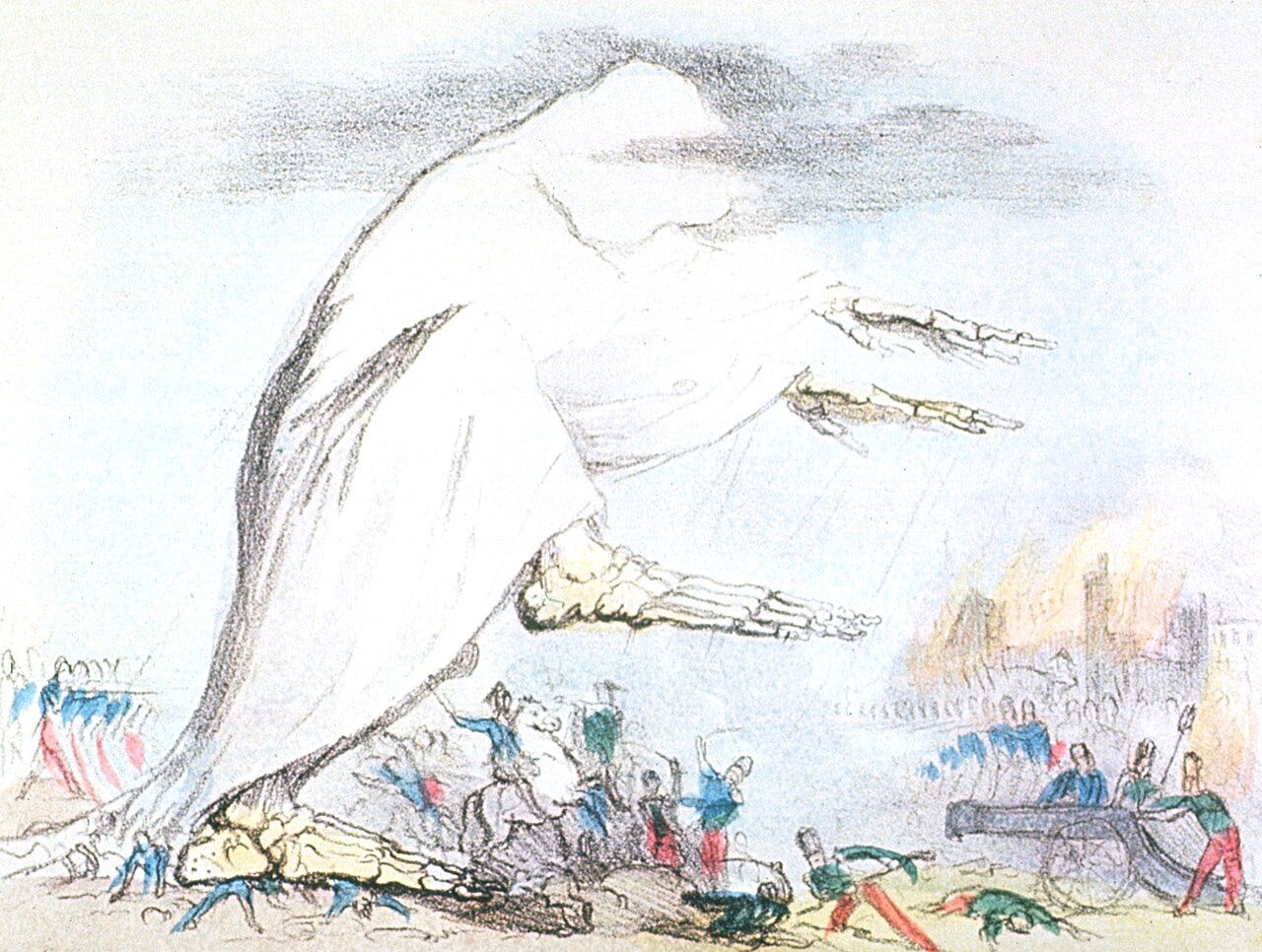
When cholera reached North America in 1832, Americans did not understand what caused it. They could see where it appeared and whom it killed, but they could not see the bacterium moving through contaminated water.
Medical uncertainty did not produce social humility. Instead, it encouraged moral certainty. Cholera became evidence of intemperance, bad food, personal filth, racial inferiority, immigrant degeneracy, or an inability to live independently. These explanations reassured respectable Americans that the disease belonged primarily to other people.
Yet the epidemic followed waterways, migration routes, prisons, poorhouses, military deployments, the internal slave trade, and Indian Removal. It revealed that vulnerability to disease was created not only by biology, but also by political and economic power.
Throughlines
In 1832, “cholera” was not yet the name of one clearly understood disease. It could refer generally to stomach distress and diarrhea. Physicians explained health through the balance of the body’s humors. Disease might arise when some outside influence disturbed that balance.
Two broad theories attempted to explain that outside influence. Contagionists believed that a poison could pass from one person to another, sometimes through clothing or goods. Supporters of the miasmatic theory blamed poisonous air rising from decaying vegetation, animal carcasses, manure, and other putrefying matter. These theories were not necessarily incompatible with humoral medicine: either contagion or miasma might throw the body out of balance.
Both explanations could point to supporting evidence. Cholera sometimes devastated entire families, and its progress from town to town suggested contagion. Yet it also skipped neighborhoods, spared physicians tending the sick, and struck some people while leaving their neighbors untouched. Bad-smelling districts suffered terribly, but not everyone living in them became ill. Cholera seemed to confirm and contradict every available theory.
Medicine and moral reform nevertheless converged upon an explanation. If health depended on maintaining bodily balance, then personal conduct could determine whether someone became sick. Alcohol received particular attention. Temperance reformers claimed that drink damaged the stomach and made the body susceptible to cholera. Some went further, describing the epidemic as providential assistance for the temperance cause, a divine scourge directed against the morally disordered.
This argument drew power from wider anxieties about Jacksonian America. The republic was becoming more urban, commercial, and unequal. Irish immigration was increasing, while a permanent wage-earning class seemed to challenge the expectation that white men would become independent property holders. Reformers could attribute these developments to alcohol and deficient self-discipline rather than to economic structures.
Such explanations expanded easily beyond the Irish working class. Enslaved people, free people of color, and Indigenous Americans could all be represented as dirty, intemperate, irresponsible, or incapable of caring for themselves. Cholera did not create these prejudices, but it benefited from the medical and providential vocabulary of these prejudices. The disease benefited from the culture.
An expanding newspaper system made cholera into a shared national and even international experience. Americans followed reports as the disease moved out of South Asia, moved into Russia, crossed Europe, and approached the Atlantic ports. News arrived before the contagion. Communities had time to form health boards, debate preventive measures, and become afraid.
When cholera appeared at Quebec and Montreal, Irish immigrants bore much of the mortality and much of the blame. The disease became associated with the immigrants carrying it, even though any traveler could spread it. Under miasmatic reasoning, the Irish body itself could be treated as a source of pollution—comparable, in the most dehumanizing accounts, to rotting matter.
As cholera approached New York, municipal authorities imposed quarantines, inspected travelers, increased policing, canceled the Fourth of July celebration, organized temporary hospitals, and issued advice on cleanliness, temperance, and diet. A society accustomed to relatively limited government quickly accepted extensive public-health powers. But it was a selective authoritarianism. Wealthier people could leave the city for country homes, relatives’ houses, or resorts. Poorer residents remained behind. Health officials emptied tenements, burned clothing, hurried bodies into graves, and confined suspected sufferers in hospitals, prisons, and poorhouses.
Those institutions became some of the epidemic’s deadliest locations. Philadelphia officials gathered vagrants into Arch Street Prison partly to remove them from public view. Cholera then spread through the crowded institution. Bellevue in New York, the Bergen County Poor House, and similar facilities in other cities experienced explosive outbreaks. Measures ostensibly intended to control disease concentrated vulnerable people where it could spread most efficiently.
The deaths of respectable people complicated the moral narrative. Evangelist Charles Grandison Finney nearly died and suffered for months from both the illness and its aggressive treatments. His friends in the Hinton family were virtually exterminated. New Jersey chief justice Charles Ewing died despite his youth, status, and apparent good health. Yet newspapers who were wedded to the humoral argument repeatedly found ways to preserve the moral explanation. Ewing’s death was attributed to eating green corn. Cheap fruits and vegetables associated with poorer consumers were often blamed. When cholera killed someone who did not fit the preferred profile, an imprudent meal could supply the missing moral failure.
In Virginia, cholera arrived during an especially tense period following Nat Turner’s rebellion and the debates over slavery that followed it. Norfolk, Richmond, and other communities suffered severe outbreaks, with enslaved people and free people of color frequently bearing disproportionate losses. But rather than weaken slavery’s defenders, the epidemic reinforced paternalism. White commentators argued that Black people were incapable of protecting themselves and therefore required the discipline and care supposedly provided by enslavement. Cholera became support for slavery because the system that increased vulnerability was represented as protection against it.
The disease also traveled through the internal slave trade. Enslaved people were transported from Baltimore, Richmond, and Norfolk toward the markets and plantations of the Lower South. Isaac Franklin, one of the nation’s most notorious traffickers, attempted to move captives to market before cholera reached them. When some died near Natchez, he buried them secretly at night to conceal the sickness from prospective buyers.
Forced movement also carried cholera westward through military operations and Indian Removal. Troops commanded by Winfield Scott suffered devastating losses while moving west during the Black Hawk War. Choctaw people driven through Memphis, Vicksburg, and Arkansas encountered the disease along the routes of removal. Hundreds died during what the Choctaws called the Trail of Tears and Death.
Here the epidemic intersected with two defining processes of Jacksonian America: the expansion of the internal slave trade and the forced displacement of Indigenous nations. Cholera did not move through an empty landscape. It moved through systems built to move laborers, soldiers, settlers, captives, and dispossessed peoples.
New Orleans experienced perhaps the most terrifying urban outbreak. Thousands may have died within a month from a population already diminished by seasonal flight from yellow fever. Corpses were reportedly thrown into the Mississippi, abandoned in houses and swamps, or buried in yards. The scale approached descriptions of medieval plague.
Nor did the danger disappear after one wave. Louisville, Cincinnati, New Orleans, and other river cities experienced repeated outbreaks between 1832 and 1836. Cholera faded in colder weather and returned with renewed travel and favorable conditions. The first crisis became a lingering presence.
We now know that cholera is caused by the bacterium Vibrio cholerae. When contaminated food or water carries the bacterium into the body, it releases a toxin in the intestine. The resulting loss of fluid produces vomiting, massive diarrhea, dehydration, spasms, blue skin, collapse, and death. Heavy rain could wash human waste from cesspools into wells and rivers. Cities with inadequate water systems were therefore especially vulnerable. Yet nineteenth-century observers did not possess germ theory, and the evidence available to them was inconsistent. People drinking from wells became ill; so did people drawing from rivers or supposedly modern water systems.
Some nevertheless suspected the water. A Black resident of Cincinnati named Henry warned people against drinking it. An Albany carriage maker assembled statistics suggesting that those using well water suffered disproportionate mortality. But both ideas were dismissed as ignorant or superstitious.
The history of cholera in Jacksonian America is therefore not a story in which foolish people failed to discover an obvious truth. The evidence was incomplete, theories could accommodate contradictory observations, and the actual mechanism was invisible. So Americans chose interpretations that flattered the respectable and condemned the vulnerable. Their explanations directed coercive power toward people already confined, exploited, enslaved, or displaced.
Questions for Reflection and Discussion
Why did medical uncertainty encourage moral certainty rather than humility? Or were people actually certain about their medical conclusions?
What evidence seemed to support contagion, and what evidence appeared to contradict it?
How did humoral medicine make personal behavior central to explanations of disease?
Why did temperance reform become so closely connected to the cholera epidemic?
How did newspapers create a shared experience of the pandemic before the disease reached many communities?
How did prisons, poorhouses, and temporary hospitals turn public-health policy into a mechanism for spreading disease?
What do attempts to explain Charles Ewing’s death through green corn reveal about the resilience of a preferred theory? Does that sound like something familiar?
How did cholera reinforce proslavery paternalism while also spreading through the internal slave trade?
What does the movement of cholera along the routes of Indian Removal reveal about the relationship between disease and state power?
When does an honest scientific mistake become a moral or political failure?
For Further Investigation
Paul Kelton, Hidden Terrors: The Scourge of Cholera in Jackson’s America (Oxford University Press, 2026).
—, Epidemics and Enslavement: Biological Catastrophe in the Native Southeast, 1492–1715 (University of Nebraska Press, 2007).
—, Cherokee Medicine, Colonial Germs: An Indigenous Nation’s Fight against Smallpox, 1518–1824 (University of Oklahoma Press, 2015).
Catherine M. Cameron, Paul Kelton, and Alan C. Swedlund, eds., Beyond Germs: Native Depopulation in North America (University of Arizona Press, 2015).
Charles E. Rosenberg, The Cholera Years: The United States in 1832, 1849, and 1866 (University of Chicago Press, 1987).
The National Library of Medicine’s Cholera Online, including maps of the epidemic’s routes and urban public-health infrastructure.
Related Episodes
The Great Shadow: Susan Wise Bauer on the ways sickness has shaped human belief, behavior, and social organization.
The Great Horse Flu: Thomas Andrews on contagion, transportation, animal labor, and the fragility of Reconstruction America.
Pox Romana: Colin Elliott on epidemic disease and the weaknesses it exposed within the Roman Empire.
Stolen: Richard Bell on the human-trafficking routes that connected northern cities to the slave markets of the Deep South.
Tags
Paul Kelton; Cholera; Epidemics; Pandemics; Jacksonian America; History of Medicine; Public Health; Temperance; Irish Immigration; Poverty; Incarceration; Slavery; Internal Slave Trade; Indian Removal; Indigenous History; New York City; Philadelphia; New Orleans; Historically Thinking