

Why This Conversation Matters
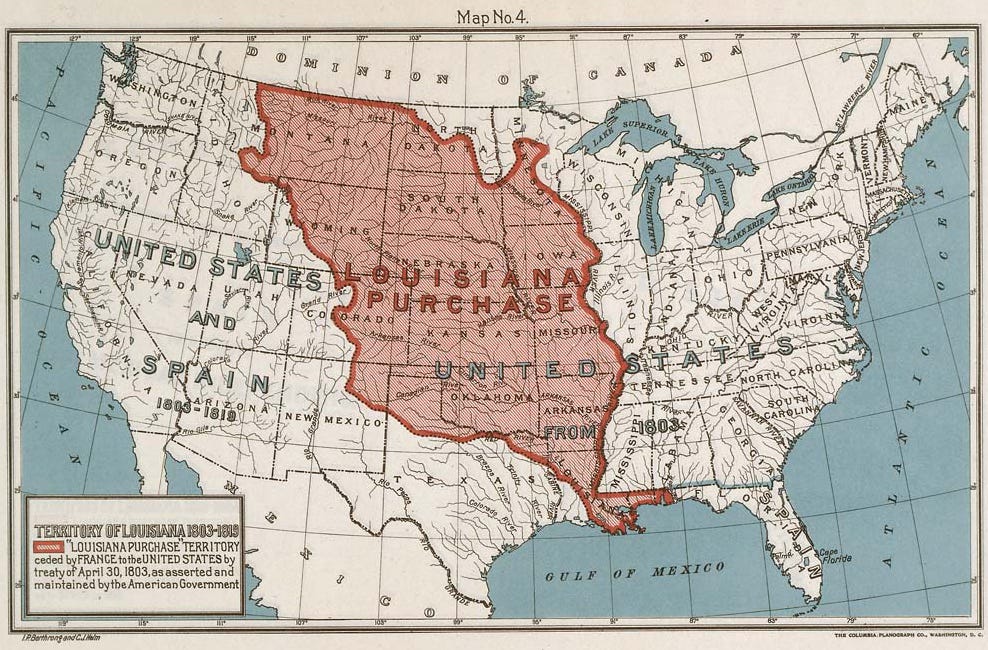
The Louisiana Purchase is one of those historical events that Americans think they already understand. We remember the headline: fifteen million dollars, 530 million acres, and a nation that doubled in size almost overnight. It seems so obvious in retrospect that it is tempting to imagine it as inevitable—as though the continent had merely been waiting for the United States to claim it.
Alexander Mikaberidze’s conversation reminds us how misleading that confidence can be. The Purchase was not simply an American triumph or a fortunate real-estate transaction. It emerged from decades of imperial failure, global war, colonial administration, revolution, and political improvisation. To understand why Thomas Jefferson acquired Louisiana, we first have to understand why France repeatedly failed there, why Spain unexpectedly succeeded, why Haiti transformed Napoleon’s ambitions, and why events unfolding simultaneously in Paris, New Orleans, London, Madrid, and Kentucky all converged in the spring of 1803.
Throughlines
One of the most valuable habits historians cultivate is resisting stories that seem too tidy. The Louisiana Purchase has long been presented as one of the cleanest success stories in American history: Jefferson recognized an opportunity, Napoleon needed money, and the United States became a continental power. Everything else is treated as background scenery.
This conversation reverses that perspective. The Purchase only becomes intelligible once the scenery moves to center stage. Suddenly things become a lot more interesting than the high school history that American students were supposed to learn.
The first lesson concerns the long durée—the deep structures of history. Napoleon’s decision to sell Louisiana cannot be understood by looking only at the frantic diplomatic negotiations of 1803. Mikaberidze argues that its roots reach back more than a century, into the persistent inability of France to populate and develop Louisiana as a successful colony. Despite possessing one of Europe’s largest populations, France never generated enough emigrants willing to cross the Atlantic, and the colony never became economically self-sustaining. Napoleon inherited those structural weaknesses rather than creating them. His dramatic decision in 1803 was, in part, the culmination of problems that Louis XIV and Louis XV had failed to solve.
The conversation also challenges another deeply rooted assumption: that Louisiana’s “French” character was primarily the product of French rule. In reality, much of what visitors today associate with New Orleans—the architecture of the French Quarter, the colony’s relative stability, and many of its legal and commercial institutions—owes far more to four decades of Spanish administration than to the preceding eighty years of French control. Spain approached Louisiana not as a profit center but as a strategic buffer protecting its richer possessions in New Spain and the Caribbean. Ironically, the colony flourished most under rulers whose presence is often forgotten.
Seen from this wider perspective, the Purchase becomes inseparable from the Caribbean. Napoleon never envisioned Louisiana as an end in itself. It was to be the supplier of timber, food, and raw materials for a restored French plantation empire centered on Saint-Domingue. The Haitian Revolution therefore was not merely a parallel event; it was central to the story. As the rebellion destroyed French hopes of reclaiming Haiti, and as renewed war with Britain threatened French communications across the Atlantic, Louisiana suddenly ceased to make strategic sense. Napoleon did not simply decide to sell land. He abandoned an entire imperial design.
The American side of the story proves equally complicated. Thomas Jefferson often appears as the philosopher-president, carefully guided by constitutional principle. Yet the crisis of 1802 exposed the limits of ideological consistency. Spain’s temporary closure of the Mississippi River threatened the economic survival of the western settlements and, perhaps more dangerously, the political unity of the young republic itself. Jefferson feared not merely commercial disruption but secession. Western farmers might seek their future through New Orleans rather than Washington. Federalists demanded military action. Westerners demanded access to the river. France loomed over both. Faced with these realities, Jefferson became remarkably pragmatic, even entertaining an alliance with Britain and ultimately embracing constitutional powers he had long questioned. Statesmanship, the conversation suggests, sometimes requires abandoning cherished theories in order to preserve larger political realities.
Perhaps the most striking insight of the episode is how few participants understood the magnitude of what they were doing. Jefferson initially wanted New Orleans and secure navigation of the Mississippi, not an empire. Robert Livingston scarcely imagined that the United States would permanently govern such an immense territory. Napoleon hoped to strengthen America largely to weaken Britain. No one foresaw precisely the continental nation that would emerge. The Purchase therefore reminds us that historical actors almost never possess the hindsight we routinely grant them.
That may be the conversation’s most enduring lesson. Great historical turning points often look inevitable only after they have succeeded. At the moment they occur, they are usually improvisations shaped by incomplete information, competing priorities, structural constraints, and more than a little luck. The Louisiana Purchase was indeed a grand bargain—but not simply because of the price. It was grand because it emerged from one of history’s most remarkable convergences of contingency and opportunity.
Questions for Reflection
Why are events like the Louisiana Purchase so often remembered as inevitable rather than contingent?
How does viewing the Purchase from Paris, Madrid, and Saint-Domingue change our understanding of American history?
Can an empire fail for structural reasons long before its leaders recognize the failure?
Did Jefferson act consistently with his political principles, or did circumstances require him to abandon them?
When should statesmen compromise deeply held constitutional or ideological commitments?
Why does geography exert such powerful influence over political decisions, particularly in the Mississippi Valley?
How important was the Haitian Revolution to the making of the United States?
What does this episode suggest about the relationship between global events and local political crises?
Which mattered more in 1803: individual leadership or long-term structural forces?
What other “inevitable” moments in history deserve to be reconsidered as products of contingency?
For Further Investigation
Books
Alexander Mikaberidze, The Louisiana Purchase: The Grand Bargain and the Making of America (Oxford University Press, 2026)
John Kukla, A Wilderness So Immense: The Louisiana Purchase and the Destiny of America (Knopf Doubleday, 2004)
Peter Kastor, The Nation’s Crucible: The Louisiana Purchase and the Creation of America (Yale, 2008)
François Furstenberg, When the United States Spoke French: Five Refugees Who Shaped a Nation (Penguin, 2014)
Tyson Reeder, Serpent in Eden: Foreign Meddling and Partisan Politics in James Madison’s America (Oxford University Press, 2024)
David Head and Timothy Hemmis, eds., Republic of Scoundrels: The Schemers, Intriguers, and Adventurers Who Created a New American Nation (Pegasus Books, 2023)
Laurent Dubois, Avengers of the New World: The Story of the Haitian Revolution (Belknap Press, 2005)
Alan Taylor, American Revolutions: A Continental History, 1750-1804 (W.W. Norton, 2016)
Primary Sources
Thomas Jefferson to Pierre Samuel Du Pont de Nemours, 25 April 1802
Thomas Jefferson to Pierre Samuel Du Pont de Nemours, 30 April 1802
Related Episodes
The Greatest Russian General, in War and Peace: Alexander Mikaberidze on Kutuzov’s life, legend, and legacy
The Third World War: Alexander Mikaberidze on why the Napoleonic Wars were the most consequential series of events between the Reformation and the First World War
Doing the Research: Alexander Mikaberidze on evidence, sources, and the historian’s craft
Serpent in Eden: Tyson Reeder on Foreign Meddling, James Madison, and the Early Republic
Founding Scoundrels: David Head and Timothy J. Hemmis on some of the swindlers and con-artists among the Founding Fathers
Inventing a New World Order: Glenda Sluga on the Congress of Vienna and the birth of international politics