

Why This Conversation Matters
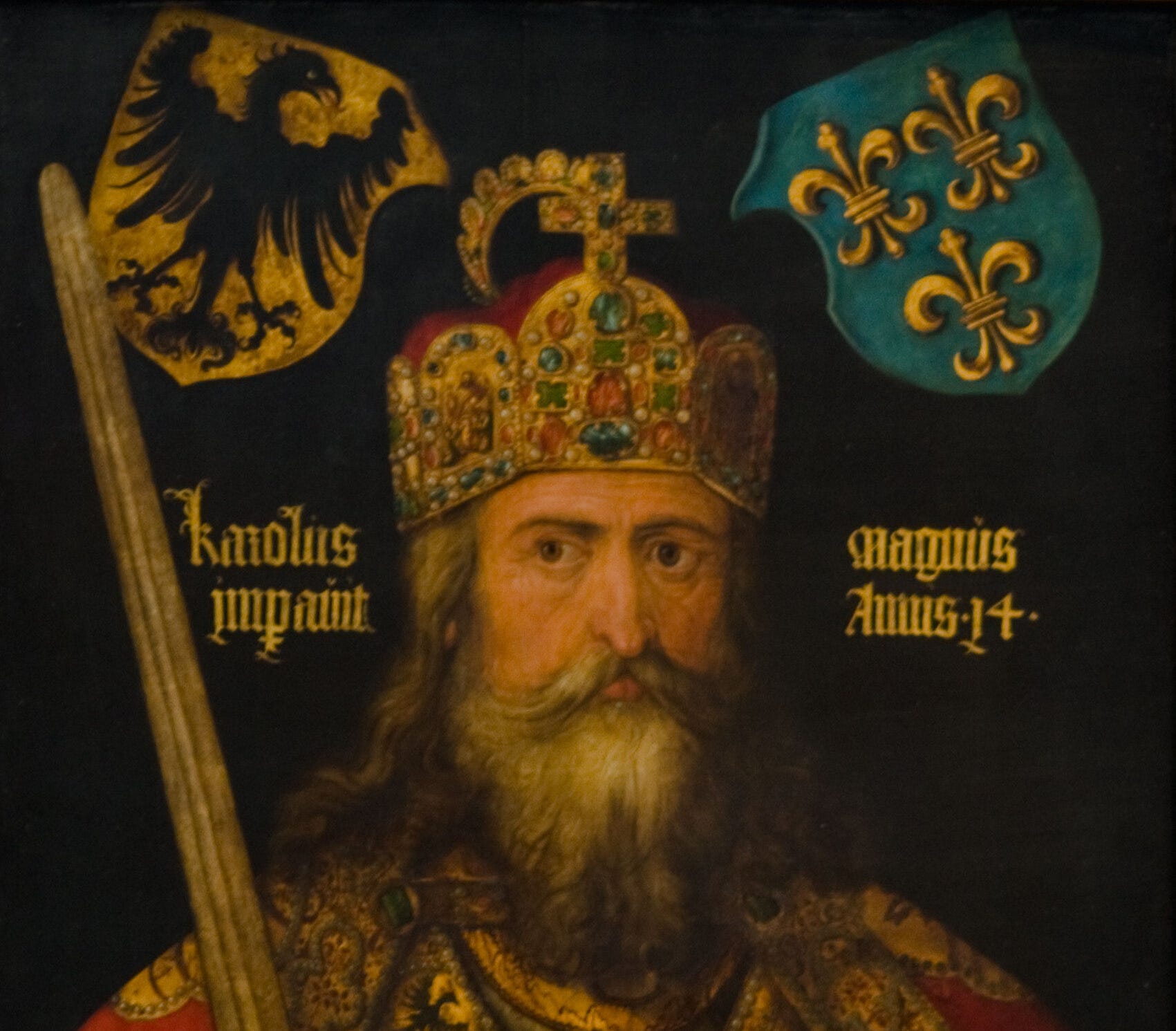
Charlemagne is one of those historical figures whose achievements seem so consequential that they have become difficult to separate from the subsequent history of Europe. He conquered swathes of Western and Central Europe, allied his family to the papacy, encouraged the reform of the Church, and assembled scholars who standardized alphabets and improved the teaching of Latin. Even in collapse it was consequential: the political divisions that emerged among his descendants helped shape the geography of medieval Europe. So it is not altogether surprising that Charlemagne has been called the Father of Europe.
Yet the familiar account of Carolingian history tends to divide rather neatly into the achievements of Charlemagne and the failures of his successors. Charlemagne conquers and creates; his descendants quarrel and destroy. From his a well-intentioned but inadequate son Louis the Pious, too preoccupied with religion to exercise the power he inherited as the nickname indicates, there followed a succession of increasingly incompetent Charleses and Louises until the whole collection collapsed.
James T. Palmer’s Charlemagne’s Dream: The Rise and Fall of the Carolingian Empire offers a different way of understanding this history. Rather than treating the empire’s disintegration simply as the failure of less capable men to preserve a great man’s achievements, Palmer examines the contradictions within the Carolingian project itself. As Palmer shows, the Carolingians were often painfully conscious of the distance between their ambitions and their conduct.
Throughlines
The title of James Palmer’s book refers to an actual dream, or at least to a dream that someone, writing about fifty years after Charlemagne’s death, claimed that the emperor had experienced. In this vision a mysterious figure appeared before Charlemagne carrying a sword inscribed with four strange words. The emperor understood that these words foretold the history of his descendants. There would first be a period of greatness and achievement, followed by sudden failure, disorder, and finally an end. Whether that last word signified the extinction of his dynasty or the end of the world was uncertain. Either way, Charlemagne’s extraordinary achievement was destined to be temporary. The story gives Palmer a way of organizing his history, but it also raises a question about the people who imagined and transmitted it. Why should a dynasty that had achieved so much be surrounded by visions of its own destruction?
To appreciate the significance of that question, it helps to remember what Charlemagne and his ancestors had actually accomplished. The Carolingians were not the hereditary rulers of the Frankish kingdoms. Charlemagne’s grandfather, Charles Martel, had accumulated extraordinary political and military power while remaining formally subordinate to the Merovingian kings. His son Pippin eventually displaced the dynasty, but only after obtaining papal approval and arranging what amounted to an election by the Frankish political elite. This was a remarkable political innovation, not least because the papacy had never previously exercised this kind of authority over the succession to a Western European kingdom. The arrangement strengthened the legitimacy of the Carolingians while beginning a transformation of the papacy’s political position. What eventually became one of the defining relationships of medieval European history began as a solution to a particular family’s problem of legitimacy.
Charlemagne subsequently transformed the scale of that achievement. His conquests extended Frankish power far beyond the Rhine, established his authority in northern Italy, and brought him into direct relations with the Islamic world and the Byzantine Empire. We devoted particular attention to Italy, whose importance in the Carolingian story can be obscured by the more familiar campaigns against the Saxons. Italy meant access to the papacy, to Mediterranean trade, and to territories that remained economically and symbolically central to the old Roman world. Yet conquest was only part of Charlemagne’s enterprise. He was also a remarkably curious man, interested in astronomy, languages, poetry, and learning. Palmer described a ruler who asked sophisticated questions about the movements of the planets while struggling with the physical business of writing. This combination of warrior and intellectual curiosity helped shape a program of reform that extended from the education of clergy, to the correction of liturgical texts, and to the organization of government.
The ambition underlying these reforms was greater than administrative efficiency. Charlemagne and his advisors believed that the ruler was responsible for guiding a Christian people toward salvation. The empire was therefore a religious enterprise as well as a political one. Charlemagne’s authority was to be exercised for the spiritual welfare of his subjects. That understanding of kingship laced an extraordinary burden upon those who exercised power. A king who claimed responsibility for the salvation of his people would have to answer for what he had done and left undone.
The difficulty became particularly clear under Charlemagne’s son, Louis the Pious. Palmer’s account of Louis challenges the conventional portrayal of a weak and excessively religious ruler. Louis had governed Aquitaine for decades before succeeding his father in 814, and he proved perfectly capable of conducting campaigns, managing diplomacy, and using force against his enemies. When his nephew Bernard of Italy challenged his arrangements for the imperial succession, Louis responded with severe punishment. Bernard was blinded and subsequently died from complications of the injury. Louis’s expressions of remorse and subsequent acts of penance have sometimes been treated as evidence of his political inadequacy. Yet as Palmer pointed out, Louis had done something that other early medieval rulers, including Charlemagne, might readily have done. What made the episode politically damaging was that Louis seemed unable simply to put the matter behind him.
The problems of succession also remained formidable through Louis’ reign. Charlemagne had originally imagined an empire divided among several sons who would govern different territories while preserving a larger political unity. The deaths of two of those sons left Louis unexpectedly responsible for the entire inheritance. Louis in turn attempted to arrange the succession among his own children, but a second marriage and the birth of another son disrupted those arrangements. The disputes eventually produced rebellions, the temporary deposition of Louis himself, and, after his death in 840, a destructive civil war among his surviving sons. The Battle of Fontenoy in 841 was remembered for generations as a catastrophe in which members of the Frankish political elite slaughtered one another. The subsequent division of the empire revealed the “wicked problem” of reconciling dynastic inheritance, territorial government, personal ambition, and an imperial ideal that demanded unity.
Meanwhile, the Carolingians confronted enemies who were remarkably adept at exploiting their divisions. Viking raiders found opportunities wherever civil war weakened the ability of Frankish rulers to organize resistance. Their attacks were not entirely beyond the Carolingians’ capacity to resist, as occasional victories and defensive innovations demonstrated, yet political fragmentation made sustained cooperation difficult. Nor were the empire’s problems solely military. Palmer’s treatment of Charles the Fat, who briefly reunited the Carolingian territories in the 880s, is another useful corrective to the conventional story. Charles was capable of considerable political and diplomatic activity, but his efforts to manage the Viking threat through payments and negotiated settlements damaged his reputation. More seriously, he could not persuade the political elite to accept his preferred successor. When he was deposed in 887, the unity of the empire came to an end. Its institutions, cultural achievements, and political traditions survived, but the Carolingian attempt to maintain a unitary imperial order had failed.
It was at this point in our conversation that we returned to Charlemagne’s dream and the other unsettling visions that Palmer has gathered from Carolingian sources. There were stories of Charles Martel being dragged into hell, of Charlemagne suffering punishments after death, and of supernatural interventions warning his descendants about their conduct. Such accounts appeared in chronicles, letters, and other writings. They were not simply expressions of a credulous age inclined to believe extraordinary things, Palmer argues, but evidence of an anxiety about the moral foundations of political power. The Carolingians knew that their empire had been built through violence, that its rulers often failed to observe the standards they imposed upon others, and that even their greatest achievements might not withstand divine judgment. Charlemagne himself once asked a church council whether they were truly Christian. That question is rather difficult to reconcile with an image of early medieval rulers confidently assuming that God approved of everything they did.
This aspect of Palmer’s argument led us into a broader discussion of the way historians approach the early Middle Ages. For much of the twentieth century, scholarship on the Carolingians emphasized state formation, administrative structures, institutional reform, and economic development. There were excellent reasons for doing so, particularly as historians sought to recover the creativity and achievements of a period too casually dismissed as the Dark Ages. Yet in correcting one misconception, historians can sometimes create another. The inhabitants of the former Roman world lived among the immense physical remains of a civilization whose institutions and urban life had contracted dramatically. The Carolingians, who aspired to renew something of Rome’s greatness, could scarcely have been unaware of the possibility of decline. Nor should historians, in their eagerness to explain how institutions worked, lose sight of the religious and moral concerns that gave those institutions meaning to the people who created them.
Palmer concludes his book by arguing that the Carolingians discovered the hard way that character mattered more than the performance of raw power. I remarked that this was an unusually humanist conclusion for a modern historical work, one concerned with what history might teach us about conduct rather than with explaining events chiefly through structures and systems. Palmer did not apologize for it, though he located his approach partly in anthropology and the effort to understand the beliefs through which people interpreted their own actions. For the Carolingians, character was not an optional quality that might make a ruler personally admirable. It was inseparable from legitimacy, political obligation, and the expectation of judgment. Their power was real, their achievements substantial, and their failures often catastrophic. But their efforts to determine whether they had governed rightly were also part of their history, and cannot be detached from it without losing something essential.
Questions for Reflection
What did the Carolingians actually create? How should we distinguish the achievements of Charlemagne himself from those of his advisors, predecessors, and successors? To what extent did the Carolingian Empire depend upon the exceptional abilities of a single ruler?
How does a ruling family acquire legitimacy? The Carolingians displaced an established dynasty through a combination of military power, aristocratic consent, and papal approval. What does this suggest about the relationship between legitimacy and the effective possession of power?
What did Charlemagne mean by Christian kingship? How did the belief that a ruler was responsible for the salvation of his subjects change the purposes of government? What obligations did that belief impose upon the ruler himself?
Was Louis the Pious a weaker ruler than his father, or merely a different sort of ruler? Why might behavior regarded as evidence of strength in Charlemagne become evidence of weakness in Louis? What role does historical reputation play in shaping such judgments?
Could the Carolingian Empire have survived as a political unity? Were the inheritance disputes and civil wars largely products of individual decisions, or did they expose contradictions inherent in the organization of the empire?
What did the Battle of Fontenoy mean to contemporaries? Why might a civil war among members of a ruling dynasty be experienced as a moral catastrophe rather than simply another contest for political supremacy?
How should historians understand the Viking invasions? Were the Vikings a principal cause of Carolingian disintegration, or did their success depend upon weaknesses that already existed? How do external threats alter the political fortunes of states experiencing internal division?
What can dreams and visions tell historians? Even if the prophetic dreams attributed to Charlemagne and his descendants never occurred, what can their circulation reveal about the fears, beliefs, and political expectations of the people who recorded them?
Can societies experience progress and decline simultaneously? The Carolingian period witnessed important advances in government, learning, and religious organization, while its inhabitants remained conscious of disorder and the loss of an earlier Roman world. How should historians reconcile these apparently competing experiences?
Does character belong at the center of historical explanation? Palmer argues that the Carolingians ultimately failed to live up to their own standards of government. How should historians weigh the moral decisions of individuals against institutional arrangements, economic circumstances, and other forces that shape political outcomes? Can character be studied historically without turning history into a morality tale?
For Further Investigation
James T. Palmer, Charlemagne’s Dream: The Rise and Fall of the Carolingian Empire Basic Books, 2026)
Einhard and Notker the Stammerer, Two Lives of Charlemagne, edited and translated by David Ganz (Penguin Classics, 2008)
Rosamond McKitterick, Charlemagne: The Formation of a European Identity (Cambridge, 2008)
Janet L. Nelson, King and Emperor: A New Life of Charlemagne (University of California Press, 2019)
Marios Costambeys, Matthew Innes, and Simon MacLean, The Carolingian World (Cambridge, 2011)
Simon MacLean, Kingship and Politics in the Late Ninth Century: Charles the Fat and the End of the Carolingian Empire (Cambridge, 2009)
Related Episodes
Offa the King: Rory Naismith writes the life of a king who has no biography
Roads to Rome: Catherine Fletcher on Empire, Infrastructure, and Imagination
House of Lilies: Justine Firnhaber-Baker on the Capetians, Medieval France, and Dynasty-Building