

Why This Conversation Matters
Political history is usually written from speeches, elections, legislation, and war. But what happens when most people are excluded from those activities? How can women, poor men, enslaved people, and Native Americans participate in the creation of a political culture when they possess little or no formal political authority?
Nancy Siegel asks us to look for answers into kitchens, gardens, dining rooms, marketplaces, and cookbooks. During the era of the American Revolution, choosing what to grow, purchase, prepare, refuse, serve, or name could become a political act. Tea expressed attachment to Britain until refusing it expressed resistance. Sugar could implicate consumers in slavery. Cakes commemorated elections in which the women who baked them could not vote. A vast cheese could proclaim confidence in Thomas Jefferson and the republic.
Throughlines
Nancy Siegel’s path into culinary history began with a soup plate. While studying how an image by Thomas Cole moved from drawing to painting, engraving, and finally British dinner ware, she found herself looking at the bottom of a plate and wondering what might once have been served in it. At roughly the same time, the Congressional cafeterias renamed french fries “freedom fries” after France opposed the American invasion of Iraq. Together, those two moments suggested a historical question: how long have people used food and its vocabulary to express political loyalties? The answer, Siegel discovered, included liberty tea, Election Cake, mammoth cheese, and a much larger political language built around consumption.
The conversation therefore begins with tea—not simply as a beverage, but as an expression of British identity. Immigrants to the colonies could use tea and its elaborate material culture to display refinement and rising status. Tea tables might include dozens of objects: porcelain, silver spoons, sugar bowls, teapots, and other costly accessories. Drinking tea allowed colonists to participate in a ritual shared across the British Empire. This was precisely why resistance to taxed tea carried so much weight. Refusing it required people to surrender, or at least alter, an established daily practice through which they had learned to think of themselves as prosperous and properly British.
Non-importation and non-consumption created a practical problem: what could replace tea? Colonists turned to herbal mixtures made from raspberry leaves, sassafras, bergamot, mint, marjoram, thyme, hyssop, sage, rosemary, lavender, and other plants. Some recipes were remarkably elaborate. This experimentation depended partly upon European traditions of medicinal infusions, but it also drew upon knowledge acquired from Indigenous herbalists and botanists. The resulting beverages could be renamed “liberty tea,” transforming an ordinary substitute into a patriotic commodity. Political language made the drink different even when its ingredients were familiar.
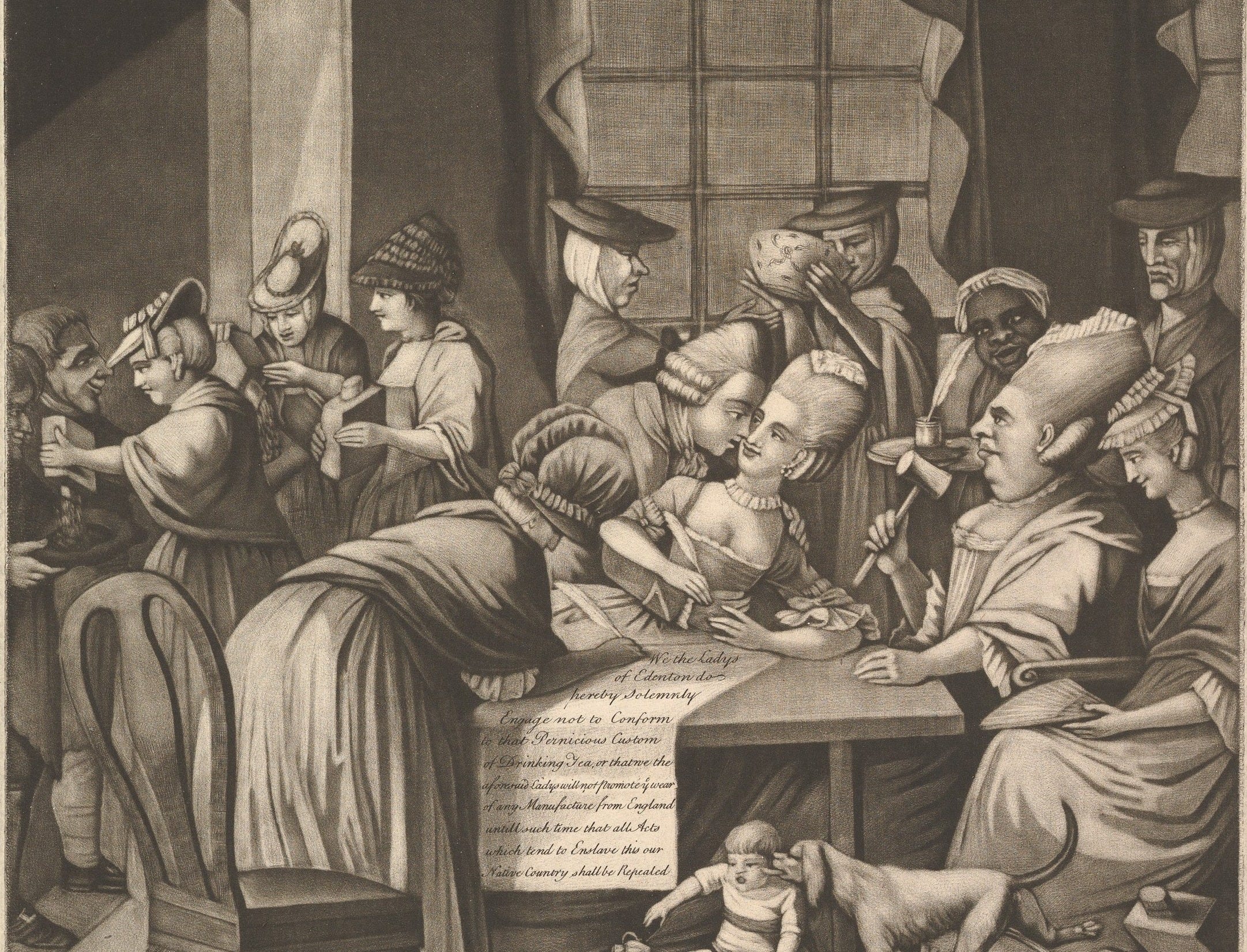
Women played a particularly important role in converting consumption into political action. In October 1774, fifty-one women in Edenton, North Carolina, signed a pledge rejecting imported tea and cloth. Their signatures possessed little formal political authority, but their statement circulated through colonial newspapers and eventually reached London. A British print mocked the women as ugly, foolish, disorderly, and sexually unserious—as people who had abandoned their proper domestic roles by entering politics. Yet the satire also acknowledged that they had done something worth answering. Unlike the disguised participants in the Boston Tea Party, the Edenton women signed their own names. Their political agency lay precisely in their willingness to be identified.
That image leads the conversation into the wider world of political caricature. Artists such as James Gillray used food, hunger, gluttony, digestion, and the body to make complicated political arguments immediately recognizable. In Temperance Enjoying a Frugal Meal, Gillray showed George III and Queen Charlotte eating eggs and salad in a deliberately plain setting. The image mocked royal miserliness and the undignified ordinariness of the scene, but it could also operate as a backhanded compliment during an age of scarcity and revolution: these were not monarchs gorging themselves while their subjects starved. Culinary satire could be politically pointed precisely because everyone understood eating.
Sugar made the moral stakes of consumption especially visible. British antislavery activists encouraged consumers to reject sugar produced by enslaved labor in the West Indies. Some writers described eating such sugar as consuming the bodies or blood of the enslaved. Maple sugar and beet sugar could therefore be promoted as moral alternatives. But Siegel emphasizes that motives overlapped. Maple sugar could express antislavery conviction, economic independence, national abundance, or some combination of the three. Culinary activism was real, but it was rarely politically simple.
The conversation then moves from protest to abundance. American horticulturists experimented with fruits, vegetables, and grafted varieties that might demonstrate the new nation’s productivity. The Peale family belonged to this culture of artistic and botanical experimentation. Raphaelle Peale’s Peaches Covered by a Handkerchief presents fruit as something cultivated at home rather than acquired as the spoil of overseas empire. Such still lifes could celebrate fertility, regeneration, skill, and abundance. Gardens and orchards became places where national identity was cultivated quite literally.
Cookbooks performed similar cultural work. Amelia Simmons’s 1796 American Cookery adapted British culinary traditions to American ingredients such as corn and pumpkin. A subsequent Albany edition added politically named recipes including Independence Cake, Federal Pancakes, and Election Cake. The scale of Election Cake is startling: thirty quarts of flour, ten pounds of butter, fourteen pounds of sugar, twelve pounds of raisins, three dozen eggs, wine, and brandy. This was food for a crowd, associated with elections, militia musters, and civic gatherings. Women who could not cast ballots could nevertheless feed the electorate and help turn voting into a public ritual.
Mary Randolph’s The Virginia House-Wife reveals a later shift. Its title is regional rather than national, and its recipes reflect Indigenous, African, Caribbean, British, French, and Spanish influences. The comparison raises one of the conversation’s most difficult questions: what does it mean to call a cuisine “American”? American cooking emerged from exchange, adaptation, coercion, enslavement, migration, and appropriation. The language of independence and freedom could appear in kitchens that remained dependent upon unfree labor.
Finally, the conversation arrives at the republic’s enthusiasm for mammoth foods. In 1802, the Baptist minister John Leland and the dairy farmers of Cheshire, Massachusetts, presented Thomas Jefferson with a 1,235-pound cheese. It celebrated Jefferson’s election, religious liberty, agricultural productivity, and the ability of ordinary citizens to create something astonishing together. It also became material for partisan ridicule, particularly when its center began to spoil. Other enormous cakes, pies, chocolates, and cheeses followed. These were publicity stunts, certainly, but they were also edible claims about abundance and confidence. Their size proclaimed that the democratic experiment was working.
The conversation’s deepest argument is not simply that food sometimes carries political meaning. It is that political life is much broader than formal institutions. People who could not vote, hold office, or speak in legislatures still participated in political culture through purchasing, abstaining, planting, naming, cooking, serving, and eating. The history of democracy can therefore be found not only in constitutions and battlefields, but also in recipes, teacups, orchards, market stalls—and exceptionally large cheeses.
Questions for Reflection and Discussion
Why did tea become such an effective symbol of both British identity and colonial resistance?
What did colonists sacrifice when they participated in non-importation and non-consumption agreements?
How did Indigenous botanical knowledge contribute to the creation of “liberty tea”?
Why did the Edenton women’s pledge provoke ridicule in Britain? What does the satire reveal about contemporary ideas of gender and political authority?
Does consumer choice constitute meaningful political action? Under what circumstances can it produce change?
What complications arise when maple sugar is interpreted simultaneously as an antislavery product and a symbol of national independence?
How could political caricature communicate arguments to people who possessed limited literacy?
What can still-life paintings and horticultural experiments reveal about national identity in the Early Republic?
How did politically named recipes allow women to participate in elections and civic celebrations from which they were formally excluded?
Can there be a single “American cuisine,” or is American food necessarily a collection of regional, Indigenous, African, European, and Caribbean traditions?
What did mammoth foods communicate that speeches or printed arguments could not?
Where do we find comparable examples of culinary politics today?
For Further Investigation
Books
Nancy Siegel, Political Appetites: The Power of Food in Revolutionary America (Johns Hopkins University Press, 2026).
Troy Bickham, Eating the Empire: Food and Society in Eighteenth-Century Britain (Reaktion Books, 2020).
James E. McWilliams, A Revolution in Eating: How the Quest for Food Shaped America (Columbia University Press, 2005).
Richard L. Bushman, The Refinement of America: Persons, Houses, Cities (Vintage, 1993).
Sarah Hand Meacham, Every Home a Distillery: Alcohol, Gender, and Technology in the Colonial Chesapeake (Johns Hopkins University Press, 2009).
Wendy A. Woloson, Refined Tastes: Sugar, Confectionery, and Consumers in Nineteenth-Century America (Johns Hopkins University Press, 2002).
Michael W. Twitty, The Cooking Gene: A Journey Through African American Culinary History in the Old South (Amistad, 2017).
Primary Sources and Material Culture
Amelia Simmons, American Cookery (1796), digitized by the Library of Congress.
Mary Randolph, The Virginia House-Wife (1824).
Attributed to Philip Dawe, A Society of Patriotic Ladies, at Edenton in North Carolina (1775).
James Gillray, Temperance Enjoying a Frugal Meal (1792).
Raphaelle Peale, Peaches Covered by a Handkerchief (1819).
Watch and Explore
Feeding the American Revolution, the WMHT Public Media documentary hosted by Nancy Siegel.
Trailer for Feeding the American Revolution, premiering December 8, 2026.
Historically Thinking, Field Guide No. 3: The Age of the American Revolution.
Related Episodes
Suitable: Chloe Chapin on clothing, consumption, and political identity in the Revolutionary era.
When the Declaration of Independence Was News: Emily Sneff on how people first encountered independence.
World Crisis: Richard Bell on the American Revolution as a global event.
Tags
American Revolution; Early Republic; Food History; Culinary History; Nancy Siegel; Political Appetites; Liberty Tea; Election Cake; Edenton Tea Party; Women’s History; Indigenous History; Slavery; Material Culture; Political Satire; Thomas Jefferson; Amelia Simmons; American Cookery; Historically Thinking