

Why This Conversation Matters
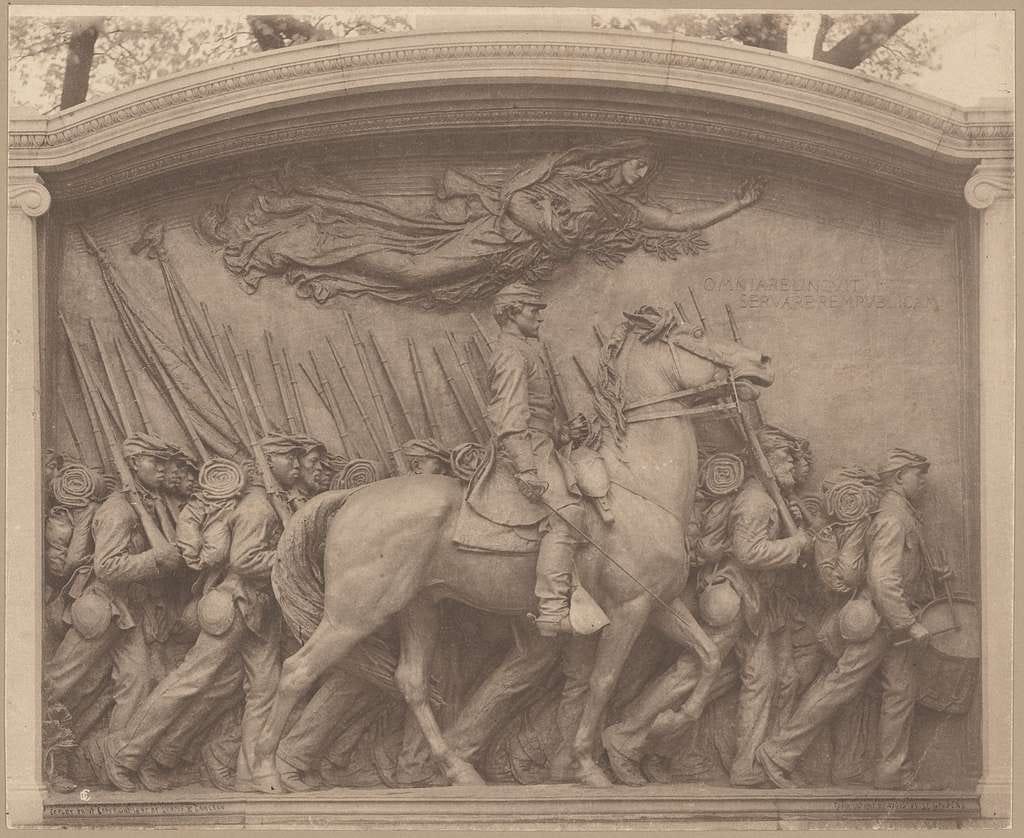
Robert Gould Shaw is literally an iconic historical figure. He rides at the head of the 54th Massachusetts in Augustus Saint-Gaudens’s great memorial—or, for most, he is personified by Matthew Broderick in Glory. Since icons are unchanging, his death at Fort Wagner appears to complete a story whose meaning was present from the beginning. In death an abolitionist martyr, it stands to reason that in his short life he was always preparing to be an abolitionist martyr.
Kevin Levin asks us to look again at the icon. The Shaw who emerges from his new biography was not the committed abolitionist later memory required—or assumed—him to be. He was a privileged and often aimless young man, seemingly failing to launch, who found direction in the army. He became a courageous and capable officer, but remained ambivalent about emancipation. He initially refused command of the 54th. His eventual acceptance brought together duty, ambition, family pressure, military opportunity, and perhaps a developing sense of purpose.
That does not make Shaw’s story less significant, but makes it more historically and biographically interesting. His life raises questions about the relationship between motives and actions, between individual development and historical circumstance, and between the people who lived through events and the symbols later generations made of them.
Throughlines
The conversation begins with the distance between Robert Gould Shaw and his historical image. To understand Shaw, the discussion first turns away from Fort Wagner and toward his remarkable family.
The Shaws were an old Boston family whose wealth had been built through Atlantic commerce. Robert’s parents, Frank and Sarah Shaw, used that wealth to support the reform movements of the 1840s. They were sincere abolitionists who also supported experiments such as Brook Farm, though they never surrendered the comforts of their class. Nor did their fervent opposition to slavery did not necessarily produce social intimacy with Black Bostonians. The conversation therefore distinguishes moral opposition to slavery from a belief in racial equality—and reminds us that nineteenth-century antislavery contained many different positions.
Robert did not initially share his parents’ intensity of social commitment. He spent important years of his adolescence in Europe, removed from the political crises that were radicalizing many young Americans. At Harvard he showed little interest in study, reform, or the growing sectional conflict. He rowed, joined clubs, socialized, and left without graduating. Work in the family business made him miserable. Farming, military service, and even a voyage to China appeared briefly among the futures he imagined, but nothing awoke his passion or attention.
The war did. Shaw as part of New York’s 7th Regiment traveled to Washington during the chaotic weeks after Fort Sumter, where he slept in the Capitol and met President Lincoln. He then accepted a commission in the 2nd Massachusetts, a regiment filled with men from his own social and educational world. Military life uncovered qualities not previously visible. Shaw became a disciplinarian, and proved capable of leading men under fire. He survived the Shenandoah Valley campaign, Cedar Mountain, and the Cornfield at Antietam while friends and fellow officers fell around him. Whatever else might be said about him, his physical courage was beyond dispute.
His political development was less straightforward. Shaw was a Unionist, but Levin describes him primarily as a pragmatist and sometimes an opportunist. Even after Lincoln issued the preliminary Emancipation Proclamation, Shaw remained lukewarm toward emancipation and asked his mother to stop pressing the subject in her letters to him. By late 1862 he was exhausted, disillusioned, and increasingly concerned with whether his military career could progress to higher levels of rank. The conversation resists the assumption that service in the Union Army—or birth into an abolitionist family—necessarily led along a straight road toward racial egalitarianism.
When Governor John Andrew of Massachusetts, a committed antislavery politician, received permission to organize a Black regiment after the Emancipation Proclamation he offered its command to Shaw, apparently assuming that the son of Frank and Sarah Shaw shared their convictions. While Shaw initially refused, within roughly twenty-four hours he changed his mind. The evidence does not permit a simple explanation of either the denial or the reversal. Command meant promotion from captain to colonel and an opportunity to lead his own regiment, but command of a regiment of black soldiers also involved risk—to his reputation, his career, and his place among fellow officers. And his family’s expectations mattered as well.
Once committed to command, Shaw proved an effective organizer. He took pride in the regiment he was helping to create, although the conversation complicates the image presented in Glory of Shaw personally training the men from the beginning. Much of his work involved administration apart from the regiment: fundraising, meetings with Governor Andrew, and the innumerable tasks required to build a regiment. Meanwhile, as it organized, the 54th drew Black volunteers from across the North and beyond. Its march through Boston in May 1863, on its way to embarkation for the southern theater, was a public declaration that Black men would fight to destroy slavery and preserve the United States.
In South Carolina, Shaw encountered James Montgomery, perhaps the episode’s most startling character. Montgomery was both a militant abolitionist and an outspoken racist, a veteran of the struggle in Kansas who practiced a ruthless form of warfare along the Southern coast. Yet he also admired Montgomery’s energy, determination, and commitment. But Shaw was horrified when Montgomery ordered the burning of Darien, Georgia, an undefended town, for he worried that the raid would dishonor the 54th. His men, Shaw believed, were intended for more honorable service.
That opportunity came at Fort Wagner. The regiment reached Morris Island exhausted, hungry, and depleted after fighting on James Island. Nevertheless, Shaw volunteered the 54th to lead the assault, a decision Levin suggests may have been irresponsible. The attack ended with approximately forty percent of the regiment killed, wounded, or captured, including Shaw. The discussion leaves open whether his decision represented confidence in his men, concern for his own honor, military ambition, obedience to the demands of the moment, or some combination of them all.
The final movement of the conversation returns to Boston Common. Sarah Shaw helped shape the memory of her son as the committed emancipationist she had always wanted him to become. Saint-Gaudens’s memorial fixed that interpretation in bronze at a moment when national reconciliation and Confederate commemoration were pushing slavery and Black military service out of public memory. Glory presented that memory to a new generation, combining it with the story of the soldiers he commanded.
Yet Levin does not conclude by simply dismantling Shaw’s reputation. When challenged, he insists that he respects Shaw more than he did before his years of research. Shaw’s importance lies not in ideological purity, but in his place within the broad and unlikely coalition that brought slavery to an end. Biography restores the imperfect person without denying the significance of what he helped accomplish.
Questions for Reflection & Discussion
How did the wealth and reform commitments of the Shaw family shape Robert Gould Shaw’s early life?
What does the social distance between white abolitionists and Black Bostonians reveal about the varieties of nineteenth-century antislavery?
Why did Shaw remain comparatively detached from the sectional controversies unfolding during his youth? Does he sound more or less like other teenagers you might have known?
In what ways did military service give Shaw an identity and purpose that he had previously lacked?
How did Shaw’s conduct in the 2nd Massachusetts complicate the image of him as an aimless and self-absorbed young man?
Why does Levin describe Shaw as a pragmatist or opportunist rather than as a committed abolitionist?
What considerations may have led Shaw first to refuse and then to accept command of the 54th Massachusetts?
Why did Shaw object so strongly to the burning of Darien, and what did his reaction reveal about his understanding of military honor?
Was volunteering the exhausted 54th to lead the assault on Fort Wagner an act of courage, irresponsibility, or both?
How did Sarah Shaw and the Saint-Gaudens memorial shape the public memory of Robert Gould Shaw?
Does recovering Shaw’s mixed motives diminish his achievements, or make them more historically intelligible?
What does Shaw’s life suggest about the role of imperfect people and unlikely coalitions in producing major historical change?
For Further Investigation
Kevin M. Levin, A Glorious Fate: The Life and Legacy of Colonel Robert Gould Shaw (University of North Carolina Press, 2026).
—, Searching for Black Confederates: The Civil War’s Most Persistent Myth (University of North Carolina Press, 2019).
Robert Gould Shaw, Blue-Eyed Child of Fortune: The Civil War Letters of Colonel Robert Gould Shaw, edited by Russell Duncan (University of Georgia Press, 1992).
Luis F. Emilio, A Brave Black Regiment: History of the Fifty-Fourth Regiment of Massachusetts Volunteer Infantry, 1863–1865 (1891)
Ray Anthony Shepard, Now or Never!: 54th Massachusetts Infantry’s War to End Slavery (Calkins Creek, 2017).
Related Episodes
Now or Never!: Ray Anthony Shepard on the battles, sacrifices, and legacy of the 54th Massachusetts Regiment in its fight for freedom
Worse Than Hell: W. Fitzhugh Brundage on Civil War prisoners and prison camps
Terrible Intimacy: Melvin Patrick Ely on interracial life in the slaveholding South.
Armies of Deliverance: Elizabeth Varon’s interpretation of the Civil War
Black Suffrage: Paul D. Escott on Lincoln’s last goal and the politics of Reconstruction
Abolitionist Civil War: Frank Cirillo on how the abolitionist movement transformed during the Civil War, eventually destroying itself.
Searching for Black Confederates: Kevin Levin on who fought for the South
Tags: Kevin M. Levin, Robert Gould Shaw, 54th Massachusetts, Fort Wagner, American Civil War, Emancipation, Black Soldiers, Abolitionism, Military History, Biography, Historical Memory, Augustus Saint-Gaudens