

Why This Conversation Matters
The history of Johns Hopkins University is not simply the history of one institution. Hopkins became a model for the modern American research university, an institution organized no longer to preserve and transmit knowledge, but to create it.
Curiously enough, within just a few years of Hopkins’ founding in 1876 nearly every feature of that model raised questions that resonate to this day, 150 years later.
What does a university owe the place in which it exists?
What was the donor or founder’s intent?
What is research for?
Is it worth it?
Who should pay for it?
How much influence should those who pay (donors, governments, corporations, and foundations) exercise?
Should faculty be allowed to follow their own judgment, even when their fields move in other directions?
And where do undergraduates belong in a university built around advanced research?
Should undergraduates be trained as very junior researchers, or should they be trained in things that are more “practical”?
Hopkins never settled these questions permanently, and it’s hard to believe that any university has. The history of Johns Hopkins is a series of provisional answers, each shaped by place, money, personalities, and changing ideas about the university’s obligations to society.
Throughlines
Johns Hopkins reflected its foundation in a particular kind of place. Baltimore in the years after the Civil War looked both north and south, a once commercial port by the 1870s becoming increasingly industrial. Its economy had been connected to plantation agriculture, Atlantic commerce, banking, and in recent decades the Baltimore and Ohio Railroad. It lacked the entrenched ecclesiastical and cultural establishment found in some older cities, while its business leaders were eager to present Baltimore as modern and forward-looking. Nothing seemed more forward looking than building a hospital along the most modern plans, and a research university to match those of Germany.
Johns Hopkins (his first name was the family name of his great-grandmother) emerged from the commercial world of the first half of the nineteenth century. A Quaker merchant who became a financier and major investor in the B&O, he left $7 million to establish a university and hospital. His instructions for the hospital were relatively detailed: it was to be comparable to the finest European institutions, associated with a medical school, and designed in ways that would improve its neighborhood. His instructions for the university amounted to little more than a direction to create one.
That ambiguity made donor intent an immediate problem. Johns Hopkins’s friend John Work Garrett believed that the founder had wanted a practically oriented institution serving Baltimore’s industries. Other trustees envisioned an institution devoted to advanced learning. They also disputed where it should be located. Garrett insisted that the university belonged at Clifton, Hopkins’s country estate, as Hopkins had wanted. But Clifton was at the time out in the suburbs, and would require an expensive building program. So the university instead began in adapted buildings near Baltimore’s cultural center, while setting aside money for a future move that it could not yet afford.
The form of the bequest created another problem. The hospital received income-producing real estate, acres of downtown Baltimore. The university received principally B&O stock that it was not allowed to sell; it had to exist on the dividends. When the railroad’s dividends declined, so did the university’s operating income. The largest philanthropic gift in American history quickly became inadequate to the ambitions it had inspired.
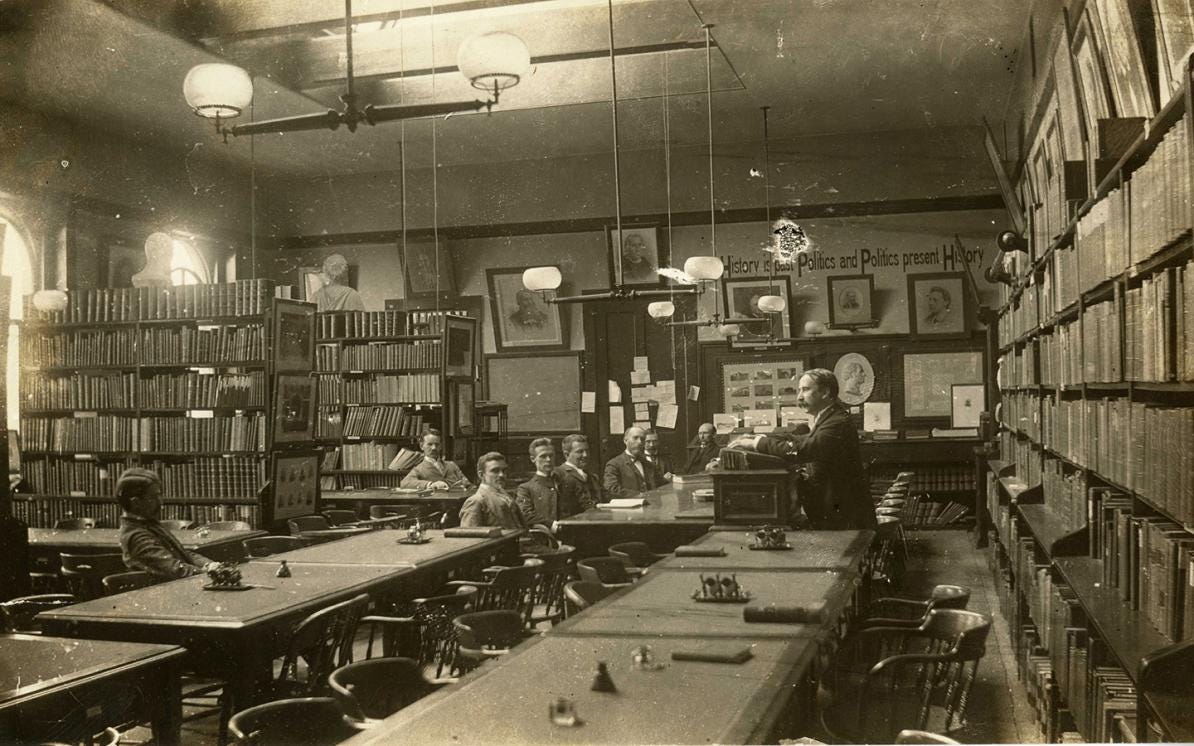
Under its first president, Daniel Coit Gilman, Hopkins established a new model of higher education in the United States. Original research and advanced training would stand at its center. Graduate students would learn by working near the frontier of knowledge, while unusually well-prepared undergraduates would be treated, in many respects, as younger graduate students—initially they were there for only a three-year course of study.
This was not an uncontested vision. Critics—including the chairman of the board—objected that Hopkins would provide “sinecures for the learned” rather than useful education for ordinary people. The argument began before the new university had demonstrated that the United States possessed either enough qualified students or enough academic positions for its graduates. The debate over whether universities should cultivate advanced scholarship or provide practical education was present at the creation of the research university.
Gilman initially hoped to recruit the leading scholars of Europe and the United States, but most declined. Hopkins lacked an established reputation, its future was uncertain, and European universities offered benefits—such as pensions—that Hopkins could not provide. Instead, the university recruited younger scholars attracted by the opportunity to pursue research as well as teach. Some, such as the mathematician J. J. Sylvester, had been obstructed elsewhere by religious or institutional barriers.
This necessity proved productive yet uneven. Hopkins became a place where younger scholars could build departments and, in some cases, disciplines. The rank of associate professor emerged partly because the university needed positions for accomplished scholars who were not the commanding full professors around whom departments were originally organized.
That structure also concentrated power in the faculty. Departments could become intellectual domains centered on senior professors, while the president’s task was to manage a collection of strong and independent personalities. Gilman did this with extraordinary skill. Later presidents were not always so successful. The “old bulls” of the faculty remained powerful enough to challenge—and sometimes remove—university presidents.
Research itself created another argument. Henry Rowland in physics and Ira Remsen in chemistry defended what became known as pure or basic research. Scientific investigation would ultimately benefit society, they argued, but researchers could not allow predetermined practical outcomes to govern their inquiries. If commercial or political sponsors required particular answers, the research would be corrupted.
Yet experimental science of the kind in which Hopkins’ departments soon focused was expensive. Laboratories, equipment, and specialized buildings required money, while research undertaken without immediate practical objectives was difficult to justify to funders. Hopkins therefore helped establish a durable paradox: society should support research because of its eventual usefulness, while allowing researchers to work without calculating that usefulness in advance.
Hopkins initially dominated American graduate education and produced scholars who carried its model throughout the country. But an innovator does not necessarily remain preeminent. Harvard adopted important features of the Hopkins system while drawing on greater resources. Newly founded institutions such as the University of Chicago possessed fortunes that dwarfed the Hopkins endowment. By 1900, competitors were producing more doctorates, hiring more faculty, and constructing larger research enterprises.
The university’s small departments and decentralized culture could produce remarkable work. Scholars enjoyed freedom to follow questions that larger institutions might neglect, and intellectually ambitious undergraduates could form close relationships with distinguished professors. But the same qualities could leave departments isolated from important developments in their disciplines. So by the 1920s and 1930s, Hopkins had lost much of its early preeminence outside medicine. Large foundations were beginning to direct resources toward selected fields and institutions, and Hopkins often failed to benefit. Its faculty culture encouraged intellectual independence, but it also made coordinated responses to new disciplinary and financial opportunities difficult.
The university’s revival came partly through medicine, public health, engineering, and defense-related research. During and after the Second World War, federal funding changed the scale and organization of American research. The Applied Physics Laboratory and the university’s medical institutions placed Hopkins in an advantageous position to receive that support.
Milton Eisenhower, who became university president in 1956, helped rebuild Hopkins’s financial base. He treated fundraising as a central responsibility of the presidency and learned how foundations evaluated successful proposals. Yet he remained wary of allowing outside funds to govern the university. He resisted using uncertain federal grants to support permanent salaries and worried that political control might follow public money.
The history of Johns Hopkins is therefore not a straightforward ascent from innovation to greatness. It is a history of recurrent tensions: between donor intent and institutional independence, research and teaching, usefulness and curiosity, faculty autonomy and strategic coordination, intimacy and neglect, prestige and financial vulnerability. Perhaps those tensions were not failures of the research-university model, but part of the model from the beginning.
Questions for Reflection and Discussion
Why did Baltimore provide an especially favorable setting for the first American research university?
When a donor leaves only general instructions, who should determine the institution’s purpose?
How did the form of Johns Hopkins’s gift matter as much as its size?
Was Gilman’s combination of graduate research and undergraduate education a stable settlement, or merely a temporary compromise?
Why did critics regard advanced research as an elite luxury rather than a public benefit?
What are the advantages and dangers of organizing departments around powerful senior professors?
Can research remain intellectually independent when it depends upon governments, foundations, corporations, or wealthy donors?
Why is it sometimes easier for a well-funded follower to benefit from an innovation than for the original innovator?
How did Hopkins’s small size strengthen its intellectual culture while weakening the experience of some undergraduates?
Did federal research funding save the research university, or did it change the university’s purposes?
Which of the arguments present at Hopkins’s founding remain unresolved in higher education today?
For Further Investigation
Andrew Jewett with Jonathan Strassfeld, Johns Hopkins: The First 150 Years (Johns Hopkins University Press, 2026).
—, Science, Democracy, and the American University: From the Civil War to the Cold War (Cambridge University Press, 2012).
—, Science under Fire: Challenges to Scientific Authority in Modern America (Harvard University Press, 2020).
John R. Thelin, A History of American Higher Education (Hopkins Press, 2026)
Julie A. Reuben, The Making of the Modern University: Intellectual Transformation and the Marginalization of Morality (University of Chicago Press, 1996)
The Johns Hopkins University Archives, including administrative records, faculty papers, student publications, oral histories, and photographs.
Dreams of Scholarship: 150 Years of Discovery—an exhibition
The University Archives’ collection of historical Johns Hopkins photographs.
Related Episodes
How College Works: Daniel Chambliss on how students actually experience college—and why relationships often matter more than prestige.
The Amateur Hour: Jonathan Zimmerman on the long, frustrating, futile, and often funny history of teaching in American colleges.
Higher Ed: A Guide for the Perplexed: The complete Historically Thinking series on how colleges and universities work.
Share this Reflection with a professor, student, administrator, trustee, alumnus, donor—or anyone who has wondered what a university is for, who ought to decide, and who ought to pay for it.
Tags
Andrew Jewett; Jonathan Strassfeld; Johns Hopkins University; Higher Education; Research Universities; History of Science; History of Medicine; Baltimore; Philanthropy; Daniel Coit Gilman; Graduate Education; Faculty Governance; Federal Research Funding; Historically Thinking